¡Acompáñanos a viajar por el mundo de los libros!
Añadir este libro a la estantería
Grey
Escribe un nuevo comentario Default profile 50px
Grey
Suscríbete para leer el libro completo o lee las primeras páginas gratis.
All characters reduced
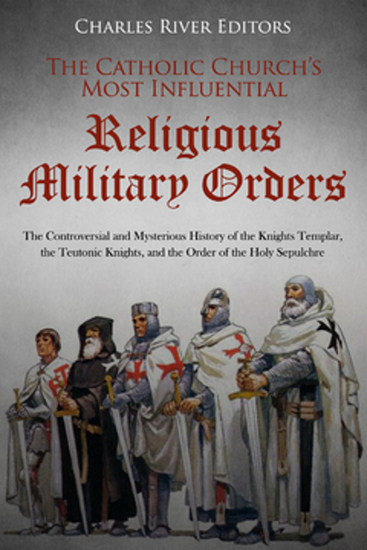
The Catholic Church’s Most Influential Religious Military Orders - The Controversial and Mysterious History of the Knights Templar the Teutonic Knights and the Order of the Holy Sepulchre - cover

The Catholic Church’s Most Influential Religious Military Orders - The Controversial and Mysterious History of the Knights Templar the Teutonic Knights and the Order of the Holy Sepulchre

Editors Charles River

Editorial: Charles River Editors

  • 0
  • 0
  • 0

Sinopsis

For centuries, Christians and Muslims were embroiled in one of the most infamous territorial disputes of all time, viciously and relentlessly battling one another for the Holy Land. In the heart of Jerusalem sat one of the shining jewels of the Christian faith, the Church of the Holy Sepulchre. Legend has it that this was where their Savior had been buried before his fabled resurrection. What was more, it was said to house the very cross Jesus Christ had died upon. It was for precisely these reasons that fearless pilgrims, near and far, risked their lives and made the treacherous trek to Jerusalem.
 
The Order of the Temple of Solomon, also known as the Templars or the Knights Templar, is one of the best-known and least-understood groups in history. They appear prominently in everything from novels (The Da Vinci Code) to films (as the Knights of the Cruciform Sword in Indiana Jones and the Last Crusade) to videogames (Assassin's Creed). In these stories, they are a sinister cult that manipulated historical events since the Middle Ages, via intimidation and assassination. They are usually connected to the Freemasons and, sometimes, to other historical cults like the Hindu Thuggees.
 
The real Templars were both more mundane and more fascinating than the myths and legends. They were the first military religious order – monks who were also knights. The founding members were veterans of the First Crusade in Palestine and their main goal was, in fact, benign. They formed their group as a small tertiary order (Lay people who took monastic vows, but lived in the larger community) in Jerusalem, policing the pilgrim routes and shrines of the Levant and protecting travelers from the many bandits that infested the area. Even though they were used as the core of Crusader armies during the later crusades, the Templars never wavered from their original goal.
 
The Templars were split into knights (about ten percent of the Order), sergeants and chaplains (the other ninety percent), with the non-noble sergeants comprising the majority of the Order, according to historians like Malcolm Barber in his history of the Order, The New Knighthood. The knights fought in the main part of the Templar army, but the sergeants appear to have backed up the knights in battle, both as horsemen and as a small infantry. The sergeants also worked as servants and in non-military support functions on the Templar farms (granges) that supported the Order. The chaplains were a small group of priests who were rotated into the Order on a temporary basis and served the monks' religious needs.
 
As the dissipating fog gave way to an unnerving sight, the mass of frightening figures clad head to toe in gleaming armor would have been enough to take anyone's breath away. Some of them were mounted on the backs of handsome stallions, while others leaned forward with squared shoulders, ready to attack. In one swift motion, the men unsheathe their swords and raise it over their heads, their weapons winking as the glare of the sunlight bounces off the blade. To the somewhat trained eye, these warriors in Norman-inspired gear would have appeared to be one of the Crusader forces, but it is that bold black cross painted across their chests and shields that give them away. These men were none other than the fabled Teutonic Knights. The knights of the Teutonic Order have since been compared to the surreal creature that appeared to the biblical Ezekiel, one that bore 2 faces – one of a man's, and one of a lion's. The human side of the creature is said to symbolize the order's charity, whereas the lion was a metaphor for its valor and gallant spirit, which they relied on to vanquish the heathens of the world. 
Disponible desde: 01/05/2025.
Longitud de impresión: 99 páginas.
Otros libros que te pueden interesar

  • Cosmic Life - cover

    Cosmic Life

    Walter Russell

    • 0
    • 0
    • 0
    Walter Russell: Cosmic Life  is a profound and immersive exploration of the universe's mysteries, the nature of human existence, and the timeless principles that govern all creation. Walter Russell, one of the most visionary and multi-talented minds of the 20th century, presents a framework for understanding life that bridges the realms of science, art, philosophy, and spirituality. This work is not simply an introduction to his ideas but a transformative experience designed to expand your perspective on reality and your role within the infinite dance of the cosmos.
    Ver libro
  • The Jacobins vs the Girondins - Political Factions - cover

    The Jacobins vs the Girondins -...

    Amara Blackwood

    • 0
    • 0
    • 0
    The Jacobins and Girondins were two of the most influential political factions during the French Revolution, each representing different visions for the future of France. Their rivalry played a significant role in shaping revolutionary politics and ultimately led to the radicalization of the movement. While both groups initially sought to overthrow the monarchy and establish a republic, their ideological differences and approaches to governance placed them on a collision course. 
    The Jacobins emerged as a radical force advocating for centralized power, direct democracy, and the use of revolutionary violence to achieve their goals. They were named after their meeting place, the Jacobin Club, a former Dominican convent in Paris. The Jacobins attracted members who believed in strong government control, economic regulation, and the direct involvement of the lower classes in politics. They were heavily influenced by Enlightenment ideals, particularly the belief in equality and the general will of the people, as expressed by philosophers like Jean-Jacques Rousseau. The most prominent Jacobin leaders, including Maximilien Robespierre, Georges Danton, and Jean-Paul Marat, pushed for radical reforms such as the execution of King Louis XVI and the implementation of policies that favored the common people. 
    In contrast, the Girondins represented a more moderate and decentralized vision of the revolution. Many of their members came from the Gironde region, giving the faction its name, and they were often associated with the provincial bourgeoisie. The Girondins supported a constitutional monarchy in the early stages of the revolution but later advocated for a republican form of government with more power distributed among local authorities rather than concentrated in Paris.
    Ver libro
  • Spanish Short Stories - Immerse Yourself in Language and Culture through Short and Easy-to-Understand Tales - cover

    Spanish Short Stories - Immerse...

    Isabella Moreno

    • 0
    • 0
    • 0
    Dive into Spanish Mastery with "Spanish Short Stories"! 
    Embark on an exhilarating language-learning journey with our captivating audiobook, featuring 10 short stories brimming with excitement and culture. Each story, carefully crafted at around 1,000 words, is a gateway to a vibrant world of Spanish expression. 
    What's Inside: 
    🎉 Engaging Narratives: Immerse yourself in thrilling tales designed to make learning Spanish a joyous adventure. 
    📚 Strategic Vocabulary Building: Discover carefully selected words in various fields like food, animals, clothes, and more. Say goodbye to endless dictionaries - our method ensures quick and lasting comprehension. 
    🌟 Proven Pedagogy: Experience the magic of an educationally sound approach. Our stories are strategically written to teach you grammar, vocabulary, and language nuances effortlessly. 
    💡 Easy-to-Grasp Grammar: Unravel the mysteries of Spanish grammar with clear and concise structures that make learning a breeze. 
    📖 Expertly Translated Glossaries: Say farewell to confusion with glossaries translated by professionals. Uncover multiple meanings as you seamlessly progress through the stories. 
    Why Choose "Spanish Short Stories": 
    🚀 Rapid Learning: 10 stories, each a linguistic masterpiece, guide you effortlessly towards Spanish proficiency. 
    🎧 Effortless Comprehension: Learn how to listen effectively, improve your comprehension skills, and conquer new vocabulary without constant dictionary reliance. 
    🏆 Satisfaction Guaranteed: Picture the instant gratification as you seamlessly absorb new words, ready to wield them confidently.Revolutionize your Spanish learning experience — grab your copy of "Spanish Short Stories" now and embark on a linguistic journey like never before! 🌟🇪🇸
    Ver libro
  • Socrates’ Children - An Introduction to Philosophy from the 100 Greatest Philosophers: Volume I: Ancient Philosophers - cover

    Socrates’ Children - An...

    Peter Kreeft

    • 0
    • 0
    • 0
    Peter Kreeft, esteemed philosophy professor and author of over eighty books, has taught college philosophy for sixty years. Throughout those decades, he yearned for a beginner's philosophy text that was clear, accessible, enjoyable, and exciting (perhaps even funny). Finding none that met those criteria, he eventually decided to write it himself.  In this four-volume series, Kreeft delivers, with his characteristic wit and clarity, an introduction to philosophy via the hundred greatest philosophers of all time. Socrates’ Children examines the big ideas of four major eras―ancient, medieval, modern, and contemporary―and immerses the reader in the “great conversation,” the ongoing dialogue among the great thinkers of history, including the most influential philosopher of all: Socrates, the father of Western philosophy.  Volume I: Ancient Philosophers investigates the foundations of philosophy laid by the ancient sages, Greeks, and Romans and introduces the philosophers who asked the first great philosophical questions―about good and evil; truth and falsehood; wisdom, beauty, and love; and the self, the world, and God. 
    Ver libro
  • Sparkle's Story - Thrown Away Children Book 8 - cover

    Sparkle's Story - Thrown Away...

    Louise Allen

    • 0
    • 0
    • 0
    Louise gets a frantic call to take in a damaged and destructive young girl. Separated from her siblings, Sparkle is hostile and angry. 
     
    A short while after settling in, Sparkle begins to identify as pansexual. A revolution is underway in the Allen household, with Sparkle’s transition motivating all of the young people to explore what becoming an adult means for them. 
     
    But it’s Sparkle’s escalating behaviour that causes concern. 
     
    Discovering a dark fact about Sparkle’s birth and the shocking events that the children in her house were part of, Louise is desperate for more help – and not just for the child in her care. As Sparkle’s erratic and violent behaviour increases, Louise finds herself and her homelife under serious threat.
    Ver libro
  • School Communities of Strength - Strategies for Educating Children Living in Deep Poverty - cover

    School Communities of Strength -...

    Jr. Peter W. Cookson, David C....

    • 0
    • 0
    • 0
    In School Communities of Strength, Peter W. Cookson, Jr., lays out a blueprint for providing equitable educational opportunities for students from all socioeconomic strata, and particularly for the five million American children who live with the extreme material hardship known as deep poverty. This work issues an urgent call to action for K–12 schools to put in place the policies, practices, and programs that enable economically vulnerable students to thrive. 


    Drawing from up-to-date findings in the science of learning and development as well as analyses of schools that serve students in poverty, Cookson pinpoints success strategies that can help schools improve their poverty responsiveness. He shows how these strategies can help educators create the culturally responsive, inclusive environments that provide a base of safety from which students can better engage with their education. 


    Offering astute analysis, Cookson notes that school communities of strength require adequate funding and also meaningful collaboration among families, neighborhood partners, and educators. This book amplifies the idea that communities working together can drive transformative change, and it brings into focus three primary policy initiatives that can advance educational equity.
    Ver libro