Unisciti a noi in un viaggio nel mondo dei libri!
Aggiungi questo libro allo scaffale
Grey
Scrivi un nuovo commento Default profile 50px
Grey
Iscriviti per leggere l'intero libro o leggi le prime pagine gratuitamente!
All characters reduced
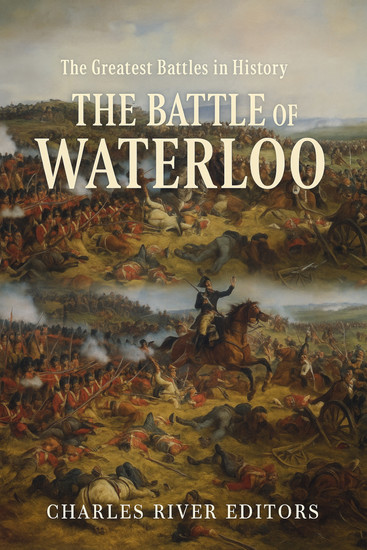
The Battle of Waterloo - cover

The Battle of Waterloo

Editors Charles River

Casa editrice: Charles River Editors

  • 0
  • 0
  • 0

Sinossi

“Believe me, nothing except a battle lost can be half so melancholy as a battle won.” – Duke of Wellington, at Waterloo
 
The names of history’s most famous battles still ring in our ears today, their influence immediately understood by all. Marathon lent its name to the world’s most famous race, but it also preserved Western civilization during the First Persian War. Saratoga, won by one of the colonists’ most renowned war heroes before he became his nation’s most vile traitor. Hastings ensured the Normans’ success in England and changed the course of British history. Waterloo, which marked the reshaping of the European continent and Napoleon’s doom, has now become part of the English lexicon. In Charles River Editors’ Greatest Battles in History series, readers can get caught up to speed on history’s greatest battles in the time it takes to finish a commute, while learning interesting facts long forgotten or never known.
 
It is late in the evening of 18th June, 1815. The scene is a coaching inn on the road between Charleroi and Brussels, a few miles south of the village of Mont St. Jean, in what is now Belgium. The inn is located on a crossroad, and for 100 yards either side of it men are strewn, dead or dying. These are elements of Napoleon’s elite Imperial Guard, three battalions of which had retreated towards the inn at the end of the battle. With the rest of the Armee du Nord streaming past him, Napoleon had taken personal command. Yet before long even these grizzled veterans had joined the rout. Now he too has left the field, fated to head for Paris, captivity, exile and an early death.
 
Across the rolling countryside a mile or two in either direction, a further 40,000 lie dead or injured. Night has fallen on one of the continent’s most cataclysmic battles. At the inn, the two exhausted but victorious allied commanders meet for the first time that day. Marshal Blucher and the Duke of Wellinton shake hands and speak briefly, in broken French. Their close co-operation has ensured the final defeat of Napoleonic France and will put an end to 23 years of almost constant warfare across the continent. Appropriately, the inn is called “La Belle Alliance”.  
 
Waterloo is the most famous battle in modern history if not all of history, and appropriately so. Gathering an army of 100,000 men, Napoleon marched into what is now Belgium, intent on driving his force between the advancing British army under the Duke of Wellington and the Prussian forces under Marshal Blucher. It was the kind of daring strategy that only Napoleon could pull off, as he had at places like Jena and Austerlitz.
 
At Waterloo, however, it would end disastrously, as Napoleon’s armies were unable to dislodge Wellington and unable to keep the Prussians from linking up with the British. The battle would end with the French suffering nearly 60% casualties, the end of Napoleon’s reign, and the restructuring of the European map. Simply put, the next 200 years of European history can be traced back to the result of the battle that day in 1815.
 
The Greatest Battles in History: The Battle of Waterloo comprehensively covers the entire campaign, analyzes the decisions made by the battle’s most important leaders, and explains the aftermath of the Allies’ victory and the legacies that were made and tarnished by the battle. Along with a bibliography, maps of the battle, and pictures of important people and places, you will learn about the Battle of Waterloo like you never have before, in no time at all.
Disponibile da: 06/06/2025.
Lunghezza di stampa: 44 pagine.

Altri libri che potrebbero interessarti

  • From The Britons to the Battle Of Hastings - prehistory to 1066 - cover

    From The Britons to the Battle...

    Gilbert Abbott A'Beckett

    • 0
    • 0
    • 0
    A captivating, uproarious and informative journey through the beginnings of British history.  
    Gilbert Abbott à Beckett was one of the great journalists of his time, being a descendant of Thomas Becket who edited Figaro, was a founder member of Punch, and wrote for The Times, The Morning Herald, and The Illustrated London News.  
    He also wrote around fifty plays, as well as two operas, and is best known for this history of England. 
    This volume covers: 
    The Britons—The Romans—Invasion By Julius Cæsar 
    Invasion By The Romans Under Claudius—Caractacus—Boadicea—Agricola—-Galgacus—Severus—Vortigern Calls In The Saxons. 
    The Saxons—The Heptarchy. 
    The Union Of The Heptarchy Under Egbert. 
    The Danes—Alfred. 
    From King Edward The Elder To The Norman Conquest. 
    Edmund Ironsides—Canute—Harold Harefoot—Hardicanute—Edward The Confessor—Harold—The Battle Of Hastings.
    Mostra libro
  • The Religion of Whiteness - How Racism Distorts Christian Faith - cover

    The Religion of Whiteness - How...

    Glenn E. Bracey II, Michael O....

    • 0
    • 0
    • 0
    Recent years have seen a growing recognition of the role that White Christian Nationalism plays in American society. As White Christian Nationalism has become a major force, and as racial and religious attitudes become increasingly aligned among whites—for example, the more likely you are to say that the decline of white people as a share of the population is "bad for society," the more likely you are to believe the government should support religious values—it has become reasonable to wonder which of the adjectives in the phrase "White Christian Nationalism" takes precedence. 


    In this book, Michael O. Emerson and Glenn E. Bracey II respond definitively: the answer is "white." The majority of white Christians in America, they argue, are believers in a "Religion of Whiteness" that shapes their faith, their politics, and more. The Religion of Whiteness, they argue, raises the perpetuation of racial inequality to a level of spiritual commitment that rivals followers' commitment to Christianity itself. 


    Using national survey data, in-depth interviews, and focus group results gathered over several years, Emerson and Bracey show how the Religion of Whiteness shapes the practice of Christianity for millions of Americans—and what can be done to confront it.
    Mostra libro
  • Wait Five Minutes - Weatherlore in the Twenty-First Century - cover

    Wait Five Minutes - Weatherlore...

    Shelley Ingram, Willow G. Mullins

    • 0
    • 0
    • 0
    The weather governs our lives. It fills gaps in conversations, determines our dress, and influences our architecture. No matter how much our lives may have moved indoors, no matter how much we may rely on technology, we still monitor the weather. Wait Five Minutes: Weatherlore in the Twenty-First Century draws from folkloric, literary, and scientific theory to offer up new ways of thinking about this most ancient of phenomena. 


    Weatherlore is a concept that describes the folk beliefs and traditions about the weather that are passed down casually among groups of people. From detailing personal experiences at picnics and suburban lawns to critically analyzing storm stories, novels, and flood legends, contributors offer engaging multidisciplinary perspectives on weatherlore. 


    As we move further into the twenty-first century, an increasing awareness of climate change and its impacts on daily life calls for a folkloristic reckoning with the weather and a rising need to examine vernacular understandings of weather and climate. Weatherlore helps us understand and shape global political conversations about climate change and biopolitics at the same time that it influences individual, group, and regional lives and identities. We use weather, and thus its folklore, to make meaning of ourselves, our groups, and, quite literally, our world.
    Mostra libro
  • The Vatican - A Look Behind the Scenes of the Catholic Church - cover

    The Vatican - A Look Behind the...

    Kelly Mass

    • 0
    • 0
    • 0
    What comes to mind when you say the words “Vatican City?” The Pope? Big cathedrals or underground catacombs with the corpses of buried saints from the past? Crowds of people with candles? Or a choir of young men in a certain attire? 
    The Vatican is a landlocked, independent city state and enclave in Rome, Italy. The Vatican City State, also called the Vatican, acquired independence from Italy in the year 1929 with the Lateran Treaty, and it is a different terrain under the Holy See's "full ownership, special rule, and sovereign authority and jurisdiction," which makes sure the city state's temporal, diplomatic, and spiritual independence. 
    This is one of the world’s most unique states/countries, something that is definitely worth understanding. With about 1.4 billion Catholics, in the world, it can be worth your while to study this guide to understand where their leadership and headquarters are situated, and what they do.
    Mostra libro
  • Man's Search for Meaning - An Introduction to Logotherapy - cover

    Man's Search for Meaning - An...

    Viktor E. Frankl

    • 0
    • 0
    • 0
    Man's search for meaning : An Introduction to Logotherapy 
    “One of the outstanding contributions to psychological thought in the last fifty years.” —Dr. Carl Rogers, psychologist and founder of Rogerian therapy. 
    “Viktor Frankl’s Man’s Search for Meaning is one of the great books of our time. Typically, if a book has one passage, one idea with the power to change a person’s life, that alone justifies reading it, rereading it, and finding room for it on one’s shelves. This book has several such passages.” —Harold S. Kushner, author and rabbi emeritus at Temple Israel. 
    Viktor Frankl's account of his battle for survival at Auschwitz and other concentration camps is included in Man's Search for Meaning, one of the great masterpieces to come out of the Holocaust. 
    Generations of readers have been captivated by this book because of its depictions of life in Nazi death camps and its spiritual survival teachings. 
    Frankl contends that although we cannot escape pain, we can decide how to manage it, find meaning in it, and go on with a new sense of purpose based on his personal experience and the testimonies of his patients. The belief that the pursuit of what we find significant, rather than pleasure, is the fundamental human motivation is at the core of his philosophy, which is known as logotherapy. 
    One of the most important books in the Universe today is Man's Search for Meaning, which never stops encouraging us to discover meaning in life itself.
    Mostra libro
  • Hoysala Empire - The Architectural Splendor of Southern India - cover

    Hoysala Empire - The...

    Rolf Hedger

    • 0
    • 0
    • 0
    The Hoysala Empire was one of the most influential dynasties in South Indian history, known for its patronage of art, culture, and architecture. Flourishing between the 10th and 14th centuries, the empire left an indelible mark on the Deccan region, particularly in present-day Karnataka. The Hoysalas emerged as a powerful force after the decline of the Western Chalukyas, establishing their capital first at Belur and later at Halebidu. Their rule was characterized by military conquests, administrative efficiency, and an enduring legacy of architectural splendor that continues to captivate historians and art enthusiasts. 
    The origins of the Hoysala dynasty are traced to a chieftain named Sala, who, according to legend, was instructed by a Jain monk to kill a tiger that was attacking them. This act of bravery led to the adoption of the royal emblem depicting a warrior slaying a tiger, symbolizing the valor of the Hoysala rulers. Over the centuries, the dynasty expanded its influence through strategic alliances and military campaigns, gaining control over vast territories in the Deccan. Prominent rulers such as Vishnuvardhana and Veera Ballala II played a crucial role in consolidating the empire and fostering a rich cultural heritage. 
    A significant aspect of Hoysala rule was its deep connection with religious and artistic traditions. The dynasty was known for its support of Hinduism, Jainism, and, to some extent, Buddhism, leading to the construction of numerous temples and religious institutions. These temples were not just places of worship but also centers of learning and artistic expression. The Hoysalas employed skilled artisans and sculptors who developed a distinctive architectural style, characterized by intricate carvings, star-shaped temple layouts, and finely detailed sculptures depicting gods, celestial beings, and mythological narratives.
    Mostra libro