Junte-se a nós em uma viagem ao mundo dos livros!
Adicionar este livro à prateleira
Grey
Deixe um novo comentário Default profile 50px
Grey
Assine para ler o livro completo ou leia as primeiras páginas de graça!
All characters reduced
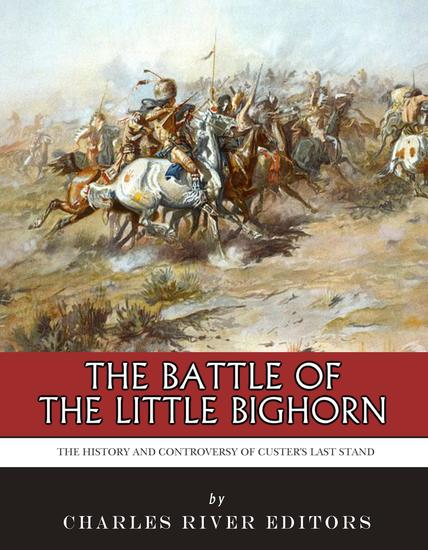
The Battle of the Little Bighorn - The History and Controversy of Custer’s Last Stand - cover
LER

The Battle of the Little Bighorn - The History and Controversy of Custer’s Last Stand

Editors Charles River

Editora: Charles River Editors

  • 0
  • 0
  • 0

Sinopse

"When I was a boy the Sioux owned the world. The sun rose and set on their land; they sent ten thousand men to battle. Where are the warriors today? Who slew them? Where are our lands?   Who owns them? Is it wrong for me to love my own? Is it wicked for me because my skin is red?  Because I am Sioux? Because I was born where my father lived? Because I would die for my people and my country?” – Sitting Bull
 
Since the Battle of the Little Bighorn, George Armstrong Custer has possessed one of the most unique places in American history. Although he was a capable cavalry officer who served honorably during the Civil War, he remains one of the most instantly identifiable and famous military men in American history due to the fact he was killed during one of the country’s most well known and ignominious defeats, the Battle of Little Bighorn. At the same time, this one relatively insignificant battle during America’s Indian Wars has become one of the country’s most mythologized events and continues to fascinate Americans nearly 140 years later.
 
On the morning of June 25, Custer’s scouts discovered a Native American village about 15 miles away in the valley of the Little Bighorn River.  Choosing to disregard his superiors’ orders to wait for a concerted effort, the grandstanding Custer intended to deliver his own decisive victory by dividing his command into three units, an extremely bold tactic when done in the face of a much larger force. Due to their belief in the inferiority of the Plains Indians, and mindful of previous Indian tactics that sought to avoid pitched battle, Custer and his men were most concerned with forcing the action and failed to understand the true nature of the situation they had entered. The Native American gathering, centered around the famous Sioux chief Sitting Bull, numbered roughly 8,000 individuals, and about 2,000 of them were warriors. Custer’s forces amounted to a mere 31 officers, 566 troopers, and 50 scouts and civilians, and they had been split into three columns in order to stop a possible retreat.
 
Before the battle, it is believed Custer thought he was facing a group of about 800, which was Sitting Bull’s strength in the weeks before the battle. However, the Army’s Native American scouts and civilian scouts had not adequately informed the Army of the reinforcements that arrived, and at Little Bighorn, Custer’s three-pronged attack was completely overwhelmed. How Custer met his fate, and whether there even was a Last Stand, remain subjects of debate, but what is known is that the Battle of the Little Bighorn was one of the U.S. military’s biggest debacles. All told, the 7th Cavalry suffered over 50% casualties, with over 250 men killed and over 50 wounded. The dead included Custer's brothers Boston and Thomas, his brother-in-law James Calhoun, and his nephew Henry Reed. Custer and his men were buried where they fell.  A year later, Custer’s remains (or more accurately, the remains found in the spot labeled with his name) were relocated to West Point for final interment.
 
The Battle of the Little Bighorn: The History and Controversy of Custer’s Last Stand comprehensively covers the entire campaign leading up to the decisive battle, analyzes the decisions made by the battle’s most important leaders, and explains the controversial aftermath and legacy of the fighting. Along with a bibliography and pictures of important people and places, you will learn about the Battle of the Little Bighorn like you never have before, in no time at all.
 
 
Disponível desde: 02/05/2025.
Comprimento de impressão: 44 páginas.
Outros livros que poderiam interessá-lo

  • NeuroGenius Flow State Wave: Brainwave MP3 Audio for Focus Creativity Wealth & Productivity - cover

    NeuroGenius Flow State Wave:...

    Melinda Barss

    • 0
    • 0
    • 0
    🎯 What If You Could Enter a Peak Mental State On Command? 
    Imagine waking up, pressing play, and instantly shifting into a laser-focused, highly creative, mentally energized zone—the kind of state elite athletes, performers, and Silicon Valley innovators call the “Flow State.” 
    Welcome to the NeuroGenius Flow State Wave™, a breakthrough audio frequency tool rooted in neuroscience, quantum sound healing, and subconscious reprogramming. 🔬 What Is the NeuroGenius Flow State Wave™?It’s a guided neuro-sound experience designed to activate your Alpha–Theta brainwave state—a scientifically backed mental frequency shown to:Supercharge focusBoost memory and creative problem solvingReduce anxiety and overthinkingTap into intuitive knowingUnlock inspired, effortless action 
    Think of it as a mental tuning fork for genius. 🧠 A 2021 study published in Frontiers in Human Neuroscience found that binaural beats in the alpha/theta range improved working memory and flow performance in subjects during creative tasks. In other words: you think better, faster, deeper. 🌟 What’s Inside the NeuroGenius Flow State Wave Package? 
    ✅ High-fidelity audio session designed for headphones. Ideal for work, study, creation, meditation, or flow practice. 
    ✅ Short, energizing version to kickstart your day with clear intention and focus. 
    ✅ Daily page prompts to harness your flow cycles and track your mental brilliance. 
    ✅ The Science of Getting Rich, 1910 Original Edition 
    🎧 Use it while writing, designing, coding, studying, meditating, creating, or anytime you need your brain to fire on all cylinders.
    Ver livro
  • Dioses Y Mitos De Los Egipcios - cover

    Dioses Y Mitos De Los Egipcios

    Onofre Quezada

    • 0
    • 0
    • 0
    Dioses y Mitos de los Egipcios es un fascinante recorrido por el vasto y enigmático mundo de la mitología del antiguo Egipto. Desde los poderosos dioses creadores como Ra y Atum, hasta las deidades del inframundo como Osiris y Anubis, este libro desentraña los relatos que dieron forma a una de las civilizaciones más influyentes de la historia. 
    A través de relatos cautivadores, descubrirás el significado de los mitos egipcios, su impacto en la cultura y la religión, y cómo estas creencias influenciaron la vida cotidiana de los faraones y el pueblo egipcio. Con ilustraciones y descripciones detalladas, esta obra te transportará a un mundo donde la magia, la eternidad y el destino se entrelazan en historias llenas de misterio y sabiduría ancestral. 
    Si eres un apasionado de la historia, la mitología o simplemente sientes curiosidad por los secretos de los dioses egipcios, este libro será una lectura imprescindible.
    Ver livro
  • Twilight of the Idols - How to Philosophize with a Hammer - cover

    Twilight of the Idols - How to...

    Friedrich Nietzsche, Tim Zengerink

    • 0
    • 0
    • 0
    What if the ideas society holds sacred are the very barriers to its progress? How do we break free from the constraints of tradition and embrace the courage to think differently? 
    Twilight of the Idols is Friedrich Nietzsche’s incisive critique of conventional morality, philosophy, and culture. Through sharp aphorisms and fearless analysis, he dismantles the “idols” of Western thought, challenging traditional ethics, religion, and the concept of absolute truth. 
    This modern translation makes Nietzsche’s provocative ideas more accessible while preserving the intensity of his original work. Twilight of the Idols is a guide to questioning societal norms, confronting outdated beliefs, and embracing the vitality of life. 
    What You’ll Discover: 
    - Challenge Traditional Morality – Understand Nietzsche’s critique of moral values and his call to embrace life-affirming principles. 
    - Redefine Truth and Belief – Explore how Nietzsche’s philosophy urges us to question long-held truths and forge our own paths. 
    - Philosophy for Modern Challenges – Apply Nietzsche’s timeless insights to navigate personal and professional complexities with clarity and strength. 
    - Inspiration for Self-Empowerment – Discover how Nietzsche’s vision of self-overcoming can help you break free from limitations and achieve personal greatness. 
    This adaptation preserves Nietzsche’s bold voice and intellectual depth while making his ideas approachable for modern readers. Twilight of the Idols is not just a philosophical critique—it’s a guide to living authentically, challenging conventions, and embracing the freedom of self-expression. 
    Imagine the clarity to question outdated beliefs, the courage to confront societal idols, and the strength to live boldly. For over a century, Twilight of the Idols has inspired thinkers, leaders, and visionaries. Now, it’s your turn. 
    Start your journey today. Get your copy now and unlock the wisdom that will challenge and transform the way you see the world.
    Ver livro
  • Becoming Little Shell - A Landless Indian’s Journey Home - cover

    Becoming Little Shell - A...

    Chris La Tray

    • 0
    • 0
    • 0
    Growing up in Montana, Chris La Tray always identified as Indian. Despite the fact that his father fiercely denied any connection, he found Indigenous people alluring, often recalling his grandmother's consistent mention of their Chippewa heritage. 


    When La Tray attended his grandfather's funeral as a young man, he finally found himself surrounded by relatives who obviously were Indigenous. "Who were they?" he wondered, and "Why was I never allowed to know them?" Combining diligent research and compelling conversations with authors, activists, elders, and historians, La Tray embarks on a journey into his family's past, discovering along the way a larger story of the complicated history of Indigenous communities—as well as the devastating effects of colonialism that continue to ripple through surviving generations. And as he comes to embrace his full identity, he eventually seeks enrollment with the Little Shell Tribe of Chippewa Indians, joining their 158-year-long struggle for federal recognition. 


    Both personal and historical, Becoming Little Shell is a testament to the power of storytelling, to family and legacy, and to finding home. Infused with candor, heart, wisdom, and an abiding love for a place and a people, Chris La Tray's remarkable journey is both revelatory and redemptive.
    Ver livro
  • A Rebel's Recollections - cover

    A Rebel's Recollections

    George Cary Eggleston

    • 0
    • 0
    • 0
    Madison & Adams Press presents the Civil War Memories Series. This meticulous selection of the firsthand accounts, memoirs and diaries is specially comprised for Civil War enthusiasts and all people curious about the personal accounts and true life stories of the unknown soldiers, the well known commanders, politicians, nurses and civilians amidst the war. 
    "A Rebel's Recollections" is a collection of various accounts written by George Cary Eggleston who served as a Confederate soldier during the American Civil War.
    Ver livro
  • Is It Possible to End the Thousand Yesterdays? - Claremont 1968 - Students Discussion 3 - cover

    Is It Possible to End the...

    Jiddu Krishnamurti

    • 0
    • 0
    • 0
    Is it possible to end the thousand yesterdays? - 13 November 1968 
    • Living together amicably, creatively, in complete relationship with one another 
    – if that is what is essential then we need not only a different kind of mind but 
    also a different quality of affection, love. 
    • What is the function of a religious mind? 
    • Our struggle in life is dualistic: good and bad, right and wrong, holy and unholy, 
    the ideal and the fact. There is only the fact, not the ideal. 
    • Is it possible to look at life as though you are looking for the first time? 
    • What is the content of the unconscious? It is the racial residue, the traditional, 
    the family, the personal. It is as trivial as the conscious mind. 
    • Q: It seems to me that the ‘I’, the ego only exists in relation to other things. 
    Could you comment on this? 
    • The impossible becomes possible only when you discard the impossibility of it. 
    To find out anything you must go beyond the impossible. 
    • Q: What do you mean by meditation? 
    • There is no ‘how’.
    Ver livro