Junte-se a nós em uma viagem ao mundo dos livros!
Adicionar este livro à prateleira
Grey
Deixe um novo comentário Default profile 50px
Grey
Assine para ler o livro completo ou leia as primeiras páginas de graça!
All characters reduced
The Battle of Stones River (Murfreesboro) - cover
LER

The Battle of Stones River (Murfreesboro)

Editors Charles River

Editora: Charles River Editors

  • 0
  • 0
  • 0

Sinopse

“In all, fifty-eight pieces of artillery played upon the enemy. Not less than one hundred shots per minute were fired. As the mass of men swarmed down the slope they were mowed down by the score. Confederates were pinioned to the earth by falling branches.” – G. C. Kniffin, aide to General Crittenden
 
Americans have long been fascinated by the Civil War and its biggest battles, particularly Gettysburg, Antietam, and Shiloh, all of which involved Robert E. Lee or Ulysses S. Grant. But one of the 6 biggest battles of the war, and the one that took the heaviest toll by % on both armies was fought at the end of 1862 in Tennessee, and it involved neither of those generals.
 
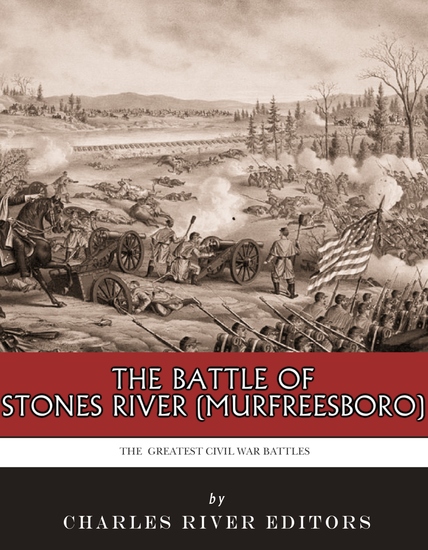
In late December 1862, William Rosecrans’s Union Army of the Cumberland was contesting Middle Tennessee against Braxton Bragg’s Army of Tennessee, and for three days the two armies savaged each other as Bragg threw his army at Rosecrans in a series of desperate assaults. Bragg’s army was unable to dislodge the Union army, and he eventually withdrew his army after learning that Rosecrans was on the verge of receiving reinforcements. Though the battle was stalemated, the fact that the Union army was left in possession of the field allowed Rosecrans to declare victory and embarrassed Bragg.
 
Though Stones River is mostly overlooked as a Civil War battle today, it had a decisive impact on the war. The two armies had both suffered nearly 33% casualties, an astounding number in 1862 that also ensured Rosecrans would not start another offensive campaign in Tennessee until the following June. The Union victory also ensured control of Nashville, Middle Tennessee, and Kentucky for the rest of the war, prompting Lincoln to tell Rosecrans, “You gave us a hard-earned victory, which had there been a defeat instead, the nation could scarcely have lived over." The battle and its results also set into motion a chain of events that would lead to Rosecrans and Bragg facing off at the crucial battle of Chickamauga in September 1863, a battle that is often viewed as the last gasp for the Confederates’ hopes in the West.
 
The Greatest Civil War Battles: The Battle of Stones River (Murfreesboro) comprehensively covers the campaign and the events that led up to the battle, the fighting itself, and the aftermath of the battle. Accounts of the battle by important participants are also included, along with maps of the battle and pictures of important people, places, and events. You will learn about the Battle of Stones River like you never have before, in no time at all.
Disponível desde: 02/05/2025.
Comprimento de impressão: 35 páginas.

Outros livros que poderiam interessá-lo

  • Beyond Growth - A Global Blueprint for the 21st Century - cover

    Beyond Growth - A Global...

    Ylia Callan

    • 0
    • 0
    • 0
    This audiobook is narrated by an AI Voice.   
    In an era defined by climate crises, technological disruption, and deep social inequalities, humanity faces a stark choice: continue pursuing endless economic growth or reimagine the foundations of prosperity. Beyond Growth: A Global Blueprint for the 21st Century offers a compelling roadmap for the latter. 
    This groundbreaking work synthesises insights from economics, environmental science, governance and technology to propose a new paradigm, one that values sustainability, collaboration and human well-being above mere financial expansion. From innovative economic models to transformative governance strategies, the book explores how countries, communities and individuals can thrive in harmony with the planet. 
    Richly illustrated with examples, case studies and actionable ideas, Beyond Growth is both a visionary manifesto and a practical guide. It challenges and inspires readers to rethink the systems that shape our lives and equips them with tools to actively participate in building a resilient, equitable and sustainable global future.
    Ver livro
  • The Wisdom of the Ancients - cover

    The Wisdom of the Ancients

    Francis Bacon

    • 0
    • 0
    • 0
    Bacon published this interesting little work in 1609. It contains thirty-one fables abounding with a union of deep thought and poetic beauty. In most fables he explains the common but erroneous supposition that knowledge and the conformity of the will, knowing and acting, are convertible terms.
    Ver livro
  • Oregon Trail and the Appalachian Trail The: The History of America’s Two Most Famous Trails - cover

    Oregon Trail and the Appalachian...

    Editors Charles River

    • 0
    • 0
    • 0
    The westward movement of Americans in the 19th century was one of the largest and most consequential migrations in history, and among the paths that blazed west, the most well-known is the Oregon Trail, which was not a single trail but a network of paths that began at one of four “jumping off” points. The eastern section of the Oregon Trail, which followed the Missouri River through Kansas, Nebraska, and Wyoming, was shared by people traveling along the California, Bozeman, and Mormon Trails. These trails branched off at various points, and the California Trail diverged from the Oregon Trail at Fort Hall in southern Idaho. From there, the Oregon Trail moved northward, along the Snake River, then through the Blue Mountains to Fort Walla Walla. From there, travelers would cross the prairie before reaching the Methodist mission at The Dalles, which roughly marked the end of the Trail. 	As many who used the Oregon Trail described in memoirs, the West represented opportunities for adventure, independence, and fortune, and fittingly, the ever popular game named after the Oregon Trail captures that mentality and spirit by requiring players to safely move a party west to the end of the trail. 
    	The most iconic of the major American pathways is the Appalachian Trail, which completes the “triple crown” of the national hiking experience. Covering a range from central Maine to Georgia at a distance of 2,193 miles, it is the longest of the three, following the crest of the Alleghenies and Blue Ridge Mountains through 14 states. All in all, it encompasses 465,000 feet in elevation and hosts three million visitors each year for at least a part of the total distance. On an annual basis, approximately 4,000 hikers begin a south to north trek beginning at Springer Mountain, Georgia, with the goal of hiking all the way to Maine. The northerly direction is greatly preferred because of the weather.
    Ver livro
  • How to Meet Your Self - The Workbook for Self-Discovery - cover

    How to Meet Your Self - The...

    Dra. Nicole LePera

    • 0
    • 0
    • 0
    Most people are stuck living life on autopilot. Are you ready to break free?  
    At the root of all healing work is awakening consciousness, a process of shining light into the darkness of the unknown. In recent years, Dr. Nicole LePera has become the leading voice in psychological self-healing, helping millions of people around the world rise out of survival mode to consciously create authentic lives they love. 
    In her first book, How to Do the Work, Dr. Nicole offered readers a revolutionary, holistic framework for self-healing. Now, in How to Meet Your Self, she shares a book designed to help every listener uncover their Authentic Self. By objectively and compassionately observing the physical, mental, and emotional patterns that fill our days and create our current selves, we can more clearly see what we do not wish to carry into the future. 
    We all fall into conditioned habits and patterns—products of our past—that lead to cycles of pain, stuckness, and self-destruction. But as Dr. Nicole shares, we also have the innate ability to awaken to and change the behaviors and habits that no longer serve us, allowing us to step into the highest versions of ourselves. And as you work through this book and witness these default habits, from sleep to movement to eating, through emotional reactivity and core beliefs, you will never again have to ask: “but where do I start?” 
    How to Meet Your Self is a revolutionary guide, a kind and encouraging companion, and a comprehensive masterwork of self-understanding that will radically transform your inner work and outer world. 
    Supplemental enhancement PDF accompanies the audiobook. 


    Ver livro
  • Laughter in Ancient Rome - on Joking Tickling and Cracking Up - cover

    Laughter in Ancient Rome - on...

    Mary Beard

    • 0
    • 0
    • 0
    What made the Romans laugh? Was ancient Rome a carnival, filled with practical jokes and hearty chuckles? Or was it a carefully regulated culture in which the uncontrollable excess of laughter was a force to fear—a world of wit, irony, and knowing smiles? How did Romans make sense of laughter? What role did it play in the world of the law courts, the imperial palace, or the spectacles of the arena? 


    Laughter in Ancient Rome explores one of the most intriguing, but also trickiest, of historical subjects. Drawing on a wide range of Roman writing—from essays on rhetoric to a surviving Roman joke book—Mary Beard tracks down the giggles, smirks, and guffaws of the ancient Romans themselves. From ancient "monkey business" to the role of a chuckle in a culture of tyranny, she explores Roman humor from the hilarious, to the momentous, to the surprising. But she also reflects on even bigger historical questions. What kind of history of laughter can we possibly tell? Can we ever really "get" the Romans' jokes?
    Ver livro
  • The Lake Filled with Skeletons - Uncovering the Mysteries of Roopkund - cover

    The Lake Filled with Skeletons -...

    John Harpoon

    • 0
    • 0
    • 0
    The discovery of Roopkund Lake, a high-altitude lake nestled in the Indian Himalayas, shocked the world with its eerie and haunting mystery. Known as the "Skeleton Lake," the site became a focus of international attention when dozens of human skeletons were found in and around the lake, scattered across the landscape. Hidden among the rugged mountains, at an elevation of about 16,500 feet, the lake was nearly inaccessible, which contributed to its preservation for centuries. This discovery raised more questions than answers and sparked numerous theories about the origins and circumstances surrounding the remains. 
      
    The skeletons found at Roopkund are not just ordinary human remains. They are unique in that they are incredibly well-preserved despite their age, leading researchers and scientists to embark on an extraordinary quest to uncover their origins. Some of the bones belong to people who lived thousands of years ago, while others are more recent, creating an enigmatic mixture of the past and present. Various expeditions have sought to determine who these people were, how they died, and why their bodies were left in such an unusual location. 
      
    Roopkund Lake, located in the state of Uttarakhand in India, was long known to the local populations, who regarded it with awe and fear. The lake and its surrounding areas are deeply ingrained in local folklore, with stories that attempt to explain the presence of these bones. Some claim that the skeletons are those of pilgrims who perished in a sudden snowstorm, while others suggest the lake holds the remains of ancient warriors or victims of a mass sacrifice. Over time, these legends have woven themselves into the cultural fabric of the region, adding an extra layer of mystique to an already puzzling phenomenon.
    Ver livro