¡Acompáñanos a viajar por el mundo de los libros!
Añadir este libro a la estantería
Grey
Escribe un nuevo comentario Default profile 50px
Grey
Suscríbete para leer el libro completo o lee las primeras páginas gratis.
All characters reduced
The Battle of Spotsylvania Court House - cover

The Battle of Spotsylvania Court House

Editors Charles River

Editorial: Charles River Editors

  • 0
  • 0
  • 0

Sinopsis

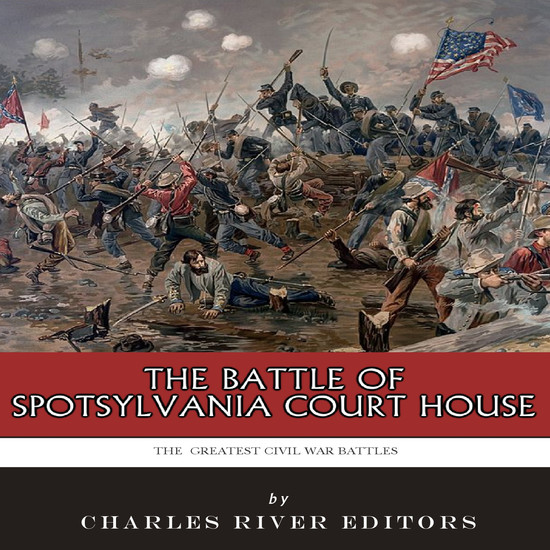
“The appalling sight presented was harrowing in the extreme. Our own killed were scattered over a large space near the "angle," while in front of the captured breastworks the enemy's dead, vastly more numerous than our own, were piled upon each other in some places four layers deep, exhibiting every ghastly phase of mutilation. Below the mass of fast-decaying corpses, the convulsive twitching of limbs and the writhing of bodies showed that there were wounded men still alive and struggling to extricate themselves from the horrid entombment. Every relief possible was afforded, but in too many cases it came too late. The place was well named the "Bloody Angle." – Horace Porter, Campaigning with Grant
 
At the Battle of the Wilderness (May 5-7, 1864), Ulysses S. Grant and Robert E. Lee had fought to a standstill in their first encounter, failing to dislodge each other despite incurring nearly 30,000 casualties between the Union Army of the Potomac and the Confederate Army of Northern Virginia. Despite the fierce fighting, Grant continued to push his battered but resilient army south, hoping to beat Lee’s army to the crossroads at Spotsylvania Court House, but Lee’s army beat Grant’s to Spotsylvania and began digging in, setting the scene for on and off fighting from May 8-21 that ultimately inflicted more casualties than the Battle of the Wilderness. In fact, with over 32,000 casualties among the two sides, it was the deadliest battle of the Overland Campaign.
 
Although the Battle of Spotsylvania technically lasted nearly 2 weeks, it is best remembered for the fighting that took place on May 12 at a salient in the Confederate line manned by Richard S. Ewell’s corps. Known as the Mule Shoe, a Union assault on the salient produced 24 hours of the most savage fighting conducted during the war, forever christening that point in the line as the Bloody Angle. Although Winfield Scott Hancock’s II Corps established a temporary breakthrough, the Confederates were ultimately able to repulse the Union soldiers in bloody hand-to-hand fighting.
 
After their inability to break Lee’s line on May 12, Grant continued to probe Lee’s line for weaknesses, attempting to gain a perceptible advantage. However, by 1864 Civil War soldiers had become adept at digging in and building the kind of trenches that would dominate the fighting of World War I 50 years later. By winning the race to Spotsylvania, the Confederates had enough time to dig in and prepare for the kind of defensive fighting that made assaults futile. On May 20, Grant began the process of disengaging from his lines and marching the Army of the Potomac further south, forcing Lee into another race toward the North Anna River. The two armies had suffered a combined 50,000 casualties in about 15 days of fighting, but the Overland Campaign was still only half finished.
 
The Greatest Civil War Battles: The Battle of Spotsylvania Court House comprehensively covers the events that led up to the battle, the fighting itself, and the aftermath of the battle. Accounts of the battle by important participants are also included, along with maps of the battle and pictures of important people, places, and events. You will learn about the Battle of Spotsylvania Court House like you never have before, in no time at all.
Disponible desde: 02/05/2025.
Longitud de impresión: 49 páginas.

Otros libros que te pueden interesar

  • World Citizen Journeys of a Humanitarian - cover

    World Citizen Journeys of a...

    Jane Olson

    • 0
    • 0
    • 0
    These stories are about light and hope in the midst of unimaginable human suffering in war zones and places of extreme poverty around the world. Important lessons from a childhood in rural western Iowa are woven throughout, as are examples of human strength and resiliency. Each chapter can be read as a complete experience. Intimate details recorded by the author in journals and on film take the reader on memorable journeys with international human rights and humanitarian organizations. Despite being plunged into war zones, crowded refugee camps, and some of the poorest and most disease-affected places on the planet, we learn the life-saving impact of humanitarian intervention, the healing power of community, the importance of justice, and the truth that one caring person can indeed make a difference. To be a World Citizen is to embrace and champion the Universal Declaration of Human Rights, knowing that all lives are valuable and equally deserving of protection and support.
    Ver libro
  • Khilaf e Dastoor - cover

    Khilaf e Dastoor

    Jyoti Bawa

    • 0
    • 0
    • 0
    According to Jyoti Bawa's self-statement, the discourse recorded in this book is the result of debates between Amit and her, as well as some debates she had within herself. Amit was her companion—for the world, he was. Physically, he is no longer present, but for her, he remains with her until her last breath. Many times, she has been accused of writing against women. However, she asserts that she is not against anyone or any relationship. Through her writing, she has come to realize that no matter how much one tries, the marks imprinted on a woman's body always narrate a story of their own.
    Ver libro
  • William Penn - Liberty and Justice for All - cover

    William Penn - Liberty and...

    Janet Benge, Geoff Benge

    • 0
    • 0
    • 0
    "You fool of a boy!" William's father screamed. "You had the world ahead of you, and you threw it away for some religious meeting. Why, Parliament has ordered the heads of a dozen Puritans to be stuck on poles around the city as a warning against disobeying the law. Have you thought of that? Have you thought of anything?"With the favor William's father enjoyed in Britain's royal court, all William had to do was show himself to be a faithful royalist, and wealth and privilege would be his. Instead he chose to follow his conscience--to expulsion from university, disinheritance, imprisonment, and the threat of death.In a world where freedoms were subject to the whims of rulers, William Penn worked passionately for religious tolerance. When this Quaker reformer secured a land grant in America, he laid for Pennsylvania a foundation of liberty, justice, fairness, and tolerance that would later guide the drafting of the Constitution of the United States.The stories of Heroes of History are told in an engaging narrative format, where related history, geography, government, and science topics come to life and make a lasting impression. This is a premier biography line for the entire family.
    Ver libro
  • F*ck Silence - Calling Trump Out for the Cultish Moronic Authoritarian Con Man He Is - cover

    F*ck Silence - Calling Trump Out...

    Anónimo

    • 0
    • 0
    • 0
    Donald Trump is the exact threat our Founding Fathers feared. 
    Joe Walsh is as rock-ribbed a conservative as they come. But he believes that no right-wing policy victory is worth the loss of our very democracy. 
    In this clear-eyed and unsparing book, Walsh makes the case that Trump has more in common with the foreign dictators he praises publicly than a predecessor like Ronald Reagan. Trump is an existential threat to conservatism, the presidency, and national unity. He has violated the Constitution in plain sight, assaulted democratic institutions, overwhelmed the country with disinformation, erected around himself a cult of personality, and governed according to his narcissism more than any discernable political philosophy. 
    Though Walsh agrees with Trump that the Washington elite has hung working-class America out to dry, traveling down the road to despotism is no response. And now a person who places himself above the rule of law and accountability sits in the Oval Office—all that’s missing is a big, beautiful throne behind the Resolute Desk.  
    In F*ck Silence, Walsh challenges his countrymen, especially his fellow conservatives, to acknowledge and oppose this unpatriotic and un-American behavior before we give away what made America great in the first place: our democracy.
    Ver libro
  • Tuskegee Airmen and Montford Point Marines The: The History of the Men Who Broke the Color Barrier in the US Army Air Forces and Marine Corps - cover

    Tuskegee Airmen and Montford...

    Charles River Editors

    • 0
    • 0
    • 0
    The United States has no shortage of famous military units, from the Civil War’s Iron Brigade to the 101st Airborne, but one would be hard pressed to find one that had to go through as many hardships off the field as the Tuskegee Airmen, a group of African American fighter pilots who overcame Jim Crow at home and official segregation in the military to serve their country in the final years of World War II. In fact, it required a concerted effort by groups such as the National Association for the Advancement of Colored People (NAACP) and the extreme circumstances brought about by World War II that the military eventually decided to establish the “Tuskegee Experiment.” 
    The black crews trained at Tuskegee before being sent overseas, and even then, they faced discrimination from those who didn’t trust them to do more than escort bombers flown by white pilots. However, as the men proved their worth in the heat of battle, some of the squadrons’ red markings helped them earn the nickname “Red Tails,” and their track record was so good that eventually the white pilots of American bombers wanted to fly with them. As Tuskegee airman Roscoe Brown eloquently put it, “They have a saying that excellence is the antidote to prejudice; so, once you show you can do it, some of the barriers will come down.” 
    In the summer of 1942, the first group of African American recruits stepped off a bus into the pine woods of North Carolina, bound for an experiment the Marine Corps had long vowed never to attempt. Their destination - Montford Point, a hastily constructed satellite to the new Camp Lejeune - was more than a training ground. It was a compromise with democracy, a segregated doorway into an institution that had defined itself for generations by who could not enter. The Corps’ exclusivity had a racial edge, as the Marines had barred black men outright from 1798 all the way up the start of the Second World War. 
    Ver libro
  • Homo Deus: Book Summary & Analysis - cover

    Homo Deus: Book Summary & Analysis

    Briefly Summaries

    • 0
    • 0
    • 0
    This is a concise summary and analysis of Homo Deus, by Yuval Noaḥ Harari. It is not the original book and is not affiliated with or endorsed by Yuval Noaḥ Harari. Ideal for those seeking a quick and insightful overview.
     
    In this compelling exploration of the future, Homo Deus examines humanity’s next great leap: from Homo sapiens to god-like beings. Delving into history, philosophy, and technology, the book analyzes how artificial intelligence, biotechnology, and data-driven decision-making may redefine life, ethics, and human purpose. As science advances, will we conquer death, eliminate suffering, and engineer happiness—or will we lose control over our own creations? This thought-provoking work challenges readers to consider what lies ahead for the species that once ruled the Earth.
    Ver libro