Join us on a literary world trip!
Add this book to bookshelf
Grey
Write a new comment Default profile 50px
Grey
Subscribe to read the full book or read the first pages for free!
All characters reduced
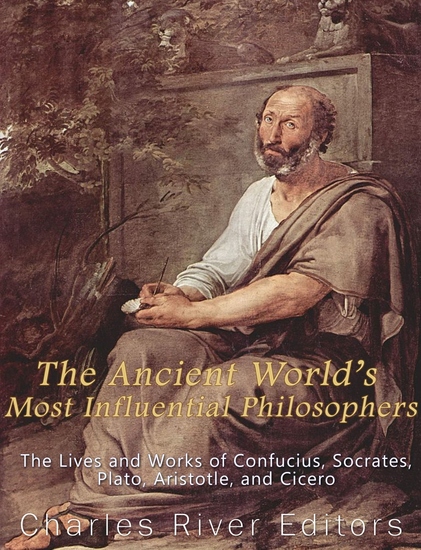
The Ancient World’s Most Influential Philosophers - The Lives and Works of Confucius Socrates Plato Aristotle and Cicero - cover

The Ancient World’s Most Influential Philosophers - The Lives and Works of Confucius Socrates Plato Aristotle and Cicero

Editors Charles River

Publisher: Charles River Editors

  • 0
  • 0
  • 0

Summary

Many people argue that Confucius is the most influential person of all time, and if having a significant effect on the greatest number of people is the criterion, he may very well be. China is one of the largest and oldest civilizations on earth, and Confucius has been influential there from almost the beginning: the first Chinese dynasty was founded around 1600 BCE and Confucius lived from 551-479 BCE.
 
Although he is still one of history’s most famous philosophers, Confucius was in many respects an unremarkable man, and even his physical features were said to be unattractive. There is little evidence that he thought of himself as a harbinger of any kind, but shortly after his death, writings, sayings, and theories based on his life and ideas spread throughout China and even took hold of the imperial court of one of the most powerful and important dynasties, the Han (206 BCE-220 CE). It was during the Han Dynasty that Confucianism became closely tied to state affairs, and it would remain so until the fall of the last dynasty in 1912. Confucianism was closely tied to state religious and ritual practice, and naturally, it benefited greatly from this relationship and was able to subsequently exert influence on all aspects of society.[1] As a "state religion", it provided "religious sanction for policy-making, official sacrifices, court ceremonies, royal marriage, funeral and mourning rights" as well as several major sacrifices to gods and ancestors.[2] Confucianism continues to reverberate to the present day; the Chinese Communist Party still discusses Confucius in their official newspapers and references his thought when they think it will help promote a political or social stance.
 
In 427 B.C., the Ancient Greek city-state of Athens was flourishing.  Approximately 80 years earlier, the Athenians had formed the first self-representative democracy in history, the Peloponnesian War against Sparta had only just started, and Socrates was only beginning to lay the foundation of what would become Western philosophy. 
 
None of Socrates’ works survived antiquity, so most of what is known about him came from the writings of his followers, most notably Plato.  What is known about Socrates is that he seemed to make a career out of philosophy, and Plato was intent on following in his footsteps. Yet for all of the influence of Socrates’ life on his followers, it was Socrates’ death around 399 B.C. that truly shaped them.  Plato was so embittered by Socrates’ trial in Athens that he completely soured on Athenian democracy, and Aristotle would later criticize politicians who relied on rhetoric; when Aristotle’s own life was threatened, he fled Greece and allegedly remarked, “I will not allow the Athenians to sin twice against philosophy."
 
Since Socrates wrote nothing down, or at least nothing that survived antiquity, there has been a wealth of scholarship ever since attempting to determine the person to whom the philosophical positions of the various (and genuine) Socratic dialogues of Plato’s should be attributed. Even though Aristotle insisted that Socrates only cared about ethics and held no metaphysical theory of the kind that Plato propounded, the attempt to read the ugly but wise Socrates via the Platonic dialogues continued up to the 20th century. The change of tone, style and philosophical topics seemed to be a big argument that Socratic views are to be found in the early Platonic works, whereas later works bear the stamp of Plato’s personal views. The Platonic scholar Gregory Vlastos introduced a developmentalist position which has almost become an orthodoxy in Platonic studies, by moving the discussion from the historical Socrates to Plato as a philosopher. According to developmentalism, if the views in the dialogue are not spelled out only to be refuted afterward, then the person they should be attributed to is Plato and not Socrates. These philosophical views developed over time.
Available since: 05/01/2025.
Print length: 154 pages.

Other books that might interest you

  • Border Bloodshed - Scotland and England at War 1369-1403 - cover

    Border Bloodshed - Scotland and...

    Alastair J. Macdonald

    • 0
    • 0
    • 0
    Scottish military offensives against England from 1369 were largely the product of government policy, were launched with careful timing and, in the reign of Robert II, involved close co-operation with France. They succeeded militarily, encouraging the Scots to the point where they were willing to engage in attacks on England beyond the ambition of their French allies. However, diplomatic gains fell well short of forcing English recognition of Scottish independence.
    Hopes of achieving this by military means were ended in the reign of Robert III when the Scots were heavily defeated in 1402. War was not solely fought with political objectives in mind or other 'rational' factors such as the quest for financial gain. The Scots went to war for emotive reasons too, such as hatred of the English, the search for renown and the sheer enjoyment of fighting. All these factors inspired the Scots to launch a series of bloody, brutal and ultimately futile offensives against England.
    Show book
  • Blame Changer: Understanding Domestic Violence - cover

    Blame Changer: Understanding...

    Carmel O'Brien

    • 0
    • 0
    • 0
    Blame Changer by psychologist Carmel O'Brien, former head of Clinical Services at Victoria's Doncare, provides straight forward answers to common questions and aims to debunk pervasive myths around what Prime Minister Malcolm Turnbull last year called "one of Australia's greatest shames" domestic violence. But Blame Changer is much more than the definitive rebuttal of some of society's most damaging, ill-informed and pervasive attitudes about domestic violence. It sounds a clarion call for a change in the way we talk - at the dinner table, on social media and in national conversation at the highest levels - about women and the violence they experience. What's more, it's also a practical guide that will help victims of abuse: Blame Changer also shows friends and family how to help a victim of abuse and challenges how the Family Court system responds to allegations of abuse. This is the definitive guide to domestic violence in Australia, by a woman who has worked with countless victims over many years.
    Show book
  • Rich's - A Southern Institution - cover

    Rich's - A Southern Institution

    Jeff Clemmons

    • 0
    • 0
    • 0
    The storied history of the iconic Atlanta department store. 


    In 1867, less than three years after the Civil War left the city in ruins, Hungarian Jewish immigrant Morris Rich opened a small dry goods store on what is now Peachtree Street in downtown Atlanta, Georgia. Over time, his brothers Emanuel and Daniel joined the business; within a century, it became a retailing dynasty. Join historian Jeff Clemmons as he traces Rich's 137-year history. 


    For the first time, learn the true stories behind Penelope Penn, Fashionata, The Great Tree, the Pink Pig, Rich's famous coconut cake and much more, including how events at the downtown Atlanta store helped John F. Kennedy become America's thirty-fifth president. With an eye for accuracy and exacting detail, Clemmons recounts the complete history of this treasured southern institution.
    Show book
  • Sins of the Shovel - Looting Murder and the Evolution of American Archaeology - cover

    Sins of the Shovel - Looting...

    Rachel Morgan

    • 0
    • 0
    • 0
    American archaeology was forever scarred by an 1893 business proposition between cowboy-turned-excavator Richard Wetherill and socialites-turned-antiquarians Fred and Talbot Hyde. Wetherill had stumbled upon Mesa Verde's spectacular cliff dwellings and started selling artifacts, but with the Hydes' money behind him, well—there's no telling what they might discover. Thus begins the Hyde Exploring Expedition, a nine-year venture into Utah's Grand Gulch and New Mexico's Chaco Canyon that—coupled with other less-restrained looters—so devastates Indigenous cultural sites across the American Southwest that Congress passes first-of-their-kind regulations to stop the carnage. As the money dries up, tensions rise, and a once-profitable enterprise disintegrates, setting the stage for a tragic murder. 


    Sins of the Shovel is a story of adventure and business gone wrong and how archaeologists today grapple with this complex heritage. Through the story of the Hyde Exploring Expedition, practicing archaeologist Rachel Morgan uncovers the uncomfortable links between commodity culture, contemporary ethics, and the broader political forces that perpetuate destructive behavior today. The result is an unsparing and even-handed assessment of American archaeology's sins, past and present, and how the field is working toward atonement.
    Show book
  • Leadership and Self-Deception Guide - Overcoming self-deception and achieving your potential - cover

    Leadership and Self-Deception...

    May Francis

    • 0
    • 0
    • 0
    "Leadership and Self Deception Guide: Overcoming self-deception and achieving your potential" is a comprehensive guide to unlocking your leadership potential.  
    This book delves into the concept of self-deception, exploring the unconscious biases that hold leaders back and the impact it has on their effectiveness.  
    The book provides a roadmap for self-awareness and introspection, helping readers to identify their own self-deceptions and overcome them. It also offers practical strategies for transforming into an effective leader, including the role of emotional intelligence, the importance of personal growth, and the impact of self-awareness on leadership.  
    This book is filled with real-life examples of leaders who have overcome self-deception and the lessons learned from their experiences. If you're looking to achieve your full potential as a leader, "Leadership and Self Deception Guide" is a must-read. 
     
    Show book
  • Small Medium Large - How Government Made the US into a Manufacturing Powerhouse - cover

    Small Medium Large - How...

    Colleen A. Dunlavy

    • 0
    • 0
    • 0
    We live in a world of seemingly limitless consumer choice. Yet, as every shopper knows without thinking about it, many everyday goods—from beds to batteries to printer paper—are available in a finite number of "standard sizes." What makes these sizes "standard" is an agreement among competing firms to make or sell products with the same limited dimensions. But how did firms—often hotly competing firms—reach such collective agreements? 


    In exploring this question, Colleen Dunlavy puts the history of mass production and distribution in an entirely new light. She reveals that, despite the widely publicized model offered by Henry Ford, mass production techniques did not naturally diffuse throughout the US economy. On the contrary, formidable market forces blocked their diffusion. It was only under the cover of collectively agreed-upon, industry-wide standard sizes—orchestrated by the federal government—that competing firms were able to break free of market forces and transition to mass production and distribution. Without government promotion of standard sizes, the twentieth-century American variety of capitalism would have looked markedly less "Fordist." 


    Small, Medium, Large will make all of us think differently about the everyday consumer choices we take for granted.
    Show book