Junte-se a nós em uma viagem ao mundo dos livros!
Adicionar este livro à prateleira
Grey
Deixe um novo comentário Default profile 50px
Grey
Assine para ler o livro completo ou leia as primeiras páginas de graça!
All characters reduced
Shiloh & Antietam - The 1862 Battles That Saved the Union - cover
LER

Shiloh & Antietam - The 1862 Battles That Saved the Union

Editors Charles River

Editora: Charles River Editors

  • 0
  • 0
  • 0

Sinopse

“The turning point of our fate." – Jefferson Davis on the death of Albert Sidney Johnston at Shiloh


“Probably no single battle of the war gave rise to such wild and damaging reports.” – William Tecumseh Sherman


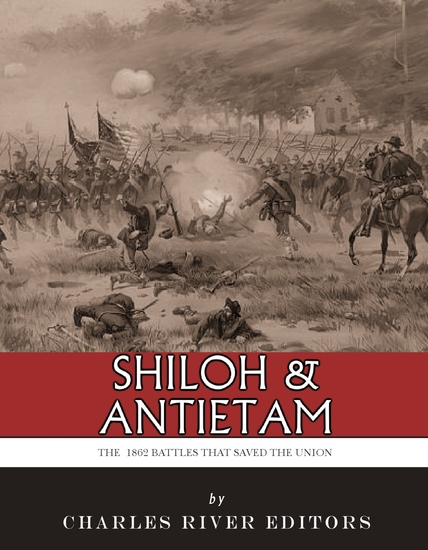
After Union General Ulysses S. Grant captured Fort Henry and Fort Donelson in early 1862, Confederate General Albert Sidney Johnston, widely considered the Confederacy’s best general, concentrated his forces in northern Georgia and prepared for a major offensive that culminated with the biggest battle of the war to that point, the Battle of Shiloh. On the morning of April 6, Johnston directed an all out attack on Grant’s army around Shiloh Church, and though Grant’s men had been encamped there, they had failed to create defensive fortifications or earthworks. They were also badly caught by surprise. With nearly 45,000 Confederates attacking, Johnston’s army began to steadily push Grant’s men back toward the river.  


As fate would have it, the Confederates may have been undone by friendly fire at Shiloh. Johnston advanced out ahead of his men on horseback while directing a charge near a peach orchard when he was hit in the lower leg by a bullet that historians now widely believe was fired by his own men. Nobody thought the wound was serious, including Johnston, who continued to aggressively lead his men and even sent his personal physician to treat wounded Union soldiers taken captive. But the bullet had clipped an artery, and shortly after being wounded Johnston began to feel faint in the saddle. With blood filling up his boot, Johnston unwittingly bled to death. The delay caused by his death, and the transfer of command to subordinate P.G.T. Beauregard, bought the Union defenders critical time on April 6, and the following day Grant’s reinforced army struck back and pushed the Confederate army off the field.


The Battle of Shiloh lasted two days, but the battle over the battle had just begun. Grant’s army had just won the biggest battle in the history of North America, with nearly 24,000 combined casualties among the Union and Confederate forces. Usually the winner of a major battle is hailed as a hero, but Grant was hardly a winner at Shiloh. The Battle of Shiloh took place before costlier battles at places like Antietam and Gettysburg, so the extent of the casualties at Shiloh shocked the nation. Moreover, at Shiloh the casualties were viewed as needless; Grant was pilloried for allowing the Confederates to take his forces by surprise, as well as the failure to build defensive earthworks and fortifications, which nearly resulted in a rout of his army. Speculation again arose that Grant had a drinking problem, and some even assumed he was drunk during the battle. Though the Union won, it was largely viewed that their success owed to the heroics of General Sherman in rallying the men and Don Carlos Buell arriving with his army, and General Buell was happy to receive the credit at Grant’s expense.


As a result of the Battle of Shiloh, Grant was demoted to second-in-command of all armies in his department, an utterly powerless position. And when word of what many considered a “colossal blunder” reached Washington, several congressmen insisted that Lincoln replace Grant in the field. Lincoln famously defended Grant, telling critics, “I can’t spare this man. He fights.”


Shiloh & Antietam explains the campaign and events that led up to the decisive battle, what went right and wrong on both sides, and the aftermath of the battle. Accounts of the battle by important leaders like Sherman, Grant, and Braxton Bragg are included, along with analysis of the generals and fighting. Along with maps of the battle and pictures of important people, places, and events, you will learn about the Battle of Shiloh like you never have before.
Disponível desde: 02/05/2025.
Comprimento de impressão: 100 páginas.
Outros livros que poderiam interessá-lo

  • China and the 20th Century - The History of the Wars and Reforms that Reshaped Asia’s Biggest Country - cover

    China and the 20th Century - The...

    Charles River Editors

    • 0
    • 0
    • 0
    In 1937, the fledgling Empire of Japan once more went to war with China, which by then had become a nation broken into petty warlord fiefdoms and wracked by civil war. The Japanese enacted a brutal campaign over the fragmented realms that made up China, committing atrocities just as horrendous as their Axis allies in Europe. Despite this, the sheer size of China, coupled with Japan’s overextension, allowed the larger, less developed nation to endure throughout World War II. 
    At the same time, China was experiencing an equally brutal civil war between Nationalist and Communist forces, which became inextricably intertwined with the fighting raging across the globe. In fact, the sheer scale of the horrors of the civil war remain hard to believe today, even as action in that theater is often overlooked because of events in Europe. What most people remember about the civil war is that it was ultimately won by Mao Zedong and the Communists, ushering in a new era of Communism in China and exiling the Republic of China’s government to Taiwan. Political tensions between Taiwan and China remain precarious to this day.  
    The Republic of China’s most famous leader and general was Chiang Kai-Shek, who rose from humble origins as the son of a local trader to become, as he liked to remind visitors, the ruler over more people than any other world leader. He certainly became one of the most influential leaders of the 20th century, yet today, he is considerably less well-known than many other figures from that period, which was so rife of chaos and tumultuous change. Chiang had come to power at a time when China was rebuilding itself after a period of internal conflict and turmoil, attempting to unify the nation in the face of the Japanese and the man who would become his arch-rival: Mao Zedong, leader of the Chinese Communists.  
    These ideological - and military - conflicts would decide the fate of Asia's biggest country going forward.
    Ver livro
  • Norman Invasion of England The: The History and Legacy of William the Conqueror’s Successful Campaign in 1066 - cover

    Norman Invasion of England The:...

    Editors Charles River

    • 0
    • 0
    • 0
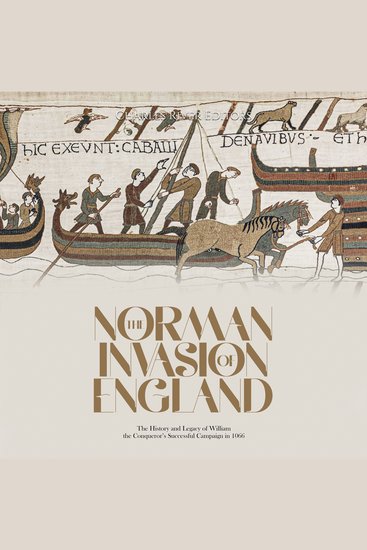
    For hundreds of years, the Anglo-Saxons – who had been harassing the Saxon Shore as pirates –began to settle in Britain, creating a patchwork of little kingdoms and starting a new era of English history. Several early medieval historians, writing well after the events, said the Anglo-Saxons were invited to Britain to defend the region from the northern tribes and ended up taking over. The Venerable Bede (672 or 673-735) said in his Historia ecclesiastica gentis Anglorum (“Ecclesiastical History of the English People”) that in the year 449, “The British consulted what was to be done and where they should seek assistance to prevent or repel the cruel and frequent incursions of the northern nations. They all agreed with their king Vortigern to call over to their aid, from the parts beyond the sea, the Saxon nation. … The two first commanders are said to have been Hengist and Horsa.” 
    	However they came to control most of England, the Anglo-Saxons became the dominant power in the region for nearly 500 years, and the strength of their cultural influence could be felt even after William the Conqueror won the Battle of Hastings and became the first Norman ruler on the island. William is one of history’s most famous conquerors, but the efforts to consolidate his rule in England were complicated from the start, both due to external enemies and those jockeying for his position while he was still alive. William ultimately decided to split Normandy and England. His son Robert, still in open revolt, would nonetheless inherit Normandy, while the next in line, his second son William, would rule England. The two states that William left behind were hardly united or at peace. Soon after his death, Odo conspired with Robert to oust his brother from the English throne and re-establish a united state, but the revolt failed, and King William “Rufus” II would rule England until his suspicious death in 1100.
    Ver livro
  • Secrets of Witches - cover

    Secrets of Witches

    Raphael Terra

    • 0
    • 0
    • 0
    This audiobook has been recorded using Text to speech (TTS). 
     
    Most people know of witches from the movies. Horror films with evil, cackling old women dressed in black, mixing potions and lotions and bringing doom to her victims. 
     
    The truth is in fact, as normal, far from the Hollywood version. Most of this false reality comes from religious intolerance over the centuries. Witchcraft was a threat to established religion and can be dated right back into the Bible itself. 
     
    Church propaganda spread stories and fear among the masses. This in turn brought down violence upon those practising witchcraft. Hounded out of town, victimised or even burned alive or drowned, the role of those practising the old arts was not one to be jealous of. If there was any true horror, then it was for the witches themselves. 
     
    Their craft is as old as history and it holds a great many truths, both natural and psychological. It finds it’s origins in ancient techniques of natural healing and a uniting of the natural world with that of humanity. Many of the discoveries made by witches are now common practice in homeopathy. 
     
    So what is the real truth? Did witches deal with the devil? Did they eat their victims? Did they mix their special brews in big black cauldrons? It’s time to find out.
    Ver livro
  • Classic Rock & Rock Radio Commercials - Volume 5 - cover

    Classic Rock & Rock Radio...

    Various Authors

    • 0
    • 0
    • 0
    This fascinating audio program includes actual radio commercials from the 1960s for the following bands: Donovan, Joni Mitchell, Monterey Pop Festival, The Beach Boys, Traffic, The Velvet Underground
    Ver livro
  • How to Educate a Citizen - The Power of Shared Knowledge to Unify a Nation - cover

    How to Educate a Citizen - The...

    Anônimo

    • 0
    • 0
    • 0
    “Profound, vital and correct. Hirsch highlights the essence of our American being and the radical changes in education necessary to sustain that essence. Concerned citizens, teachers, and parents take note!  We ignore this book at our peril.""— Joel Klein, former Chancellor of New York City Public Schools 
    In this powerful manifesto, the bestselling author of Cultural Literacy addresses the failures of America’s early education system and its impact on our current national malaise, advocating for a shared knowledge curriculum students everywhere can be taught—an educational foundation that can help improve and strengthen America’s unity, identity, and democracy. 
     
    In How to Educate a Citizen, E.D. Hirsch continues the conversation he began thirty years ago with his classic bestseller Cultural Literacy, urging America’s public schools, particularly at the elementary level, to educate our children more effectively to help heal and preserve the nation. Since the 1960s, our schools have been relying on “child-centered learning.” History, geography, science, civics, and other essential knowledge have been dumbed down by vacuous learning “techniques” and “values-based” curricula; indoctrinated by graduate schools of education, administrators and educators have believed they are teaching reading and critical thinking skills. Yet these cannot be taught in the absence of strong content, Hirsch argues. 
    The consequence is a loss of shared knowledge that would enable us to work together, understand one another, and make coherent, informed decisions. A broken approach to school not only leaves our children under-prepared and erodes the American dream but also loosens the spiritual bonds and unity that hold the nation together. Drawing on early schoolmasters and educational reformers such as Noah Webster and Horace Mann, Hirsch charts the rise and fall of the American early education system and provides a blueprint for closing the national gap in knowledge, communications, and allegiance. Critical and compelling, How to Educate a Citizen galvanizes our schools to equip children with the power of shared knowledge. 
    Supplemental enhancement PDF accompanies the audiobook.
    Ver livro
  • Minnie - The remarkable story of a true trailblazer who found freedom and adventure in the outback - cover

    Minnie - The remarkable story of...

    Marianne van Velzen

    • 0
    • 0
    • 0
    The inspiring story of a feisty pioneering woman who sought freedom and adventure in the outback and became the first woman to work as an opal miner in Australia. 
     
    People always asked her if she was ever afraid, living out in the desert alone with all those rough and scruffy men. But Minnie Berrington was not the faint-hearted type, and never had been. Being tough came naturally to her, growing up with three brothers and a family that went from riches to ruins. 
     
    Only a slip of a girl, Minnie could match any man in stamina, perseverance and strength. She arrived in Coober Pedy when camels still brought in essential supplies, and water was so scarce that no-one washed. Together with the other miners, she braved the heat, the flies and the dust. Every day she waited for that special sound the pick made when it cracked opal. 
     
    The first woman to dig her own shafts in the Australian opal fields, Minnie began her working life as a typist in London. But she and her younger brother, Victor, sought freedom and adventure in the 1920s and found plenty of it in the outback. 
     
    'Destined to become an outback classic' LIZ HARFULL, bestselling author of Women of the Land 
     
    'Minnie brings to life a gutsy, independent woman living a remarkable but simple life in the harshest of conditions' JULIET WILLS, author of The Diamond Dakota Mystery
    Ver livro