Junte-se a nós em uma viagem ao mundo dos livros!
Adicionar este livro à prateleira
Grey
Deixe um novo comentário Default profile 50px
Grey
Assine para ler o livro completo ou leia as primeiras páginas de graça!
All characters reduced
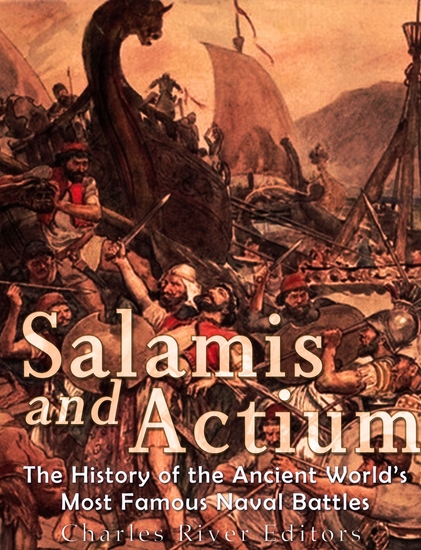
Salamis and Actium - The History of the Ancient World’s Most Famous Naval Battles - cover
LER

Salamis and Actium - The History of the Ancient World’s Most Famous Naval Battles

Editors Charles River

Editora: Charles River Editors

  • 0
  • 0
  • 0

Sinopse

When the Spartans’ famous and sacrificial stand at the Battle of Thermopylae ended during the Second Persian War, the Athenian fleet was forced to fall back, and Xerxes’ massive Persian army marched unopposed into Greece before advancing on Athens. The Greek armies were scattered and unable to face the might of Persia, so Athens was forced to do the unthinkable: evacuate the entire population of the city to Salamis, from where the Athenians watched in horror as Xerxes’ troops plundered the defenseless city, set it aflame, and razed the Acropolis.
 
However, the Athenians remained belligerent, in part because according to the oracle at Delphi, “only the wooden wall shall save you.” Indeed, this would prove true when Themistocles managed to lure the Persian fleet into the straits of Salamis. There, on a warm day in September 480 BCE, hundreds of Greek and Persian ships faced each other in a narrow strait between the Attic peninsula of Greece and the island of Salamis. The battle that ensued would prove to be epic on a number of different levels, as it set a precedent for how later naval battles were fought in the ancient Mediterranean, turned the tide in the Greeks’ favor against the Persians in the Persian Wars, and ultimately played a role in Athens’ rise to a preeminent role in the Hellenic world.
 
Bereft of much of his fleet after Salamis, Xerxes feared being stranded on the wrong side of the Hellespont, as there was a chance Themistocles might take the allied navy north to destroy his bridge across the straits. Accordingly, he retreated with the greater part of his army, back through Thermopylae and then from there to Persia, and many of his men perished from lack of adequate supplies and disease. Thus, it can safely be said that while Thermopylae continues to be more celebrated and better remembered, Salamis was the decisive battle of the Second Persian War.
 
Every era has watershed moments that shape the arc of history, and for Ancient Rome, few were as decisive or monumental as the Battle of Actium in 31 B.C. The battle’s importance is understandable given the stakes and people involved; Actium pitted the joint navies of Cleopatra and Mark Antony against the battle fleet of Octavian. In many ways, this climactic battle was the culmination of a years-long power struggle between the heirs of the assassinated Julius Caesar, with Octavian being his legally appointed heir and Antony being his longtime lieutenant and trusted advisor. Antony had even taken Caesar’s Egyptian mistress as his own.
 
Actium is also remarkable because Roman conflicts were almost always decided on land. The generals of the Roman Republic were far more comfortable fighting on land than at sea, and while Pompey Magnus had made a reputation fighting on the Mediterranean, it was his victories during Sulla’s war that earned him his distinguished nickname. Likewise, Caesar had largely shunned naval combat throughout his distinguished career, and he had even been captured by pirates while sailing in the Aegean. Philippi, Mutina, Utica and Pharsalus had all been land battles, and with good reason. Unlike the British Empire of the 19th century or Athens and her “Wooden Wall”, the Roman military machine was almost entirely geared towards land combat, which received the greater part of funding from the state and was considered by far the more honorable profession. While the annals of Roman history are replete with great generals, they are considerably lighter on the side of the admirals, and there were many examples of generals finding the transition to sea difficult. Roman antipathy for sea fighting may explain why the piracy problem was such an endemic one for the Mediterranean during their rule. 
Disponível desde: 01/05/2025.
Comprimento de impressão: 86 páginas.

Outros livros que poderiam interessá-lo

  • Eurotrash - Why America Must Reject the Failed Ideas of a Dying Continent - cover

    Eurotrash - Why America Must...

    Anônimo

    • 0
    • 0
    • 0
    Why should America try to be more like countries that are worse in nearly every way?  
    Europe has been declining under the weight of its antiquated institutions, economic fatigue, moral anemia and cultural surrender. Yet American politicians, technocrats, academics, and pundits argue, with increasing popularity, that Americans should look across the Atlantic for solutions to the nation’s problems, including on issues like health care, the welfare state, immigration, and a bloated bureaucracy. 
    In Eurotrash, David Harsanyi argues we are looking in the wrong place. By every economic and societal measure, the United States is more tolerant than Europe. It is more welcoming of immigrants, but also far more successful at assimilating them. Minorities do far better in United States. Our economy is dominant. Only one European company appears in top 10 corporate powerhouses in the world and only seven in the top 50. Americans make up nearly half of the list. 
    Americans are far more charitable and happier than Europeans. Our slightly lower life expectancy and our slightly higher infant mortality rate are not a result of substandard care, but a statistical misunderstanding based on the fact we treat every life as one worth saving. 
    In this biting, fast-moving, and well-researched polemic, Harsanyi debunks prevailing notions about European supremacy and makes an unapologetic case for American exceptionalism, offering insight and reasoned arguments to counter current policy prescriptions.
    Ver livro
  • How Soccer Explains the World - An Unlikely Theory of Globalization - cover

    How Soccer Explains the World -...

    Franklin Foer

    • 0
    • 0
    • 0
    “An eccentric, fascinating exposé of a world most of us know nothing about. . . . Bristles with anecdotes that are almost impossible to believe.” —New York Times Book Review 
    “Terrific. . . . A travelogue full of important insights into both cultural change and persistence. . . . Foer’s soccer odyssey lends weight to the argument that a humane world order is possible.” — Washington Post Book World 
    A groundbreaking work—named one of the five most influential sports books of the decade by Sports Illustrated—How Soccer Explains the World is a unique and brilliantly illuminating look at soccer, the world’s most popular sport, as a lens through which to view the pressing issues of our age, from the clash of civilizations to the global economy. 
    From Brazil to Bosnia, and Italy to Iran, this is an eye-opening chronicle of how a beautiful sport and its fanatical followers can highlight the fault lines of a society, whether it’s terrorism, poverty, anti-Semitism, or radical Islam—issues that now have an impact on all of us. Filled with blazing intelligence, colorful characters, wry humor, and an equal passion for soccer and humanity, How Soccer Explains the World is an utterly original book that makes sense of our troubled times.
    Ver livro
  • The Lost Cause and the Great War - Progressive Reform and Patriotism in the American South - cover

    The Lost Cause and the Great War...

    Robert E. Hunt

    • 0
    • 0
    • 0
    The Lost Cause and the Great War tells the stories of central Tennessee Progressive-era reformers to illustrate the fascinating broader issue of how Southerners steeped in Lost Cause Civil War mythologies simultaneously developed patriotic American fervor. Focusing on Luke Lea, a prominent politician and American army officer who attempted to capture Kaiser Wilhelm II during World War I, the book reveals the intricate interplay between three competing ideas: attachment to the memory of the Confederacy, intense American nationalism, and advocacy for progressive reforms. 


    Hunt shows that Lea and his contemporaries sought either to harmonize these competing loyalties or to compartmentalize them to use when needed. Through insightful accounts of Tennessee's 1928 presidential campaign, the American Legion's response to cuts to veteran benefits in 1933, and the redefinition of America's global role post–World War II, Hunt shows how these reformers achieved a balance that held until the Civil Rights movement disrupted this delicate consensus. 


    Hunt's rich account reveals how Lea and others like him wove national patriotism and Southern collective memory into a cohesive narrative that supported their broader Progressive goals. The book provides vivid examples of how collective memory and narratives shape social and political movements.
    Ver livro
  • Merian Tin Moutan Part - I - cover

    Merian Tin Moutan Part - I

    Dr. Indu Bali

    • 0
    • 0
    • 0
    Merian Tin Moutan (My Three Deaths) is a thought-provoking short story collection by Dr. Indu Bali, a talented and acclaimed writer known for her deep insight into human emotions and society. The book reflects the realities of its time, offering fresh perspectives and social reflection. Translated from Hindi to Punjabi by the renowned writer Shri Ram Sarup Anakhi, the collection bridges linguistic and emotional connections between two rich literary traditions. It highlights Dr. Indu Bali’s versatility as a novelist, critic, and artist, whose contributions to literature and art have earned her the prestigious "Shiromani Hindi Sahitkar" award in 1982.
    Ver livro
  • Soul of sex - cover

    Soul of sex

    Thomas More

    • 0
    • 0
    • 0
    In our age of science and psychology, it's tempting to think of human sexuality in terms of biology and interpersonal relationships. But in The Soul of Sex, Thomas Moore regards sex as an experience of the soul and emphasizes the more human themes of fantasy, desire, meaning, and morality. Moore turns especially to the religious traditions of the world, to rites, stories, and visual imagery that see in sex some of the most profound mysteries of life. He finds spirituality inherent in sex, and at the same time explores the many ways in which spiritual values can sometimes wound our sexuality. He recommends chastity and celibacy for everyone, as aspects of sexuality, and presents them as a means of developing a sensuous spirituality. 
    Moore also establishes the principle that one can't have a fully satisfying sex life in an asexual and anti-erotic world. He spells out an Epicurian way of life where the simple, deep pleasures of good food, friends, family, home and intimacy with nature provide an appropriate sensual base for a fulfilling sex life.  
    This is an audiobook for any individual, of whatever gender or lifestyle, who is trying to integrate sex into the rest of life. It is also a tool for couples, helping them to explore their sexuality with honesty, with appropriate emotional complexity, and with civility and comfort. Moore argues that sex should be at the center of life and at the top of our priorities, and if we don¹t give sex its due, it will haunt us and take us over. But when sex has soul, deep pleasure and meaning find a common home, and in that sense this audiobook is a sex manual for the soul. 
    Thomas Moore reads on two cassettes.
    Ver livro
  • Java Hill - An African Journey: A Nation's Evolution Through Ten Generations of a Family Linking Four Continents - cover

    Java Hill - An African Journey:...

    T.P. Manus Ulzen

    • 0
    • 0
    • 0
    Born in the gold mining hot bed of Tarkwa, Ghana, T. P. Manus Ulzen is the oldest of 5 children. His parents were both educators. He grew up in Bolgatanga, Wa, Wenchi, Accra, Kumasi and Takoradi in Ghana until he was 12 years old. He started high school at the age of 10 at St. Augustine's College, Cape Coast and continued his education at Kabulonga School for Boys in Lusaka, Zambia after his family left Ghana following the 1966 coup which ended Nkrumah's first republic. He returned to Ghana to complete his high school education at Ghana Secondary Technical School, Takoradi. 
    Though, greatly interested in liberal arts pursuits, he chose medicine as a career and graduated from the University of Ghana Medical School at the age of 22, becoming the youngest physician in his country at the time. After working as a general physician in Cape Coast, he left Ghana in 1980 for Canada to begin his specialist training. 
    He completed his postgraduate studies in Psychiatry at the University of Toronto in 1985 and has since had a successful career as an academic psychiatrist. He has been on the faculty at the University of Toronto, Brody School of Medicine at East Carolina University and is now Professor and Chair of Psychiatry and Behavioral Medicine in the College of Community Health Sciences at the University of Alabama, Tuscaloosa, Alabama where he is also Associate Dean for Academic Affairs. He is married to Ekua Mensah, a musician and they have 3 children, Adwoa, Kweku and Kofi.
    Ver livro