¡Acompáñanos a viajar por el mundo de los libros!
Añadir este libro a la estantería
Grey
Escribe un nuevo comentario Default profile 50px
Grey
Suscríbete para leer el libro completo o lee las primeras páginas gratis.
All characters reduced
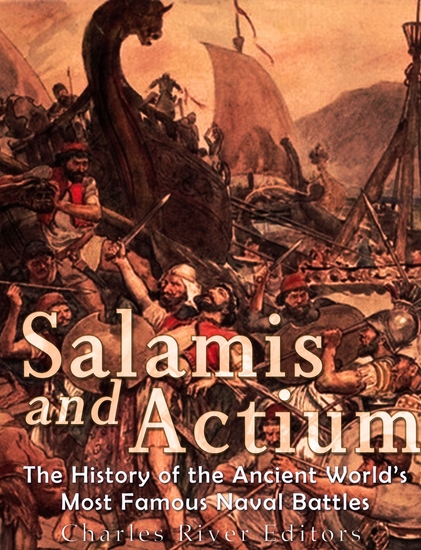
Salamis and Actium - The History of the Ancient World’s Most Famous Naval Battles - cover

Salamis and Actium - The History of the Ancient World’s Most Famous Naval Battles

Editors Charles River

Editorial: Charles River Editors

  • 0
  • 0
  • 0

Sinopsis

When the Spartans’ famous and sacrificial stand at the Battle of Thermopylae ended during the Second Persian War, the Athenian fleet was forced to fall back, and Xerxes’ massive Persian army marched unopposed into Greece before advancing on Athens. The Greek armies were scattered and unable to face the might of Persia, so Athens was forced to do the unthinkable: evacuate the entire population of the city to Salamis, from where the Athenians watched in horror as Xerxes’ troops plundered the defenseless city, set it aflame, and razed the Acropolis.
 
However, the Athenians remained belligerent, in part because according to the oracle at Delphi, “only the wooden wall shall save you.” Indeed, this would prove true when Themistocles managed to lure the Persian fleet into the straits of Salamis. There, on a warm day in September 480 BCE, hundreds of Greek and Persian ships faced each other in a narrow strait between the Attic peninsula of Greece and the island of Salamis. The battle that ensued would prove to be epic on a number of different levels, as it set a precedent for how later naval battles were fought in the ancient Mediterranean, turned the tide in the Greeks’ favor against the Persians in the Persian Wars, and ultimately played a role in Athens’ rise to a preeminent role in the Hellenic world.
 
Bereft of much of his fleet after Salamis, Xerxes feared being stranded on the wrong side of the Hellespont, as there was a chance Themistocles might take the allied navy north to destroy his bridge across the straits. Accordingly, he retreated with the greater part of his army, back through Thermopylae and then from there to Persia, and many of his men perished from lack of adequate supplies and disease. Thus, it can safely be said that while Thermopylae continues to be more celebrated and better remembered, Salamis was the decisive battle of the Second Persian War.
 
Every era has watershed moments that shape the arc of history, and for Ancient Rome, few were as decisive or monumental as the Battle of Actium in 31 B.C. The battle’s importance is understandable given the stakes and people involved; Actium pitted the joint navies of Cleopatra and Mark Antony against the battle fleet of Octavian. In many ways, this climactic battle was the culmination of a years-long power struggle between the heirs of the assassinated Julius Caesar, with Octavian being his legally appointed heir and Antony being his longtime lieutenant and trusted advisor. Antony had even taken Caesar’s Egyptian mistress as his own.
 
Actium is also remarkable because Roman conflicts were almost always decided on land. The generals of the Roman Republic were far more comfortable fighting on land than at sea, and while Pompey Magnus had made a reputation fighting on the Mediterranean, it was his victories during Sulla’s war that earned him his distinguished nickname. Likewise, Caesar had largely shunned naval combat throughout his distinguished career, and he had even been captured by pirates while sailing in the Aegean. Philippi, Mutina, Utica and Pharsalus had all been land battles, and with good reason. Unlike the British Empire of the 19th century or Athens and her “Wooden Wall”, the Roman military machine was almost entirely geared towards land combat, which received the greater part of funding from the state and was considered by far the more honorable profession. While the annals of Roman history are replete with great generals, they are considerably lighter on the side of the admirals, and there were many examples of generals finding the transition to sea difficult. Roman antipathy for sea fighting may explain why the piracy problem was such an endemic one for the Mediterranean during their rule. 
Disponible desde: 01/05/2025.
Longitud de impresión: 86 páginas.

Otros libros que te pueden interesar

  • The Birmingham Book - Lessons in urban education leadership and policy from the Trojan Horse affair - cover

    The Birmingham Book - Lessons in...

    Colin Diamond CBE

    • 0
    • 0
    • 0
    The Trojan Horse affair sent shock waves across England's education system in 2014. The affair centred around an anonymous letter that contained instructions on how to take over schools with a majority Muslim population by influencing their governing bodies and undermining head teachers. The authenticity of the letter remains hotly disputed, yet its publication generated huge turbulence - not only in Birmingham's schools and communities, but also in both Parliament and the national news.
    The book offers fresh perspectives based on unique access to information from within the city, written by respected educationalists who have worked successfully in Birmingham for many years both during the Trojan Horse era and since. It explains what led to the publication of the letter, its profound consequences for education in Birmingham, and how it influenced events in the city since.
    Crucially the book also opens up an informed discussion around the issues raised during Trojan Horse, such as delivering a well-rounded curriculum suitable for a diverse school community, developing working partnerships in the local area, and boosting the attainment and aspirations of children from disadvantaged backgrounds.
    Colin shares case studies of school improvement in local and national MATs in tough, multicultural urban environments, and how schools worked to develop pupils' social capital. The Birmingham Book reveals how the Trojan Horse affair was handled by the Department for Education as their academies and free schools policies underwent their first major stress tests. Furthermore, the book provides an up-to-date appraisal of the interrelationship between education in England's schools and the cultural and religious practice of the local communities the schools serve - and of the underachievement levels of the different ethnic groups in Birmingham.
    Suitable for teachers, school leaders, governors and policymakers.
    Ver libro
  • What Really Happened In Wuhan - cover

    What Really Happened In Wuhan

    Anónimo

    • 0
    • 0
    • 0
    Walkley Award-winning journalist, Sharri Markson is the Investigations Editor at The Australian and host of prime-time show Sharri on Sky News Australia. 
      
    The origins of Covid-19 are shrouded in mystery. Scientists and government officials insisted, for a year and a half, that the virus had a natural origin, ridiculing anyone who dared contradict this view. Tech giants swept the internet, censoring and silencing debate in the most extreme fashion. Yet it is undeniable that a secretive facility in Wuhan was immersed in genetically manipulating bat-coronaviruses in perilous experiments. And as soon as the news of an outbreak in Wuhan leaked, the Chinese military took control and gagged all laboratory insiders. 
    Part-thriller, part-expose, What Really Happened in Wuhan is a ground-breaking investigation from leading journalist Sharri Markson into the origins of Covid-19, the cover-ups, the conspiracies and the classified research. It features never-before-seen primary documents exposing China's concealment of the virus, fresh interviews with whistleblower doctors in Wuhan and crucial eyewitness accounts that dismantle what we thought we knew about when the outbreak hit. 
    With unprecedented access to Washington insiders, Markson takes you inside the White House, with senior Trump lieutenants revealing first-hand accounts of fiery Oval Office clashes and new stories of compromised government advisors and censored scientists. 
    Bravely reported and chillingly laid out, Markson brings to light the stories of the pandemic from the people on the ground: the scientists and national security officials who raised uncomfortable truths and were labelled conspiracy theorists, until government agencies began to suspect they might have been right all along. These brave individuals persisted through bruising battles and played a crucial role in investigating the origins of Covid-19 to finally, in this book, bring us closer to the truth of what really happened in Wuhan.
    Ver libro
  • The First Anzacs - cover

    The First Anzacs

    Jimmy Thomson, George Hulse

    • 0
    • 0
    • 0
    This is the unknown story of the combat engineers who kept World War I running. Although it has been repeatedly denied by the army, they were the first Australians to land at Anzac Cove: in any combat, even today, sappers are always the first in and last out. 
     
     
    They were airbrushed out of history. Official historian Charles Bean claimed the first Australian ashore at the Gallipoli landing on 25 April 1915 was an infantry officer. But Bean wasn't there, and a bunch of Australian and New Zealand army engineers were. Even today, the army is reluctant to accept that sappers were among the very first Australian soldiers ashore. 
     
    This is the untold story of the Australian and New Zealand sappers - combat engineers - who fought in World War I. They were always in the vanguard, clearing defences, and building bridges, roads and walkways for the troops who followed, usually under fire. At Gallipoli, strafed by machine guns and targeted by snipers, they dug trenches and tunnels to advance on the Turkish defences. On the Western Front, they burrowed under the German lines to plant massive explosives, whose eruption could be heard in England. In Egypt they demolished a Turkish railway in a day. 
     
    From Gallipoli to the sands of the Middle East, to the blood-soaked battlefields of France and Belgium, engineers put down their tools to also fight as combat soldiers at every major battle and campaign, often with heroic feats of astonishing courage. Three sappers stole a giant field gun from under German noses at Amiens. Sappers were classic Aussie larrikins, indefatigably practical men who don't take kindly to bureaucracy. Typically under-appreciated, two were cheated of their well-earned VCs by a British general after they, working alone, tricked a German platoon into surrendering. 
     
     
    'Sappers are the unsung heroes of the First World War and this book helps bring them back into the limelight where they belong.' WILL DAVIES, Beneath Hill 60 
     
     
    'It has taken 111 years for true stories to appear in a book adequately honouring Australian sappers in WW1 - you will remember these heroes forever'. COLONEL SANDY MACGREGOR MC (rtd) 
     
     
    'An excellent insight into the role of the Field Engineers as part of the combined arms team in World War One' BRIGADIER MICK SAY DSC, Head of Corps, Royal Australian Engineers
    Ver libro
  • Fascist Yoga - Grifters Occultists White Supremacists and the New Order In Wellness - cover

    Fascist Yoga - Grifters...

    Stewart Home

    • 0
    • 0
    • 0
    Thanks to the power of its "mystic" Indian origins, yoga promises peace, self-realization, and release. But what if this is just hype? In Fascist Yoga, Stewart Home sweeps away the half-truths to reveal a new origin story of modern postural practice. 


    Starting with the world's first modern yogi—a Californian escapologist who added Hindu fairy dust to circus exercises—this history reveals a community full of grifters, occultists, and white supremacists, out to exploit and recruit via the medium of exercise. 


    From Aleister Crowley to Ezra Pound to Heinrich Himmler, cult leaders and brainwashed followers, TV celebrities, and fake gurus, the story of yoga has involved some of the strangest currents of humanity with a dangerous understanding of wellness.
    Ver libro
  • The EQ Prescription - Put Yourself First to Thrive in Healthcare - cover

    The EQ Prescription - Put...

    Mickey Lebowitz

    • 0
    • 0
    • 0
    Health-care professionals—clinicians, nurses, students—have dedicated countless hours to and made endless sacrifices for their careers, yet too many face dissatisfaction and exit early due to the overwhelming pressures of the system, many of which are out of their control. Unfortunately, standard healthy habits like eating and sleeping well and exercising aren’t enough. The remedy? Putting yourself first using The EQ Prescription. 
    Dr. Mickey Lebowitz, a certified endocrinologist and emotional intelligence expert, offers and guides you through a transformative, groundbreaking concept: the Emotional Intelligence (EQ) Zone. This framework provides practical, easy-to-use strategies that can be utilized in real time, especially when the heat is on, and is designed to help you navigate the high-stress demands of health care, allowing you to stay emotionally and physically well so you can be your best and give your best. The benefits are enormous: greater job fulfillment, better patient satisfaction and outcomes, enhanced leadership, and reduced risk of malpractice and burnout. If you’re ready to thrive in health care, managing yourself through its inescapable pain points, while delivering exceptional patient care and deservedly enjoying both your professional and personal life, The EQ Prescription is written for you.
    Ver libro
  • Original Self - Living with Paradox and Originality - cover

    Original Self - Living with...

    Thomas More

    • 0
    • 0
    • 0
    According to Thomas Moore, people today have lost the deep, direct, and vivid sense of what it means to live with passion and originality.  Moore believes that beneath the many thick layers of indoctrination about who we are and who we should be lies an original self, a person who came into this world full of possibility and destined for a particular life. 
    The fifty mediations in this collection offer fresh interpretations of living with that original self rather than conformity.  he presents multidimensional portraits of the creative self and different angles from which to tap one's primal emotions and possibilities.  This audio demonstrates what it means to live from the burning essence of the heart, with the creativity that comes from allowing the soul to blossom in its own colors and shapes. 
    With his usual grace and insight, Moore counters the prevailing assumptions of the day and offers strikingly unorthodox views on what is virtuous and healthy, opening up possibilities for a renewal of the way we live socially and in our private lives.
    Ver libro