¡Acompáñanos a viajar por el mundo de los libros!
Añadir este libro a la estantería
Grey
Escribe un nuevo comentario Default profile 50px
Grey
Suscríbete para leer el libro completo o lee las primeras páginas gratis.
All characters reduced
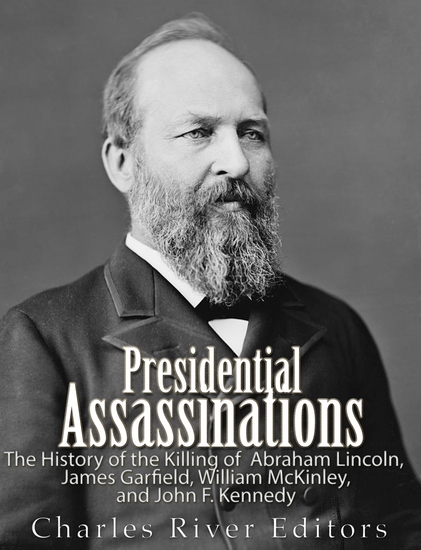
Presidential Assassinations - The History of the Killing of Abraham Lincoln James Garfield William McKinley and John F Kennedy - cover

Presidential Assassinations - The History of the Killing of Abraham Lincoln James Garfield William McKinley and John F Kennedy

Editors Charles River

Editorial: Charles River Editors

  • 0
  • 0
  • 0

Sinopsis

Until April 14, 1865, John Wilkes Booth was one of the most famous actors of his time, and President Abraham Lincoln had even watched him perform. But his most significant performance at a theater did not take place on the stage. That night, Booth became one of history’s most infamous assassins when he assassinated President Lincoln at Ford's Theatre in Washington, D.C.
 
Booth was a member of the prominent 19th century Booth theatrical family from Maryland and, by the 1860s, was a well-known actor. But he was also a Confederate sympathizer who dabbled in espionage, and he was increasingly outraged at the Lincoln Administration. Although Robert E. Lee's Army of Northern Virginia had surrendered days earlier, Booth believed the war was not yet over because Confederate General Joseph E. Johnston's army was still fighting the Union Army, so he and his group of conspirators plotted to kill Lincoln and other top officials in a bid to decapitate the federal government and help the South.
 
James Garfield went on to narrowly edge Winfield Scott Hancock in the 1880 election, and Guiteau, harboring delusions of grandeur, believed he had helped tip the scales in Garfield’s favor. As such, he believed that he was entitled to a post in Garfield’s nascent administration, perhaps even an ambassadorship, and he continued to rack up debts while operating under the assumption that he would soon have the government salary to pay them back. However, despite lobbying around Republican headquarters in New York City and even approaching Cabinet members, no post was forthcoming for the troubled man. Eventually, in May 1881, Secretary of State James Blaine told him to never show up again.
 
Enraged by the perceived slight, Guiteau bought a revolver and plotted to kill the president. He got his chance on July 2, 1881 at a railroad station, shooting Garfield in the back twice and bragging to the authorities, "I am a Stalwart of the Stalwarts...Arthur is president now!" In reality, Garfield would live for nearly 3 more months, and the poor standards of medical care in the 1880s would end up being responsible for the fact he did not survive wounds that he would’ve survived at the end of the 19th century. Indeed, Guiteau would cite medical malpractice at trial, stating, "I deny the killing, if your honor please. We admit the shooting."
 
President James Garfield had been assassinated just 20 years earlier, but McKinley didn’t worry about presidential security or his own safety, and that was the case in Buffalo. McKinley’s insistence on greeting the public and shaking hands allowed Czolgosz to walk up to him on September 6, 1901 at a public reception in the Temple of Music on the expo grounds and shoot him point blank, with one bullet grazing the president and another lodging in his abdomen. In the aftermath of the shooting, as Czolgosz was beaten and seized by the crowd, he uttered, "I done my duty." For his part, McKinley said, “He didn't know, poor fellow, what he was doing. He couldn't have known."
 
Despite being president, McKinley’s medical services were shoddy, and given the still primitive medical standards of the early 20th century, gunshots to the abdomen often brought death. One of the best known aspects of the assassination is that Thomas Edison’s x-ray machine was on hand and may have been used to try to locate the bullet that doctors couldn’t find, but for reasons that remain unknown, the x-ray machine was not used.
 
November 22, 1963 started as a typical Friday, and many Americans were unaware that President Kennedy was even heading to Dallas, Texas. John and Jackie arrived in Dallas in the morning, with Texas Governor John Connally alongside them and Vice President Lyndon B. Johnson due to arrive later to meet them there. The Kennedys and the Connallys intended to participate in public events later in the day.
Disponible desde: 01/05/2025.
Longitud de impresión: 167 páginas.

Otros libros que te pueden interesar

  • Journey of Influence: The Lyndon Johnson Years Book Three - "Unveil Lyndon Johnson's legacy with riveting audio lessons ensuring a captivating journey through history’s corridors" - cover

    Journey of Influence: The Lyndon...

    Graham Becket

    • 0
    • 0
    • 0
    'Journey of Influence: The Lyndon Johnson Years, Book Three' 
    Are you aiming to elevate your career and deepen your understanding by mastering influential leadership from Lyndon Johnson's era? 
    In search of a detailed guide that offers all the essential components to comprehend the impact of Lyndon Johnson's leadership? 
    Your exploration concludes here! 
    This guide is your essential ally, offering profound insights, practical applications, and engaging exercises to ensure your success in understanding Johnson's influence. 
    Updated with insights drawn from Lyndon Johnson's impactful leadership era. 
    Highlighted features of this comprehensive guide: 
    - In-depth exploration of leadership insights from Lyndon Johnson's era 
    - Thorough explanation of impactful leadership during Johnson's time 
    - Effective strategies for mastering leadership qualities and challenges 
    Our guide distinguishes itself through extensive coverage, essential for grasping the intricacies of Johnson's leadership. Concepts are examined precisely and thoroughly. 
    Crafted with a coherent structure and straightforward language, our guide ensures smooth progression between topics. Embrace clear, precise, and insightful content on Lyndon Johnson's leadership. 
    So, why delay? Click the BUY NOW button to secure your guide and embark on your journey to mastering the impactful leadership of Lyndon Johnson's era! 
    Experience the profound journey of influence through the lens of Lyndon Johnson's years and enhance your leadership skills today!
    Ver libro
  • The Funny Stuff - The Official P J O’Rourke Quotationary and Riffapedia - cover

    The Funny Stuff - The Official P...

    P. J. O'Rourke

    • 0
    • 0
    • 0
    A compendium of quotes and riffs by P.J. O'Rourke on subjects ranging from government to fishing to apps, to be published on what would have been his seventy-fifth birthday. 


    When The Penguin Dictionary of Modern Humorous Quotations was published in 1994, P. J. O'Rourke had more entries than any living writer. And he kept writing funny stuff for another twenty-eight years. Now, for the first time, the best material is collected in  one volume. Edited by Terry McDonell, The Funny Stuff is arranged in six sections, organized by subject in alphabetical order from Agriculture to Xenophobia. From his earliest days at the National Lampoon in the 1970s, through his classic reporting for Rolling Stone in the '80s and '90s to his post-Trump, pandemic, new media observations of recent years, P. J. produced incisive, amusing copy. Not only did P. J. write memorable one-liners, he also meticulously constructed riffs that are still being quoted years later. His prose has the electric verbal energy of Tom Wolfe or Hunter Thompson, but P. J. is more flat out funny. And through it all comes his clear-eyed take on politics, economics, human nature—and fun. The Funny Stuff is a book for P. J. fans to devour but also a book that will bring new audiences and stand as testament to one of the truly original American writers of the last fifty years.
    Ver libro
  • The Shakespeare Conundrum - Examining the True Identity of the Literary Genius - cover

    The Shakespeare Conundrum -...

    John Harpoon

    • 0
    • 0
    • 0
    The question of who wrote the works attributed to William Shakespeare has intrigued scholars, historians, and literary enthusiasts for centuries. Despite being one of the most celebrated figures in the world of literature, Shakespeare’s true identity remains a subject of mystery. The sheer volume of his works, their profound depth, and the complexity of their themes have led many to wonder whether the man from Stratford-upon-Avon was truly the author of the plays and sonnets that bear his name. This uncertainty has given rise to one of the most enduring and controversial debates in literary history: the Shakespeare authorship question. 
      
    The core of this mystery lies in the limited biographical information available about Shakespeare’s life. Born in 1564 in Stratford-upon-Avon, Shakespeare’s early years remain largely undocumented, with no personal manuscripts or letters bearing his signature. The surviving records of his life mainly consist of legal documents, such as his marriage license, business transactions, and his will. While these historical artifacts confirm his existence and some of his professional endeavors, they provide little insight into his intellectual and literary development. For a figure of his stature, this absence of personal evidence is startling, leading some to question whether the “Stratford man” could have truly written the works attributed to him. 
      
    In the absence of definitive evidence, a number of alternative theories have emerged, suggesting that another writer, or group of writers, may have been responsible for Shakespeare’s remarkable body of work. These theories have ranged from the claim that the works were penned by an aristocrat such as Francis Bacon, to the suggestion that the true author was the playwright Christopher Marlowe, whose death in 1593 has been disputed by some.
    Ver libro
  • Blossoming Resilience - Stories of Pain Healing and Triumph - cover

    Blossoming Resilience - Stories...

    Dr. Kimberly Toney

    • 0
    • 0
    • 0
    "Blossoming Resilience: Stories of Pain, Healing and Triumph" is more than a story of personal triumph. Dr. Toney’s candid reflections offer hope and inspiration to anyone who has ever felt marginalized, underappreciated, or overwhelmed by life’s challenges. In this powerful autobiography, Dr. Kimberly Toney shares her remarkable journey from the challenging streets of Chicago’s South Side to a successful career in medicine. Growing up in a world where poverty was a constant companion, Kimberly faced battles with self-acceptance, body image, and societal pressures. Her story is one of perseverance and resilience, guided by the unwavering love and strength of her father. Despite the obstacles, she excelled academically, graduating with honors and breaking barriers as she pursued her dream of becoming a doctor. Along the way, Kimberly discovered that true strength lies in embracing one’s authentic self. Through struggles and triumphs, she learned invaluable life lessons about love, family, and the importance of self-acceptance.
    Ver libro
  • Suburban Policing - Cleveland Style - cover

    Suburban Policing - Cleveland Style

    Jim Brown

    • 0
    • 0
    • 0
    Suburban Policing: Cleveland Style is an unfiltered, behind-the-scenes journey through the eyes of a seasoned law enforcement officer who spent 25+ years as a Police Officer making his way through the ranks (Patrol Officer, Sergeant, Lieutenant, Detective Bureau Commander, SWAT Team Commander, etc.,)—which culminated in serving his final eleven (11) years as a municipal Police Chief. With raw honesty, sharp insight, and moments of unexpected humor, this book offers a gripping look at what it truly means to wear the badge in one of America’s most challenging suburban environments. From high-speed pursuits and SWAT operations to life-altering auto accidents and unpredictable disturbances, this isn’t just another cop story—it’s a boots-on-the-ground memoir of dedication, danger, and deeply personal encounters with both tragedy and triumph. Drawn from decades of real-life experiences, these stories reflect the grit, compassion, and unwavering resolve of those who serve and protect. For anyone curious about what police officers really face day to day—and how a lifetime in law enforcement shapes a person—this book offers an authentic, unforgettable perspective.
    Ver libro
  • The Next Day - Transitions Change and Moving Forward - cover

    The Next Day - Transitions...

    Melinda French Gates

    • 0
    • 0
    • 0
    In a rare window into some of her life’s pivotal moments, Melinda French Gates draws from previously untold stories to offer a new perspective on encountering transitions.This program is read by the author.      “You don’t get to be my age without navigating all kinds of transitions. Some you embraced and some you never expected. Some you hoped for and some you fought as hard as you could.”   – Melinda French Gates  Transitions are moments in which we step out of our familiar surroundings and into a new  landscape—a space that, for many people, is shadowed by confusion, fear, and indecision. The Next Day accompanies readers as they cross that space, offering guidance on how to make the most of the time between an ending and a new beginning and how to move forward into the next day when the ground beneath you is shifting.  In this book, Melinda will reflect, for the first time in print, on some of the most significant transitions in her own life, including becoming a parent, the death of a dear friend, and her departure from the Gates Foundation. The stories she tells illuminate universal lessons about loosening the bonds of perfectionism, helping friends navigate times of crisis, embracing uncertainty, and more. Each one of us, no matter who we are or where we are in life, is headed toward transitions of our own. With her signature warmth and grace, Melinda candidly shares stories of times when she was in need of wisdom and shines a path through the open space stretching out before us all.A Macmillan Audio production from Flatiron Books.
    Ver libro