Junte-se a nós em uma viagem ao mundo dos livros!
Adicionar este livro à prateleira
Grey
Deixe um novo comentário Default profile 50px
Grey
Assine para ler o livro completo ou leia as primeiras páginas de graça!
All characters reduced
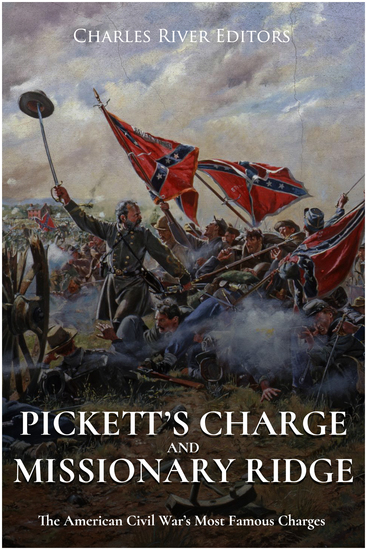
Pickett’s Charge and Missionary Ridge - The American Civil Wars Most Famous Charges - cover
LER

Pickett’s Charge and Missionary Ridge - The American Civil Wars Most Famous Charges

Editors Charles River

Editora: Charles River Editors

  • 0
  • 0
  • 0

Sinopse

Despite the fact that the Civil War began over 150 years ago, it remains one of the most widely discussed topics in America today, with Americans arguing over its causes, reenacting its famous battles, and debating which general was better than others. Americans continue to be fascinated by the Civil War icons who made the difference between victory and defeat in the war's great battles.
 
The most famous attack of the Civil War was also one of its most fateful and fatal. Pickett’s Charge, the climactic assault on the final day of the Battle of Gettysburg, has become the American version of the Charge of the Light Brigade, and it is one of the most famous events of the entire Civil War.
 
Having been unable to break the Army of the Potomac’s lines on the left and right flank during Day 2 of the Battle of Gettysburg, Confederate Army of Northern Virginia commander Robert E. Lee decided to make a thrust at the center of the Union’s line with about 15,000 men spread out over three divisions. The charge required marching across an open field for about a mile, with the Union artillery holding high ground on all sides of the incoming Confederates.
 
Though it is now known as Pickett’s Charge, named after division commander George Pickett, the assignment for the charge was given to General James Longstreet, whose 1st Corps included Pickett’s division. Longstreet had serious misgivings about Lee’s plan and tried futilely to talk him out of it. Longstreet later wrote that he said to his commander, “General Lee, I have been a soldier all my life.  It is my opinion that no fifteen thousand men ever arrayed for battle can take that position.”
 
Aware of the insanity of sending 15,000 men hurtling into all the Union artillery, Lee planned to use the Confederate artillery to try to knock out the Union artillery ahead of time. Although old friend William Pendleton was the artillery chief, the artillery cannonade would be supervised by Edward Porter Alexander, Longstreet’s chief artillerist, who would have to give the go-ahead to the charging infantry because they were falling under Longstreet’s command. Alexander later noted that Longstreet was so disturbed and dejected about ordering the attack that at one point he tried to make Alexander order the infantry forward, essentially doing Longstreet’s dirty work for him.
 
Although the Chattanooga Campaign was months long and involved several battles, it has become mostly remembered for the Battle of Missionary Ridge, one of the most remarkable and successful charges of the war. As Thomas’s men reached the base of the Missionary Ridge, they found that it had not afforded them protection from the Confederate defenders in their front. As a result, they began making impromptu charges up the hill, in defiance of Grant’s orders, since Grant had only ordered them to take the rifle pits at the base of Missionary Ridge and believed that a frontal assault on that position would be futile and fatal. As the Union soldiers stormed ahead, General Grant caught the advance from a distance and asked General Thomas why he had ordered the attack.  Thomas informed Grant that he hadn’t; his army had taken it upon itself to charge up the entire ridge. To the amazement of everyone watching, the Union soldiers scrambled up Missionary Ridge in a series of uncoordinated and disorganized attacks that somehow managed to send the Confederates into a rout, thereby lifting the siege on Chattanooga. While Pickett’s Charge, still the most famous attack of the war, was one unsuccessful charge, the Army of the Cumberland made over a dozen charges up Missionary Ridge and ultimately succeeded.
Disponível desde: 01/05/2025.
Comprimento de impressão: 102 páginas.

Outros livros que poderiam interessá-lo

  • Meditations - In New Translation - cover

    Meditations - In New Translation

    Marcus Aurelius, Filibooks...

    • 0
    • 0
    • 0
    "Meditations" offers timeless reflections from Roman Emperor Marcus Aurelius. This text draws from his personal notes, written as a guide to self-discipline, virtue, and tranquility. In these pages, readers find a direct and sincere voice, reminding them that inner calm is possible through thoughtful observation and purposeful action. Aurelius's stoic insights emphasize the importance of understanding one's own nature, maintaining rational composure, and accepting the realities of life. This new translation by Filibooks Translation provides a clear, accessible approach to the core of Stoic thought. Readers can engage with a practical philosophy that encourages responsibility and empathy, illuminating the path to living a balanced life. "Meditations" remains ever relevant in today's complex world, offering a humble invitation to reflect on personal values, confront daily challenges, and foster inner strength.
    Ver livro
  • A Rare Recording of Jim Garrison - cover

    A Rare Recording of Jim Garrison

    Jim Garrison

    • 0
    • 0
    • 0
    Jim Garrison (1921-1992) was the District Attorney of Orleans Parish, Louisiana, from 1962 to 1973. He is best known for his investigations into the assassination of President John F. Kennedy. Garrison was able to subpoena the Zapruder film from Life magazine. As a result, the American public was able to see the film for the first time. Garrison made the case that the Kennedy assassination was too complex to be carried out by Oswald alone. Later, he was played by Kevin Costner in Oliver Stone's 1991 feature film, "JFK." This recording is part of a speech he gave on the assassination.
    Ver livro
  • Hooked - Art and Attachment - cover

    Hooked - Art and Attachment

    Rita Felski

    • 0
    • 0
    • 0
    How does a novel entice or enlist us? How does a song surprise or seduce us? Why do we bristle when a friend belittles a book we love, or fall into a funk when a favored TV series comes to an end? What characterizes the aesthetic experiences of feeling captivated by works of art? In Hooked, Rita Felski challenges the ethos of critical aloofness that is a part of modern intellectuals’ self-image. The result is sure to be as widely read as Felski’s book, The Limits of Critique. 
     
    Wresting the language of affinity away from accusations of sticky sentiment and manipulative marketing, Felski argues that “being hooked” is as fundamental to the appreciation of high art as to the enjoyment of popular culture. Hooked zeroes in on three attachment devices that connect audiences to works of art: identification, attunement, and interpretation. Drawing on examples from literature, film, music, and painting—from Joni Mitchell to Matisse, from Thomas Bernhard to Thelma and Louise—Felski brings the language of attachment into the academy. Hooked returns us to the fundamentals of aesthetic experience, showing that the social meanings of artworks are generated not just by critics, but also by the responses of captivated audiences.
    Ver livro
  • Armageddon: Book Summary and Analysis - cover

    Armageddon: Book Summary and...

    Briefly Summaries

    • 0
    • 0
    • 0
    This is a concise summary and analysis of Armageddon, by Dick Morris &Eileen McGann.
     
    It is not the original book and is not affiliated with or endorsed by Dick Morris &Eileen McGann.
     
    Ideal those seeking a quick and insightful overview.


    In this compelling and thought-provoking audiobook, the AUTHOR takes you on a journey through the perilous and unpredictable landscape of our modern world. Armageddon is not just a warning about the end of times—it’s an eye-opening exploration of the global forces shaping our future and a powerful call to action for anyone seeking to thrive in an increasingly complex and interconnected world.
     
    From the shifting balance of global power to the dangers of economic collapse, political polarization, and the rapid rise of technology, Armageddon paints a vivid picture of the forces that threaten our stability. But this is not a story of doom and gloom; it’s a roadmap for success in the face of uncertainty. The AUTHOR offers practical insights on how you can prepare for the challenges ahead, adapt to the changing global environment, and stay ahead of the curve.
    Ver livro
  • What the Hell - How Wittgenstein Made Philosophy Even More Confusing While Claiming to Solve Everything - cover

    What the Hell - How Wittgenstein...

    Sophia Blackwell

    • 0
    • 0
    • 0
    Finally, a philosophy book that won't make you contemplate throwing yourself into the abyss! " WHAT THE HELL" tears into Ludwig Wittgenstein—history's most insufferable genius—with savage wit and zero academic pretension. 
    Journey through the mind-bending contradictions of a trust-fund philosopher who claimed to solve all philosophical problems (twice!), while making everyone around him miserable. Discover how a man who couldn't maintain a single healthy relationship somehow revolutionized our understanding of language, meaning, and communication. 
    From his early days writing numbered lists so pretentious they make Instagram influencers look humble, to his later career interrupting people to tell them they're using words wrong, this book exposes Wittgenstein in all his paradoxical glory. You'll laugh, you'll cry, you'll question whether language has any meaning at all—just like Ludwig wanted! 
    Whether you're a philosophy student desperately seeking comic relief, or simply enjoy watching neurotic geniuses get thoroughly roasted, this irreverent guide proves that even the most profound philosophical insights can come from someone you'd absolutely hate to be seated next to at dinner. Warning: Reading this book in public may cause uncontrollable snorting in libraries and concerned looks from serious academics.
    Ver livro
  • Flower of Battle by Fiore dei Liberi The: Translated and narrated by Guy Windsor - Il Fior di Battaglia by Fiore dei Liberi - cover

    Flower of Battle by Fiore dei...

    Guy Windsor, Fiore dei Liberi

    • 0
    • 0
    • 0
    Il Fior di Battaglia, the Flower of Battle, was written by the great Italian master at arms Fiore dei Liberi around the year 1400. It covers knightly combat on foot and on horseback, in armour and without, in great depth and detail. The sections of the manuscript include an introduction, then plays of wrestling, the dagger, the sword in one hand, the sword in two hands, the sword in armour, the pollax, the spear, the lance on horseback, the sword on horseback, and wrestling on horseback.  
    This audiobook is the translation into English by Dr. Guy Windsor.
    Ver livro