¡Acompáñanos a viajar por el mundo de los libros!
Añadir este libro a la estantería
Grey
Escribe un nuevo comentario Default profile 50px
Grey
Suscríbete para leer el libro completo o lee las primeras páginas gratis.
All characters reduced
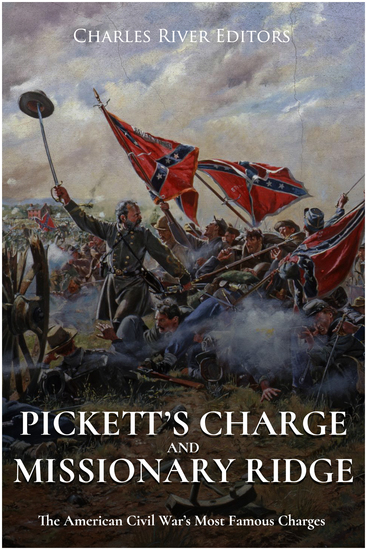
Pickett’s Charge and Missionary Ridge - The American Civil Wars Most Famous Charges - cover

Pickett’s Charge and Missionary Ridge - The American Civil Wars Most Famous Charges

Editors Charles River

Editorial: Charles River Editors

  • 0
  • 0
  • 0

Sinopsis

Despite the fact that the Civil War began over 150 years ago, it remains one of the most widely discussed topics in America today, with Americans arguing over its causes, reenacting its famous battles, and debating which general was better than others. Americans continue to be fascinated by the Civil War icons who made the difference between victory and defeat in the war's great battles.
 
The most famous attack of the Civil War was also one of its most fateful and fatal. Pickett’s Charge, the climactic assault on the final day of the Battle of Gettysburg, has become the American version of the Charge of the Light Brigade, and it is one of the most famous events of the entire Civil War.
 
Having been unable to break the Army of the Potomac’s lines on the left and right flank during Day 2 of the Battle of Gettysburg, Confederate Army of Northern Virginia commander Robert E. Lee decided to make a thrust at the center of the Union’s line with about 15,000 men spread out over three divisions. The charge required marching across an open field for about a mile, with the Union artillery holding high ground on all sides of the incoming Confederates.
 
Though it is now known as Pickett’s Charge, named after division commander George Pickett, the assignment for the charge was given to General James Longstreet, whose 1st Corps included Pickett’s division. Longstreet had serious misgivings about Lee’s plan and tried futilely to talk him out of it. Longstreet later wrote that he said to his commander, “General Lee, I have been a soldier all my life.  It is my opinion that no fifteen thousand men ever arrayed for battle can take that position.”
 
Aware of the insanity of sending 15,000 men hurtling into all the Union artillery, Lee planned to use the Confederate artillery to try to knock out the Union artillery ahead of time. Although old friend William Pendleton was the artillery chief, the artillery cannonade would be supervised by Edward Porter Alexander, Longstreet’s chief artillerist, who would have to give the go-ahead to the charging infantry because they were falling under Longstreet’s command. Alexander later noted that Longstreet was so disturbed and dejected about ordering the attack that at one point he tried to make Alexander order the infantry forward, essentially doing Longstreet’s dirty work for him.
 
Although the Chattanooga Campaign was months long and involved several battles, it has become mostly remembered for the Battle of Missionary Ridge, one of the most remarkable and successful charges of the war. As Thomas’s men reached the base of the Missionary Ridge, they found that it had not afforded them protection from the Confederate defenders in their front. As a result, they began making impromptu charges up the hill, in defiance of Grant’s orders, since Grant had only ordered them to take the rifle pits at the base of Missionary Ridge and believed that a frontal assault on that position would be futile and fatal. As the Union soldiers stormed ahead, General Grant caught the advance from a distance and asked General Thomas why he had ordered the attack.  Thomas informed Grant that he hadn’t; his army had taken it upon itself to charge up the entire ridge. To the amazement of everyone watching, the Union soldiers scrambled up Missionary Ridge in a series of uncoordinated and disorganized attacks that somehow managed to send the Confederates into a rout, thereby lifting the siege on Chattanooga. While Pickett’s Charge, still the most famous attack of the war, was one unsuccessful charge, the Army of the Cumberland made over a dozen charges up Missionary Ridge and ultimately succeeded.
Disponible desde: 01/05/2025.
Longitud de impresión: 102 páginas.
Otros libros que te pueden interesar

  • Speak Still - Articulating the Silence of Bilingualism - cover

    Speak Still - Articulating the...

    Wing Lam Tong

    • 0
    • 0
    • 0
    Speak Still confronts colonial silencing by asking out loud: why do non-native speakers of English feel estranged from the English language, despite having known it since childhood? Is it possible for us to own this silence? If so, how can we find our eloquence from our experience of speechlessness? How can we bring the foreign language home?
    Blending personal narrative and cultural criticism, Speak Still takes Tong's bilingual experience in Hong Kong and the UK as a point of departure and reflects on the meaning of language, selfhood, and belonging. Through poignant observations of everyday life as it is experienced between languages, Tong conceptualises a possibility to communicate and connect beyond words: by reclaiming silence as an interlocutor that interrupts cultural homogeneity and creates space for the unheard.
    Speak Still shows that this silence, indeed, speaks volumes.
    Ver libro
  • Islamic Relics: The History of Some of the Holiest Items in Islam - cover

    Islamic Relics: The History of...

    Editors Charles River

    • 0
    • 0
    • 0
    Muslim relics have become sought after relatively recently, since in the tradition of Islam it is customary to bury the deceased together with his belongings. However, many religious relics have rather controversial origins. Sometimes the faithful sincerely worship artful forgeries masquerading as holy relics and things that supposedly belonged to saints. The real sanctuaries are carefully guarded and are not always accessible to believers. They are brought out for public viewing on especially festive days. It is often represented as creating a special ritual.  
    	It is curious that the attitude towards such relics gradually changed over the centuries. If, at first, they were considered amulets used by private individuals, then over time their purpose and comprehension took on a different character. Most notably, the possession of the relics of the prophet began to be considered one of the arguments in favor of the appointment of the Caliph. The concentration of several relics in one mosque immediately sharply increased, in the eyes of the believers, the piety of such a mosque; this, in turn, immediately affected the growth of its wealth and political influence. Thus, in the published catalog of relics stored in the former Badshahi mosque of the Mughal state in Lahore (now Pakistan), there are 28 items: seven belonged to the prophet himself, three to the son-in-law of the prophet Ali, two to the daughter of the prophet Fatima, five to the grandson of the prophet Hussein, etc. It is believed that some of these items were taken out by Timur after the capture of Damascus, and some were donated by Sultan Bayazid to Timur's descendant, Babur. After the fall of the Mughal dynasty in India, they were first in private possession in the second half of the 19th century. In different ways, they came to the Lahore Mosque.
    Ver libro
  • OCME - Life in America's Top Forensic Medical Center - cover

    OCME - Life in America's Top...

    Bruce Goldfarb

    • 0
    • 0
    • 0
    Bruce Goldfarb spent ten years with Maryland's Office of the Chief Medical Examiner, where every sudden or unattended death in the state is scrutinized. 


    Touching on numerous scandals, including Derek Chauvin's trial for the murder of George Floyd and the tragic killing in police custody of Freddie Gray, Goldfarb pulls back the curtain on a pioneer institution in crisis. 


    Medical examiners and the investigators and technicians who support them play vital roles in the justice and public health systems of every American community. During Goldfarb's time with the Maryland OCME, opioid-related deaths contributed to a significant increase in their workload. Faced with a chronic shortage of qualified experts and inadequate funding, their important and fascinating work has become more challenging than most people could ever imagine. 


    The public gets a skewed view of the relationship between police and medical examiners from procedural crime dramas, Bruce Goldfarb writes of his work inside one of America's most storied forensic centers. We aren't on the same team . . . We aren't on any team. The medical examiner’s sole duty is to the deceased person. We speak for the dead.
    Ver libro
  • Ḏamurruŋ'puy Mälk Saltwater Skin - cover

    Ḏamurruŋ'puy Mälk Saltwater Skin

    Mary McCarthy

    • 0
    • 0
    • 0
    A memoir of a woman's journey into remote Arnhem Land in Australia being adopted into a tribe. Her transition into a new world and a new life with the Yolŋu people and her experiences with culture, kinship, language and traditional ceremonies. 
    References & Photographs attached PDF https://www.dropbox.com/s/qir91mgkbu3iuyg/saltwater_skin_pdf_photos_and_references.pdf?dl=0
    Ver libro
  • Calm in the Chaos - True Tales from Elite US Navy Aviation Rescue Swimmers - cover

    Calm in the Chaos - True Tales...

    Brian Dickinson

    • 0
    • 0
    • 0
    From an elite Navy rescue swimmer comes this insider perspective on what it takes to survive some of the most dangerous situations imaginable—and how the lessons learned can help overcome other momentous challenges. 


    Brian Dickinson, famously known for having climbed down Mt. Everest while completely snow blind, is often asked how he managed the incredible feat. He has always attributed it to his faith and to his U.S. Navy Search and Rescue Training. For the first time, Brian takes an in-depth look at the training that saved his life and the missions—both his and others'—where these skills were put to the test to save other people. 


    Over two decades after being honorably discharged from the Navy, Brian is compelled to share his unique military training and experiences. He believes that sharing the training that he received to overcome adversity in the most extreme scenarios can help others to overcome their own personal Everest. Even beyond mountaineering, the military training has rewired Brian's ability to navigate difficult business, financial, health, and relationship challenges. With the chaos of the world continuing to expand, these stories from U.S. Navy rescue swimmers provide a fresh perspective on what it takes to survive some of the most dangerous situations, and how that shapes the rest of a person's life.
    Ver libro
  • Capitalism and Its Impact - The Growth and Consequences of Capitalist Systems (5 in 1) - cover

    Capitalism and Its Impact - The...

    Arlo Holders

    • 0
    • 0
    • 0
    This book bundle contains the following books: 
      - The Rise of Capitalism  
      - The Capitalist Dilemma  
      - Capitalism and Inequality  
      - Capitalism Unveiled  
      - Global Capitalism  
    Take advantage of this deal now!
    Ver libro