¡Acompáñanos a viajar por el mundo de los libros!
Añadir este libro a la estantería
Grey
Escribe un nuevo comentario Default profile 50px
Grey
Suscríbete para leer el libro completo o lee las primeras páginas gratis.
All characters reduced
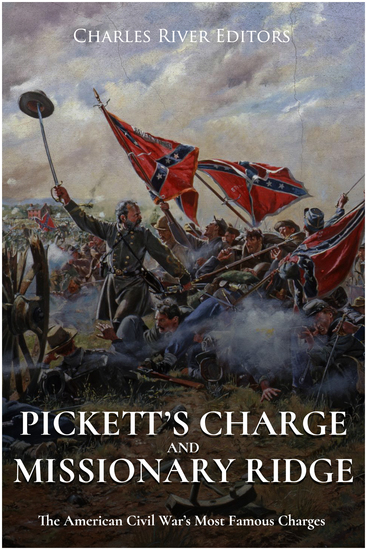
Pickett’s Charge and Missionary Ridge - The American Civil Wars Most Famous Charges - cover

Pickett’s Charge and Missionary Ridge - The American Civil Wars Most Famous Charges

Editors Charles River

Editorial: Charles River Editors

  • 0
  • 0
  • 0

Sinopsis

Despite the fact that the Civil War began over 150 years ago, it remains one of the most widely discussed topics in America today, with Americans arguing over its causes, reenacting its famous battles, and debating which general was better than others. Americans continue to be fascinated by the Civil War icons who made the difference between victory and defeat in the war's great battles.
 
The most famous attack of the Civil War was also one of its most fateful and fatal. Pickett’s Charge, the climactic assault on the final day of the Battle of Gettysburg, has become the American version of the Charge of the Light Brigade, and it is one of the most famous events of the entire Civil War.
 
Having been unable to break the Army of the Potomac’s lines on the left and right flank during Day 2 of the Battle of Gettysburg, Confederate Army of Northern Virginia commander Robert E. Lee decided to make a thrust at the center of the Union’s line with about 15,000 men spread out over three divisions. The charge required marching across an open field for about a mile, with the Union artillery holding high ground on all sides of the incoming Confederates.
 
Though it is now known as Pickett’s Charge, named after division commander George Pickett, the assignment for the charge was given to General James Longstreet, whose 1st Corps included Pickett’s division. Longstreet had serious misgivings about Lee’s plan and tried futilely to talk him out of it. Longstreet later wrote that he said to his commander, “General Lee, I have been a soldier all my life.  It is my opinion that no fifteen thousand men ever arrayed for battle can take that position.”
 
Aware of the insanity of sending 15,000 men hurtling into all the Union artillery, Lee planned to use the Confederate artillery to try to knock out the Union artillery ahead of time. Although old friend William Pendleton was the artillery chief, the artillery cannonade would be supervised by Edward Porter Alexander, Longstreet’s chief artillerist, who would have to give the go-ahead to the charging infantry because they were falling under Longstreet’s command. Alexander later noted that Longstreet was so disturbed and dejected about ordering the attack that at one point he tried to make Alexander order the infantry forward, essentially doing Longstreet’s dirty work for him.
 
Although the Chattanooga Campaign was months long and involved several battles, it has become mostly remembered for the Battle of Missionary Ridge, one of the most remarkable and successful charges of the war. As Thomas’s men reached the base of the Missionary Ridge, they found that it had not afforded them protection from the Confederate defenders in their front. As a result, they began making impromptu charges up the hill, in defiance of Grant’s orders, since Grant had only ordered them to take the rifle pits at the base of Missionary Ridge and believed that a frontal assault on that position would be futile and fatal. As the Union soldiers stormed ahead, General Grant caught the advance from a distance and asked General Thomas why he had ordered the attack.  Thomas informed Grant that he hadn’t; his army had taken it upon itself to charge up the entire ridge. To the amazement of everyone watching, the Union soldiers scrambled up Missionary Ridge in a series of uncoordinated and disorganized attacks that somehow managed to send the Confederates into a rout, thereby lifting the siege on Chattanooga. While Pickett’s Charge, still the most famous attack of the war, was one unsuccessful charge, the Army of the Cumberland made over a dozen charges up Missionary Ridge and ultimately succeeded.
Disponible desde: 01/05/2025.
Longitud de impresión: 102 páginas.
Otros libros que te pueden interesar

  • Conscious Grieving - A Transformative Approach to Healing from Loss - cover

    Conscious Grieving - A...

    Claire Bidwell Smith

    • 0
    • 0
    • 0
    From one of the leading grief therapists, this compassionate and accessible guide to grieving offers a new framework for understanding and navigating loss.An intimate guide to grieving that offers hope and healing within loss from one of the nation’s top grief therapists.    Conscious Grieving is a book for anyone seeking guidance and support after loss. Renowned grief therapist Claire Bidwell Smith combines her deeply personal experience of loss with her long career spent working with thousands of people to introduce a new approach to grief, one that promotes hope and even transformation.   What does it mean to grieve consciously? Most of the time, when we lose someone we love, it feels like grief is just happening to us. We feel out of control, and overwhelmed. Claire reminds us that while loss is something that inevitably happens to all of us, how we choose to grieve is up to us. When we can consciously engage with our grief, rather than avoiding it, we can access profound pathways to healing.  Presented in a series of thoughtful, brief vignettes that don’t overwhelm the reader, Conscious Grieving offers a new framework for each stage of grief: Entering, Engaging, Surrendering, and Transforming. Entering – staying present and taking care of ourselves as we navigate the shock and upheaval of a new loss.  Engaging – navigating that first year after a loss by staying in tune with our needs as more complicated feelings of depression, guilt or anger surface. Surrendering – facing the changes to our identity and who we are becoming in the face of loss. Transforming – through ritual, honor, hope, and grace, and learning to carry our grief with intention so that we can continue to grow, heal, and thrive.  Grief asks a lot from us. But the ability to grieve is a birthright. We grieve throughout our lifetimes. We grieve the deaths of loved ones yes, but also moves, divorce, illness, injustice, time lost, changes in the world and healing from these losses requires that we evaluate everything we ever considered meaningful. Healing means making our lives worth the pain we endure when we lose someone we love. And transforming through grief is an opportunity afforded to all.
    Ver libro
  • Quiet by Susan Cain - Book Summary - The Power of Introverts in a World That Can't Stop Talking - cover

    Quiet by Susan Cain - Book...

    FlashBooks, Dean Bokhari

    • 0
    • 0
    • 0
    Quiet by Susan Cain - Book Summary 
    Important note: This is not the original book, this is a book summary. 
    About 
    Quiet: The Power of Introverts in a World That Can't Stop Talking by Susan Cain • Susan Cain’s book Quiet is a respectfully written, long-needed validation for introverts everywhere. In addition to using research findings to help introverts understand why they experience the world the way they do, Susan Cain offers insight and strategies for introverts to use to thrive in an extrovert-driven world. She also gives useful explanations to extroverts, partners and managers of introverts, and parents of introverted children to bring out the best in their innate gifts, while helping them cope with the extroverted requirements of daily life. 
     
    Here’s what you’ll learn about in this summary: 
     
    An appreciation for introverts, and for being an introvert (if you are one).An explanation of the wonderful and challenging aspects of being an introvert.How to thrive as an introvert, and how to help other introverts function optimally.
    Ver libro
  • Free Speech and Turbulent Freedom - The Dangerous Allure of Censorship in the Digital Era - cover

    Free Speech and Turbulent...

    Michael J. Glennon

    • 0
    • 0
    • 0
    A vast censorship regime has smothered America's digital marketplace of ideas, squelching free speech on vital policy issues. Its supporters regard its benefits as morally and politically beyond question. They contend it's carried out by private social media platforms, not governmental authorities. 


    In Free Speech and Turbulent Freedom, Michael J. Glennon offers a timely and incisive response. The censors are short-sighted, he argues. Quibbling over outdated distinctions misses the real threat—which is the fusion of public and private power into a modern-day cartel able to overleap longstanding constitutional safeguards. American democracy, he argues, rests on a decentralized marketplace of ideas independent of the government. In crisp, trenchant terms, Glennon shows how concrete practical concerns justify protecting admittedly harmful online speech—even speech that advocates violence or embraces hatred or apparent falsehood. 


    To safely self-correct, democracy requires open channels of political communication. Glennon calls on the courts to unblock those channels—to measure such speech against enduring First Amendment precepts rather than pliable international norms—and to protect the speech interests not merely of the government and Big Tech, but of all participants in the marketplace of ideas.
    Ver libro
  • Teamwork for Scrum Masters and Agile Coaches - cover

    Teamwork for Scrum Masters and...

    Tom Henricksen

    • 0
    • 0
    • 0
    Scrum Masters and Agile Coaches can create exceptional teams. Collaborating with their team members with qualities of great team players. They can influence their peers and bring unity. Help your team achieve as a teamwork all-star!Learn the qualities of great team playersBuild empathy and credibilityCreate team normsAdd accountability to your teamEstablish team structure 
    We ask two leaders in the industry to share their expertise. You won't be disappointed.
    Ver libro
  • Alien Abduction - cover

    Alien Abduction

    Raphael Terra

    • 0
    • 0
    • 0
    This audiobook has been recorded using Text to speech (TTS). 
     
    Across the world people are paralysed, abducted, abused and terrorised. Landscapes are burned and scarred. Towns are closed down, radio stations threatened and lies are spread. Why? Because our governments are covering up the greatest of secrets. The aliens are here. They are contacting us and even abducting us. 
     
    Our secretive military and inner-governments know what is happening and they are hiding it from us. They close down every site, cordon off, recover technology and corpses and then cover-up. They have been doing so for decades and we are being fooled. 
     
    This is the story of alien contact from across the globe. This is the tale of how aliens have infiltrated our very governments who work with them to hide the secrets. This is the amazing truth about alien contact and abduction.
    Ver libro
  • Rhodesian Bush War - Decolonization Conflict and Nationhood in Southern Africa - cover

    Rhodesian Bush War -...

    Daniel Wrinn

    • 0
    • 0
    • 0
    The Rhodesian Bush War (1964–1979) was a long, brutal guerrilla struggle that brought an end to white minority rule in Rhodesia, leading to the birth of modern Zimbabwe. This audiobook takes you through the key events, figures, and battles that shaped this critical chapter in African history, offering a comprehensive yet engaging look into one of the continent’s most significant liberation wars. 
    Uncover the strategies used by the Rhodesian government and African nationalist forces in a complex battle for the country's future. You'll also explore the wider global context, from Cold War politics to foreign interventions, and how they all played a role in determining the war's outcome. 
    What you’ll discover:The rise of ZANU and ZAPU and their ideological differencesIan Smith’s Unilateral Declaration of Independence (UDI)Major military operations like Operation Dingo, and guerrilla tactics from ZANLA and ZIPRAThe influence of Cold War geopolitics and sanctions on the warDiplomatic efforts that led to the Lancaster House Agreement and Zimbabwe’s independenceThe war’s long-term effects on Zimbabwe’s political and economic landscape 
    Perfect for history lovers, African conflict enthusiasts, and those interested in the making of modern Zimbabwe, this audiobook provides an insightful look at how this pivotal conflict shaped Southern Africa and left a lasting legacy on the continent’s fight for independence.
    Ver libro