Junte-se a nós em uma viagem ao mundo dos livros!
Adicionar este livro à prateleira
Grey
Deixe um novo comentário Default profile 50px
Grey
Assine para ler o livro completo ou leia as primeiras páginas de graça!
All characters reduced
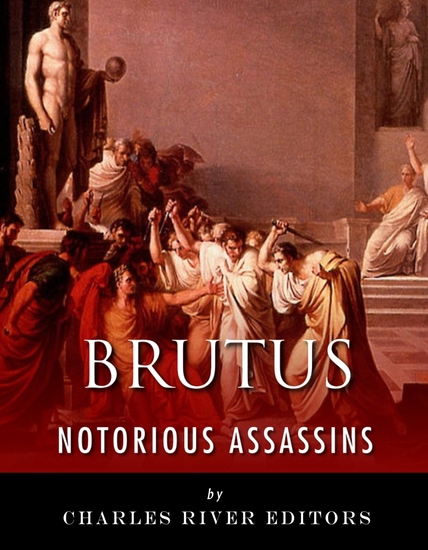
Notorious Assassins - The Life and Legacy of Marcus Brutus - cover
LER

Notorious Assassins - The Life and Legacy of Marcus Brutus

Editors Charles River

Editora: Charles River Editors

  • 0
  • 0
  • 0

Sinopse

“Sic semper tyrannis!” (“Thus, always, to tyrants!”) – attributed to Brutus
 
Throughout the annals of history, there have been few men as reviled as Marcus Junius Brutus the Younger. To this day, he is associated with murder, betrayal, violence and infamy, so much so that in modern English his name provides the root for the words “brute” and “brutal”, as it does in several other Romance languages. Indeed, Brutus’s reputation was so infamous that when Dante composed his timeless Divine Comedy, he relegated Brutus to the very nethermost depths of Hell. In the Inferno, Dante reaches the pit of the Ninth Circle of Hell, where he finds the Fallen Angel, Lucifer, himself. Lucifer is described as a giant, three-faced demon whose three mouths are perpetually gnashing upon three sinners, widely regarded as being the three most despicable individuals in history. According to Dante, the deepest circle of Hell is reserved for traitors, including Traitors against Kin, Traitors against Homeland, Traitors against Guests, and Traitors against Benefactors. The three men being devoured by Satan in Dante’s Inferno are Judas, the greatest traitor of all, and the two conspirators whose knives cut down Julius Caesar: Gaius Cassius Longinus and Brutus.
 
By Dante’s logic, Brutus had betrayed both his kin and benefactor, because Caesar had been as a father to him and always treated him with leniency and benevolence. Similarly, he also betrayed his homeland, because his actions helped bring about the downfall of the Republic. Since his appearance in the Inferno, Brutus has proven himself to be a resilient fictional character, naturally appearing as the main antagonist in Shakespeare’s Julius Caesar, as well as turning up in places as diverse as contemporary novels, the Asterix comic books, and video games. This is hardly surprising, since Brutus was said to be the orchestrator and main perpetrator of the plot against Caesar, and legend had it that it was Brutus himself who dealt the final blow that struck Caesar down. Shakespeare’s “Et tu, brute?” (“And you, Brutus?”) is widely recognized as one of the most iconic lines in theatre, further cementing Brutus’s lurid notoriety, although most of the chronicles dispute whether Caesar actually said anything at all as he died.
 
Brutus has been history’s most notorious assassin since the Ides of March in 44 B.C., but aside from his conspiracy, the rest of his life is often overlooked, especially his role in the subsequent civil war. In fact, forces loyal to Brutus and the other main conspirator, Cassius, fought one of the biggest battles in Roman history against Octavian and Antony, and it was one that they very nearly won. However, by the end of the decisive battle, Brutus and Cassius had lost, and Brutus had taken his own life. After Octavian rose to power by defeating Antony in yet another civil war, he was able to establish himself as Caesar Augustus, and the Republic that Brutus had hoped to save was truly finished.
 
Naturally, Augustus ensured that Brutus was universally despised during his reign, and Brutus’s negative reputation mostly persevered over the centuries. But in more modern times, Brutus has undergone something of a rehabilitation. As Western political thought shifted away from the Divine Right of Kings and towards democracy, Brutus began to be viewed in a far more sympathetic light. In Shakespeare’s Julius Caesar itself, Brutus is praised as the best of the conspirators, because his motives were described not as being for personal gain but a genuine desire to act for the good of the Republic, however misguided. Later, he became viewed as something of a populist hero, the man who had stood up in defense of a democratic government against a tyrant who wished to seize power for himself alone. Brutus achieved a particularly positive public portrayal in the fledgling United States.
Disponível desde: 02/05/2025.
Comprimento de impressão: 32 páginas.

Outros livros que poderiam interessá-lo

  • Plutarco Elías Calles and the Mexican Revolution - cover

    Plutarco Elías Calles and the...

    Jürgen Buchenau

    • 0
    • 0
    • 0
    This biography of the Mexican revolutionary examines his rise from soldier to president to his continued influence as Jefe Maximo. Hailing from the border state of Sonora, Plutarco Elías Calles found his calling in the early years of the revolution, quickly rising to national prominence. As president from 1924 to 1928, Calles undertook an ambitious reform program, modernized the financial system, and defended national sovereignty against an interventionist U.S. government. Yet these reforms failed to eradicate underdevelopment, corruption, and social injustice. Moreover, his unyielding campaigns against political enemies and the Catholic Church earned him a reputation as a repressive strongman. After his term as president, Calles continued to exert broad influence as his country's foremost political figure while three weaker presidents succeeded each other in an atmosphere of constant political crisis. He played a significant role in founding a ruling party that reined in power-hungry military leaders and helped workers attain better living conditions. This dynastic party and its successors, including the present-day Partido Revolucionario Institucional (Party of the Institutional Revolution), remained in power until 2000. Through this comprehensive assessment of a quintessential Mexican politician, Buchenau opens an illuminating window into both the Mexican Revolution and contemporary Mexico.
    Ver livro
  • Great Empires - History of the Mongols and the Huns - cover

    Great Empires - History of the...

    Kelly Mass

    • 0
    • 0
    • 0
    This book contains several titles, which are the following: 
    Genghis Khan - Genghis Khan was the Mongol emperor who has expanded his region to the biggest empire on the face of the earth ever. His empire stretched from East Asia all the way to various European countries, the Middle East, and beyond. 
    What made Genghis Khan so successful? 
    Was he a brute, rapist, and pillaging dictator, or did he have a tolerant side as well? 
    You will learn more about his early life, his relationships, marriage, families and children, his attacks, his unification of the Mongolian Federations, his death, succession, and the continuing of the Mongolian Empire after his death. 
    Mongolian Empire - The Mongolian Empire was not to be trifled with! Genghis Khan and his followers conquered a vast part of Asia, Europe, and beyond. There aren’t many people who haven’t heard of these conquerors and their achievement. Honor them or despise them, but at least acknowledge their existence. 
    How did the Mongol Empire grow so big? 
    What was it like before the expansion? 
    These questions and many others will be answered in this historical guide. Their dominance, their attitude, and their culture will be explained, as well as their practices of war and various other parts of their society. 
    Attila the Hun - You may have heard about him: Attila the Hun. Let's discover who this individual actually was and why he has such a bad track record of being a callous, aggressive conqueror in the first millennium after Christ. Attila the Hun was the ruler of the Huns from the year 434 till his death in the month of March in the year 453. Also, he was the leader of a tribal realm which consisted mainly of Huns, Ostrogoths, Alans and Bulgars, to name a few, in Central Europe and in Eastern Europe.
    Ver livro
  • Teaching to Live - Black Religion Activist-Educators and Radical Social Change - cover

    Teaching to Live - Black...

    Almeda M. Wright

    • 0
    • 0
    • 0
    Teaching to Live: Black Religion, Activist-Educators, and Radical Social Change interrogates the stories of African American activist-educators whose faith convictions inspired them to educate in radical and transformative ways. Almeda M. Wright explores the connections between religion, education, and struggles for freedom within twentieth-century African American communities by telling the stories of key African American teachers. 


    Wright brings together the lives and work of three related subgroups of activist-educators: those who worked in public or secular education but were religiously inspired; radical scholars who transformed the ways that Black religion and Black religious life are studied and valued; and radical religious educators, or those educators who were involved more formally with the religious formation of Black people but who regarded this work of spiritual development as part of the struggle for freedom and liberation of all people. 


    The rich and complex narratives of these educators show how religion, education, and radical social change can intersect. This book invites listeners to continue exploring how these concepts will evolve for future generations of activist-educators.
    Ver livro
  • Echoes of Revolution 3-In-1 Bundle - The Three Revolutions of France Russia and China - cover

    Echoes of Revolution 3-In-1...

    Will Forrest

    • 0
    • 0
    • 0
    Explore the Groundbreaking Revolutions with This 3-In-1 Bundle! 
    Delve into the pivotal moments of modern history with this exceptional 3-in-1 bundle, providing you with an in-depth exploration of the revolutions of France, Russia, and China. Discover the transformative events that shaped these powerful nations and altered the course of human history. 
    In this book, you will uncover:  
    • The Unyielding Spirit of the French Revolution 
    • The Revolutionary Struggles of the Russian Empire 
    • The Far-Reaching Impact of China's Revolutions 
    • The Ideals and Challenges that Defined Each Uprising 
    • The Lasting Legacies of the Revolutions on Global Politics 
    Why You'll Cherish This Collection: 
    Learn about Vladimir Lenin of Russia, Mao Zedong of China, and Maximilien Robespierre of France who set the stage for the rise of Napoleon Bonaparte. Each of these leaders played a pivotal role in shaping their respective countries and the world as a whole. 
    Don't miss this opportunity to explore the echoes of revolution. Take Action Now, and Click the Buy Button!  
    Embark on an unforgettable journey through the transformative revolutions of France, Russia, and China!
    Ver livro
  • Abortion - a personal story a political choice - cover

    Abortion - a personal story a...

    Pauline Harmange

    • 0
    • 0
    • 0
    From the author of I Hate Men, a personal and political reflection on abortion rights. 


    Discussion about abortion and associated rights are often limited to either "anti-abortion" or "pro-choice," the latter of which focuses on the importance of having the right to choose, rather than on what that right means for real people. 


    In this timely essay, Pauline Harmange provides an intimate, detailed account of her abortion. Reminiscent of Annie Ernaux's Happening, Abortion is nuanced, complex, honest, and precise. Harmange gives voice to the emotions, reflections, and contradictions that someone could experience when they choose to terminate a pregnancy. 


    At a time in which women's reproductive rights are being called into question around the world, Abortion is a clarion call, a powerful personal testimony, and a resolutely political vision: to restore power to our experiences, all our experiences, by sharing them, and to transform society for the better.
    Ver livro
  • American Impresario - William F Buckley Jr and the Elements of American Character - cover

    American Impresario - William F...

    Lawrence Perelman

    • 0
    • 0
    • 0
    Lawrence Perelman, an eighteen-year-old aspiring pianist and son of Soviet Jewish immigrants, wrote a letter to William F. Buckley, Jr., the conservative icon, in 1994. A remarkable cross-generational friendship was sparked by Buckley's response. During their friendship Perelman would go on to learn of the timeless elements of Buckley's character and the central role of classical music in Buckley's American vision. 


    In 2025, the 100th anniversary of Buckley's birth, this book delves into some of Buckley's virtues which Perelman witnessed firsthand and argues that those virtues can transform the fabric of America's character. Their friendship spanned from 1995 to February 27, 2008, the day Buckley passed away in his Connecticut home while Perelman practiced piano in a nearby room for a private recital that evening for Buckley and friends that would never happen. 


    American Impresario is a portrait of Buckley, the impresario of the conservative movement, man of faith, Cold Warrior, bulwark against Anti-Semitism, Renaissance man, musician, and mentor to countless people. This book will inspire listeners to emulate Buckley's virtues, including a return to civil discourse, anonymous philanthropy, faith, patriotism and fostering relationships between mentor and protégé, as part of a goal to reweave the fabric of our nation's character.
    Ver livro