¡Acompáñanos a viajar por el mundo de los libros!
Añadir este libro a la estantería
Grey
Escribe un nuevo comentario Default profile 50px
Grey
Suscríbete para leer el libro completo o lee las primeras páginas gratis.
All characters reduced
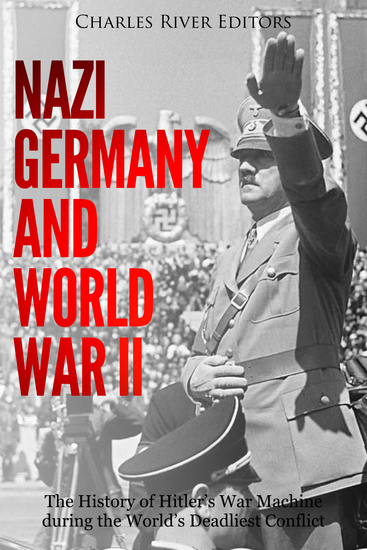
Nazi Germany and World War II - The History of Hitler’s War Machine during the World’s Deadliest Conflict - cover

Nazi Germany and World War II - The History of Hitler’s War Machine during the World’s Deadliest Conflict

Editors Charles River

Editorial: Charles River Editors

  • 0
  • 0
  • 0

Sinopsis

Munich is widely reviled today and is held up as the epitome of appeasement, but historians still debate its effects on the Second World War, as well as Neville Chamberlain's character and motivations. Some believe the attempted appeasement of Nazi Germany hastened, or even caused, the mayhem occupying the next seven years. Others believe that the pact merely failed to alter war's inevitable arrival in either direction. Historians and authors alternately interpret Chamberlain as a bumbling, arrogant fool, a strong-willed statesman who simply miscalculated the nature of Hitler and Nazi Germany, or even a man with dictatorial ambitions surreptitiously inserting himself into the Fuhrer's orbit and prevented from further damaging democracy only by his fall and death from bowel cancer. Another possible interpretation, with considerable documentary support, asserts Chamberlain wished to enlist Germany's aid against the state most Europeans perceived as the true threat of the era, the Soviet Union.
 
Europe’s attempts to appease him, most notably at Munich in 1938, failed, as Nazi Germany swallowed up Austria and Czechoslovakia by 1939. Italy was on the march as well, invading Albania in April of 1939. The straw that broke the camel's back, however, was Germany's invasion of Poland on September 1 of that year.  Two days later, France and Great Britain declared war on Germany, and World War II had begun in earnest.
 
Of course, as most people now know, the invasion of Poland was merely the preface to the Nazi blitzkrieg of most of Western Europe, which would include Denmark, Belgium, and France by the summer of 1940. The resistance put up by these countries is often portrayed as weak, and the narrative is that the British stood alone in 1940 against the Nazi onslaught, defending the British Isles during the Battle of Britain and preventing a potential German invasion.
 
At the beginning of 1941, it was unclear whether the Allies would be able to remain in the war for much longer. British Prime Minister Winston Churchill had already immortalized the men of the Royal Air Force with one of the West’s most famous war-time quotes, but the potential of a German invasion of Britain still loomed. With the comfort of hindsight, historians now suggest that the picture was actually more complex than that, but the Battle of Britain, fought throughout the summer and early autumn of 1940, was unquestionably epic in scope. The largest air campaign in history at the time, the vaunted Nazi Luftwaffe sought to smash the Royal Air Force, but thankfully, the RAF stood toe to toe with the Luftwaffe and ensured Hitler’s planned invasion was permanently put on hold. The Allied victory in the Battle of Britain inflicted a psychological and physical defeat on the Luftwaffe and Nazi regime at large, and as the last standing bastion of democracy in Europe, Britain would provide the toehold for the June 1944 invasion of Europe that liberated the continent. For those reasons alone, the Battle of Britain was one of the decisive turning points of history’s deadliest conflict.
Disponible desde: 01/05/2025.
Longitud de impresión: 666 páginas.

Otros libros que te pueden interesar

  • Gettysburg Campaign The: The History and Legacy of the Civil War’s Most Famous Campaign - cover

    Gettysburg Campaign The: The...

    Editors Charles River

    • 0
    • 0
    • 0
    “The failure to crush the Federal army in Pennsylvania in 1863, in the opinion of almost all of the officers of the Army of Northern Virginia, can be expressed in five words: the absence of the cavalry.” – Confederate General Henry Heth 
    Without question, the most famous battle of the American Civil War took place outside of the small town of Gettysburg, Pennsylvania, which happened to be a transportation hub, serving as the center of a wheel with several roads leading out to other Pennsylvanian towns. From July 1-3, Robert E. Lee’s Confederate Army of Northern Virginia tried everything in its power to decisively defeat George Meade’s Union Army of the Potomac, unleashing ferocious assaults that inflicted nearly 50,000 casualties in all. 
    Day 1 of the battle would have been one of the 25 biggest battles of the Civil War itself, and it ended with a tactical Confederate victory. But over the next two days, Lee would try and fail to dislodge the Union army with attacks on both of its flanks during the second day and Pickett’s Charge on the third and final day. Meade’s stout defense held, barely, repulsing each attempted assault, handing the Union a desperately needed victory that ended up being one of the Civil War’s turning points. 
    After the South had lost the war, the importance of Gettysburg as one of the “high tide” marks of the Confederacy became apparent to everyone, making the battle all the more important in the years after it had been fought. While former Confederate generals cast about for scapegoats, with various officers pointing fingers at Robert E. Lee, James Longstreet, and James Stuart, historians and avid Civil War fans became obsessed with studying and analyzing all the command decisions and army movements during the entire campaign. Despite the saturation of coverage, Americans refuse to grow tired of visiting the battlefield and reliving the biggest battle fought in North America.
    Ver libro
  • Viking - From Norway to America - cover

    Viking - From Norway to America

    Rasmus sen

    • 0
    • 0
    • 0
    In his book, Rasmus Rasmussen provides a full account of the Viking's [1893] journey from Norway to Chicago from a crew-member's point of view. The trip was not without peril and hardship. Their accommodations were crude. The weather, at times, threatened their very lives. Most cities rolled out the red carpet to meet them, but one rolled out the paddy wagon. All together, an informative journal and a delightful read, and one that compels reflection and awe of the exploits of our Viking ancestors. - Paul A. Anderson, Honorary Norwegian Consul General 
    Rasmussen's diary recounts the historic journey made by twelve courageous seamen aboard Viking and includes his personal experiences during and after the Fair [1893 Chicago World's Fair]. Viking is the first Viking ship to sail in nearly 1,000 years, showing the world that Leif Erikson could have reached the New World almost 500 years before Columbus. 
    The Addendum continues the story of Viking and brings the reader up to date on the most recent preservation accomplishments. - Friends of the Viking Ship, NFP
    Ver libro
  • ART OF PEACE THE - An opposite approach to the classic The Art of War - cover

    ART OF PEACE THE - An opposite...

    MAX EDITORIAL

    • 0
    • 0
    • 0
    In a world full of challenges and conflicts, the quest for peace emerges as an essential and urgent ideal for the survival and prosperity of humanity. While history is marked by wars and violent disputes, the time has come to question and reflect on the true meaning of peace and how we can achieve it in a lasting way.The concept of peace transcends the mere absence of war and violence. Peace covers the creation of an environment conducive to human flourishing, the guarantee of rights and dignity, respect for diversity, social justice and harmony between individuals and nations. Peace is not only a passive state, but an active condition, built with continuous and strategic efforts.In this ebook, we will explore various perspectives on the quest for peace, questioning the paradigm of war as a solution to conflicts and presenting alternatives for building a more peaceful world. Through historical examples, contemporary analyses and insights from visionary thinkers, we will examine how ideas and practices that sustain war can be questioned, challenged and replaced by a culture of peace.We believe that peace is not only a distant utopia, but an achievable goal through collective commitment, dialogue, mutual understanding and cooperation. In this journey, we will unveil the inner and outer dimensions of peace, recognizing its importance in our personal, community and global lives.Throughout the next chapters, we will explore various areas in which the quest for peace can be applied, from diplomacy between nations to the promotion of inner peace in each individual. Together, we will seek to expand our understanding of the complex nature of peace and learn how we can contribute significantly to building a more just, secure and peaceful world for all.We invite you to engage in this journey of reflection and discovery, in which the art of peace is revealed not only as an ideal to be pursued, but as a path that leads us towards a more promising future for all humanity. The quest for peace is in itself an act of courage and wisdom, and it is through it that we will find the strength to transform conflicts into opportunities for growth and harmony, building a world where the true art of peace prevails over the art of war.
    Ver libro
  • Fear and Other Uninvited Guests - Tackling the Anxiety Fear and Shame That Keep Us from Optimal Living and Loving - cover

    Fear and Other Uninvited Guests...

    Anónimo

    • 0
    • 0
    • 0
    Bestselling author Harriet Lerner is at her provocative best in this examination of fear as the key motivating force in our lives. 
     Often unrecognised, fear and shame drive our choices and attitudes in ways that most of us never figure out. As Lerner explains, fear is not an amorphous unknown to be transcended or overcome but an emotion to be recognized, explored, decoded and embraced. Once we befriend fear, it can actually help us achieve calm, clarity and fundamental peace. 
     Lerner teaches us the best ways to deal with fear: to expect, allow, and accept its presence in our lives, to mindfully observe and attend to how it feels in our bodies and, ultimately to own it. We can become experts on our personal triggers of anxiety, learning when fear signals real danger and when it's best to plough through it because it comes with the territory of making necessary changes. The very worst thing we can do in the face of fear is to run from it or try to avoid it. Fear is not something to be conquered or eliminated––or even tackled, for that matter. Instead, we need to pay close attention to the message it is trying to convey. 
     Using her wonderfully rich and inviting therapeutic voice along with personal memories and examples drawn from her practice, Lerner gives fear its due. We needn't let anxiety, fear, and shame silence our authentic voice, close our hearts to the different voices of others, or stop us from acting with dignity, integrity and brio. We need to harness fear and put it in service to our best selves.
    Ver libro
  • The History of D-Day - The Greatest Air Land and Sea Operation of World War II - cover

    The History of D-Day - The...

    History Retold

    • 0
    • 0
    • 0
    Discover the untold stories of one of the most pivotal moments in history with our second book about D-Day. This compelling read includes: 
      
    • Advancement up the beach 
    • Assaulting the bluffs 
    • The heroic efforts of the Pointe du Hoc Rangers 
    • Inland Advancement 
    • The end of D-Day 
      
    Order your copy today and experience the unforgettable journey through one of the most important moments in human history. Get your book and witness the bravery and sacrifice of the soldiers who fought on the beaches of Normandy. 
    Ver libro
  • T-dola 11 - cover

    T-dola 11

    Jason Yonai

    • 0
    • 0
    • 0
    T-DOLA 11 by Jason Yonai is narrated by KazeLoon for K.D Lean Inc. publishing.
    Ver libro