¡Acompáñanos a viajar por el mundo de los libros!
Añadir este libro a la estantería
Grey
Escribe un nuevo comentario Default profile 50px
Grey
Suscríbete para leer el libro completo o lee las primeras páginas gratis.
All characters reduced
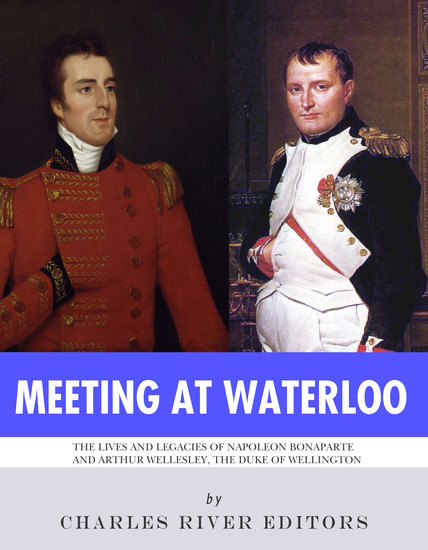
Meeting at Waterloo - The Lives and Legacies of Napoleon Bonaparte and Arthur Wellesley the Duke of Wellington - cover

Meeting at Waterloo - The Lives and Legacies of Napoleon Bonaparte and Arthur Wellesley the Duke of Wellington

Editors Charles River

Editorial: Charles River Editors

  • 0
  • 0
  • 0

Sinopsis

When historians are asked to list the most influential people of the last 200 years, a handful of names might vary, but there is no question that the list will include Napoleon Bonaparte (1769-1821), the most successful French leader since Charlemagne and widely acknowledged one of the greatest generals ever. Indeed, Napoleon was likely the most influential man of the 19th century, leaving an indelible mark on everything from the strategy and tactics of warfare to the Napoleonic Code that drafted laws across the continent. To defeat Napoleon, the Europeans had to form large coalitions multiple times, which helped bring about the entangling alliances that sparked World War I after Europe was rebuilt following Waterloo and the Congress of Vienna. Napoleon’s influence on the United States was also palpable. To finance his endeavors, he struck a deal with President Thomas Jefferson that became the Louisiana Purchase, and it was Napoleonic warfare that was used throughout the Civil War, leading to massive casualties because the weaponry of the 1860s was now more advanced than the tactics of 1815.
 
When Napoleon died at St. Helena, he still engendered fear and distaste among the Europeans, but the man and his legacy continued to be held in awe across the world. In Napoleon’s time, emperors and leaders still hoped to become the next Julius Caesar. After the Napoleonic Era, emperors and generals hoped to become the next Napoleon. For the next century, military leaders and even civilians struck Napoleonic poses when having their pictures taken, and phrases like “Napoleonic complex” and “meeting one’s Waterloo” are now common phrases in the English lexicon. It would be truly impossible to envision or understand geopolitics in the West over the last two centuries without Napoleon.
 
With the passage of time, Napoleon’s legacy has had time to crystallize, but the legends, myths, and controversies about the man and his empire continue to swirl. Was he really short? Did his men shoot the nose off the Sphinx? Was he a good chess player? Was he poisoned by the British? In the rush to analyze his stunningly successful military record or question whether he was very short or a great chess player, people often overlook his political reign and personality.
 
In September 1852, a steam train carried the body of Arthur Wellesley, First Duke of Wellington, from Kent to London, where he was to be interred at St. Paul’s Cathedral after a huge state funeral. A million would flock to pay their final respects, and young Queen Victoria wept openly, lamenting that “his loss will be quite irreparable”.
 
By the time of his death, Wellington had been prime minister twice, a shrewd personal advisor to four British monarchs and one of the nation’s most prominent politicians for three decades.  But despite his nearly four decades of peacetime service in and out of politics, Wellington has remained one of the titans of the 19th century because of one June day in 1815. Then, as now, the Duke of Wellington is best remembered for defeating Napoleon in the most famous battle of modern history at Waterloo.
 
Even then, the fact Wellington is remembered for Waterloo belies his extraordinary military career, which saw him come up through fighting in the Netherlands and India before opposing Napoleon’s forces on the Iberian Peninsula for several years. By the time Wellington took command of allied forces during the Hundred Days Campaign and decisively finished the Napoleonic Era at Waterloo, he had participated in about 60 battles and was one of Britain’s greatest war heroes.
 
Historical memory of Wellington often stops there, but he spent half his lifetime in politics after Waterloo, serving as a prime minister in the 1820s and an influential Tory in the House of Lords in the 1830s and 1840s, serving all the while as Commander-in-Chief of Britain’s military. 
Disponible desde: 06/06/2025.
Longitud de impresión: 99 páginas.

Otros libros que te pueden interesar

  • Brown Neon - cover

    Brown Neon

    Raquel Gutierrez

    • 0
    • 0
    • 0
    A meditation on southwestern terrains, intergenerational queer dynamics, and surveilled brown artists that crosses physical and conceptual borders. 
     
    Part butch memoir, part ekphrastic travel diary, part queer family tree, Raquel Gutiérrez’s debut essay collection, Brown Neon, gleans insight from the sediment of land and relationships. For Gutiérrez, terrain is essential to understanding that no story, no matter how personal, is separate from the space where it unfolds.  
     
    Whether contemplating the value of adobe as both vernacular architecture and commodified art object, highlighting the feminist wounding and transphobic apparitions haunting the multigenerational lesbian social fabric, or recalling a failed romance, Gutiérrez traverses complex questions of gender, class, identity,  
    and citizenship with curiosity and nuance.
    Ver libro
  • Death on Ireland's Eye - The Victorian Murder Trial that Scandalised a Nation - cover

    Death on Ireland's Eye - The...

    Dean Ruxton

    • 0
    • 0
    • 0
    A tragic death, a murder trial and a 170-year-old mystery – but what really happened?
    Shortly after Maria Kirwan died in a lonely inlet on Ireland's Eye, it was decided that she had drowned accidentally during a day spent with her husband on the picturesque island. This inquest verdict appeared to conclude the melancholy events that consumed the fishing village of Howth, Co Dublin, in September 1852.
    But not long afterwards, suspicion fell upon Maria's husband, William Burke Kirwan, as whispers of unspeakable cruelty, an evil character and a secret life rattled through the streets of Dublin. Investigations led to William's arrest and trial for murder.
    The story swelled into one of the most bitterly divisive chapters in the dark annals of Irish criminal history. Yet questions remain: Does the evidence stand up? What role did the heavy hand of Victorian moral outrage play? Was William really guilty of murder, or did the ever-present 'moral facts' fill in gaps where hard proof was absent?
    Now, this compelling modern analysis revisits the key evidence, asking sober questions about the facts, half-facts and fantasies buried within the yellowed pages of the Ireland's Eye case files.
    Ver libro
  • The Diary of a God - From their pens to your ears genius in every story - cover

    The Diary of a God - From their...

    Barry Pain

    • 0
    • 0
    • 0
    Barry Eric Odell Pain was born at 3 Sydney Street in Cambridge on 28th September 1864. He was one of 4 children. 
    He was educated at Sedbergh School and then Corpus Christi College, Cambridge where he read classics and contributed to and edited Granta. 
    Four years of service as an Army coach followed before he moved to London. In 1889, Cornhill Magazine published his short story ‘The Hundred Gates’.  This opened the way for Pain to advance his literary career on several fronts. He became a contributor to Punch and The Speaker, as well as joining the staff of both the Daily Chronicle and Black and White.  
    In 1897 he succeeded Jerome K Jerome as editor of To-Day but still contributed regularly, until 1928, to the Windsor Magazine. 
    It is often said that Pain was discovered by Robert Louis Stevenson, who compared his work to that of Guy de Maupassant.  It’s an apt comparison. Pain was also a master of disturbing prose but able to inject parody and light comedy into many of his works.  A simple premise could in his hands suddenly expand into a world very real but somehow emotionally fraught and on the very edge of darkness as many of these short stories demonstrate.   
    Despite applying his talents to several genres and forms today Pain is more readily thought of, especially during the first decade of the 20th Century, as perhaps the leading British humorist of his day.  These stories reveal a darker side and beg to differ. 
    Barry Pain died on 5th May 1928 in Bushey, Hertfordshire.
    Ver libro
  • Disappeared for Good - A Memoir of Finding God's Goodness in the Midst of Trauma - cover

    Disappeared for Good - A Memoir...

    Jeanne Griener

    • 0
    • 0
    • 0
    In January 1972, my beloved teen brother, Richard, was late coming home from sledding. Extensive searches yielded no indication of Richard’s whereabouts. No one reported seeing or hearing anything that helped. We found no sled, no gloves, no hat… 
    And no Richard.                         
    He had vanished without a trace. There was not one solid clue for my parents or the police to investigate. How did life go on after a loved one goes missing? My 11-year-old self was grieved and confused. Was Richard someone’s captive? Was he being hurt? Would the police advocate for Richard? Who could I trust? Who would help? What was now a normal day? Life became insane. 
    So began an endless cycle of searches, ransom calls, and police investigations. Unanswered questions swirled with dashed hopes to make a slurry of heartache. I blocked out the trauma. The ever-present need for closure left me anxious and angry. I was angry with the police, my parents, myself, and, even God. My faith in Jesus, fragile as a snowflake, had melted. 
    Did God overlook evil? Did I have to forgive? Who received Mercy? And what about Justice? As I matured, my yearning for these answers actually led me to find Jesus as Lord. Together we traversed these faith-crushing questions to glean true faith. 
    Despite years of living in the traumatic chaos of an unsolved crime against my family, I found answers in Jesus. I hope my journey of faith will inspire you to find God’s Goodness. His Love never fails.
    Ver libro
  • Modern Nations - The Making of Australia New Zealand and Māori Identity (2 in 1) - cover

    Modern Nations - The Making of...

    Lillian Brooks

    • 0
    • 0
    • 0
    "Modern Nations: The Making of Australia, New Zealand, and Māori Identity (2 in 1)" explores the transformative journey of two nations as they evolved from colonial settlements into independent, modern states, while also examining the ongoing struggle for recognition and identity among Indigenous communities. This two-part volume captures the complex and often challenging histories that shaped Australia and New Zealand, revealing how these countries forged their national identities amidst cultural clashes, political shifts, and social change.  
    The first section, The Making of Modern New Zealand, traces New Zealand's path from British colony to sovereign nation, highlighting the impact of European settlement, the Treaty of Waitangi, and the ongoing fight for Māori rights and cultural preservation.  
    The second section, History of Australia, explores the formation of modern Australia — from its origins as a British penal colony to its emergence as a diverse and independent nation — while also acknowledging the profound and lasting effects of colonization on Aboriginal communities.  
    Together, these narratives provide a comprehensive understanding of how colonial histories, Indigenous resistance, and nation-building efforts have shaped the modern identities of Australia, New Zealand, and their Indigenous peoples. This book is an essential resource for anyone seeking to understand the dynamic and often contested histories that continue to influence these nations today.
    Ver libro
  • Never Enough Zeroes - cover

    Never Enough Zeroes

    Joel Soper, Philip Wyeth

    • 0
    • 0
    • 0
    When Joel Soper placed his first “sure thing” bet at the Detroit Race Course back in 1987, he never imagined that such an innocent gesture might lead him down the path to gambling addiction. But now, after tossing millions of dollars into the bonfire of unfulfilled dreams, Joel is stepping out of the shadows to bare his soul about the realities of compulsive sports betting. 
    Never Enough Zeroes is an unflinching and searing portrayal that exposes the all-too-human foibles of a man trapped on the treadmill of obsession. Co-author Philip Wyeth captures the essence of Joel’s tortured existence by telling his unforgettable life story with compassion, humor, and literary flair. 
    The result is a memoir that will touch readers from all backgrounds as it throws a lifeline to anyone caught in the relentless undertow of addiction who also dreams of creating a better version of themselves. 
    “I’ve made millions of dollars with my silver tongue, but it always just slips through my fingers...” 
    As more states legalize gambling across the nation, Joel’s story is an especially timely warning about this scourge where losses often extend beyond money into broken relationships and mental health issues. The proliferation of live betting has the potential to turn a generation of unwitting sports fans into nothing more than rats frantically tapping their phone screens for the next dopamine rush. 
    This book is a call to action! It raises a banner of hope amid a sea of desperation, and signals the start of a new alliance which is weaving a safety net so that addicts of all stripes might never hit rock bottom again. 
    As Joel continues his difficult journey as a “work in progress,” he hopes that Never Enough Zeroes will be a worthy addition to the self-help canon, as well as a companion piece to the mental health professional’s bookshelf. 
    “If you know you’re powerless over gambling, how can you make gambling powerless over you?”
    Ver libro