¡Acompáñanos a viajar por el mundo de los libros!
Añadir este libro a la estantería
Grey
Escribe un nuevo comentario Default profile 50px
Grey
Suscríbete para leer el libro completo o lee las primeras páginas gratis.
All characters reduced
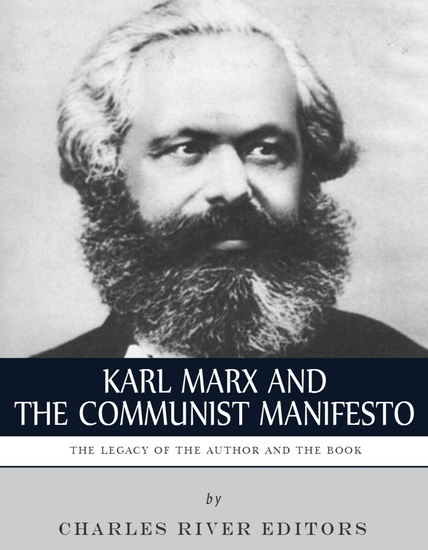
Karl Marx & The Communist Manifesto - The Life and Legacy of the Author and Book - cover

Karl Marx & The Communist Manifesto - The Life and Legacy of the Author and Book

Editors Charles River

Editorial: Charles River Editors

  • 0
  • 0
  • 0

Sinopsis

It would be almost impossible to exaggerate the influence Karl Marx has had upon the world in the last 150 years. Marx was an influential historian, journalist and economist who is widely considered one of the first social scientists, but he is best remembered for advocating socialism, particularly the brand that would take his name. As the father of Marxism, Marx predicted that capitalistic societies, ruled by a “dictatorship of the bourgeoise”, would eventually give way via class struggles to a “dictatorship of the proletariat”, and eventually to a more stateless form of communism.


Marx certainly wasn’t the first to espouse these kinds of political views, but nobody before or since had as much influence in actually bringing about the implementation of their ideas. Working with Friedrich Engels and others, Marx went about authoring a series of works, most notably The Communist Manifesto (1848) and Capital (1867-1894), championing his ideas.


The Communist Manifesto is in several respects a paradoxical document.  A product of the Western European political struggles that culminated in the pan-European Revolutions of 1848, its greatest historical impact was nevertheless not felt until the following century, in countries far from Western Europe (Russia and China) that Marx and Engels would never have viewed as ripe for revolutionary activity.  The Manifesto was written as a diagnosis of the ills of what is often called high industrial capitalism, yet in many ways the world it describes, in which “all that is solid melts into air,” sounds more like a prediction of a globalized capitalist world of political flux, virtual life, and accelerated time than a description of Marx’s era, in which monarchies and established churches still wielded immense power across Europe.  Moreover, although the best-known attempts to put Marx’s and Engels’s program into practice failed and are now in almost universal disrepute, the fundamental contradictions and deadlocks of capitalist society they present so vividly are still awaiting adequate remedies. 


While Marx laid out the ideological groundwork, many put it into action, leading to the formation of socialist powers in the Soviet Union and China during the first half of the 20th century. Marx’s writings and philosophy had an impact on the social sciences and economic theories, but one of his biographers could comfortably and accurately assert that the political history of the 20th century was “Marx’s legacy”. Whether fairly or not, in the West Marx has become inextricably linked with some of the totalitarian excesses of the regimes that claimed to espouse his ideology, and for that reason Marx is often associated with some of the negative connotations that come with the Soviets. Nevertheless, few would deny the very decisive impact Marxism had on the global landscape, and the ramifications continue to have a political influence today.


Karl Marx and The Communist Manifesto chronicles the life of the revolutionary socialist and his seminal work, analyzing its ideological themes and its influential and enduring legacy. Along with pictures of important people, places and events, you will learn about Marx and the Manifesto like you never have before, in no time at all.
Disponible desde: 28/05/2025.
Longitud de impresión: 85 páginas.
Otros libros que te pueden interesar

  • The Dark Side of Winston Churchill - Unmasking The Complexity of The Man Behind The Myth - cover

    The Dark Side of Winston...

    Davis Truman

    • 0
    • 0
    • 0
    This audiobook is narrated by an AI Voice.   
    What if the hero of World War II wasn’t as heroic as history remembers? 
    Winston Churchill is widely celebrated as the indomitable leader who stood against tyranny and rallied a nation in its darkest hour. But behind the rousing speeches and iconic persona lies a far more complicated figure—one whose decisions, beliefs, and actions raise hard questions about power, privilege, and morality. 
    The Dark Side of Winston Churchill strips away the myth to reveal the man—and forces us to confront the full truth of his legacy. 
    This provocative and deeply researched book examines the contradictions, controversies, and consequences of Churchill’s political career, from his involvement in the Bengal Famine and colonial repression to his perspectives on race, empire, and social class. Drawing on primary sources, personal letters, and historical records, it paints a nuanced portrait of a man revered by some and reviled by others. 
    Inside, you’ll discover: 
    How Churchill’s imperialist ideology shaped British policies from India to Africa 
    His controversial decisions during World War II—and their human cost 
    The political maneuvering and rhetoric that built his myth while obscuring uncomfortable truths 
    How Churchill’s legacy continues to influence modern politics, nationalism, and historical memory 
    History isn’t just what we remember—it’s also what we choose to forget. 
    👉 Buy The Dark Side of Winston Churchill today and take a bold step beyond the myth.
    Ver libro
  • The Brothers of the Shining Robe - cover

    The Brothers of the Shining Robe

    Manly P. Hall

    • 0
    • 0
    • 0
    In this rare and mystical work, Manly P. Hall unveils the hidden thread of spiritual brotherhood that guides the evolution of humanity from behind the veil. The Brothers of the Shining Robe refers to the invisible order of Initiates, Sages, and Adepts who, throughout the ages, have silently labored for the advancement of truth, beauty, and enlightenment on Earth. 
    Through poetic symbolism and philosophical insight, Hall traces the legacy of these hidden guardians—from ancient Egypt and Greece to the esoteric schools of the East and the secret societies of the modern West. He explores their doctrines, their sacred duty to the soul of the world, and their constant battle against ignorance and materialism. 
    More than a history, this book is a spiritual call to remembrance: that there are still those who wear the shining robe—not of cloth, but of light—and who work for the regeneration of the human spirit. Their presence is known not by words, but by their silent wisdom and unwavering service.
    Ver libro
  • Falklands War - History of Its Causes Consequences and Casualties - cover

    Falklands War - History of Its...

    Kelly Mass

    • 0
    • 0
    • 0
    The Falklands War (Guerra de las Malvinas) was a brief but intense conflict in the South Atlantic between Argentina and the United Kingdom. Fought over the sovereignty of the Falkland Islands and their territorial dependencies—South Georgia and the South Sandwich Islands—the war lasted from April to June 1982. The confrontation marked a significant chapter in the longstanding dispute between the two nations over these remote territories. 
    On April 2, 1982, Argentina launched an invasion of the Falkland Islands, quickly seizing control. The following day, Argentine forces invaded South Georgia. These aggressive actions were framed by the Argentine government as a reclamation of their sovereign territory, asserting claims they had maintained since the early 19th century. However, the United Kingdom, viewing the invasion as an attack on a British Crown colony, responded decisively. On April 5, the British government dispatched a naval task force to the South Atlantic. After intense naval and air engagements, the British launched an amphibious assault on the islands. The conflict concluded 74 days later, on June 14, 1982, with Argentina’s surrender and the restoration of British control over the islands.
    Ver libro
  • The Healing Tree - Botanicals Remedies and Rituals from African Folk Traditions - cover

    The Healing Tree - Botanicals...

    Stephanie Rose Bird

    • 1
    • 0
    • 0
    “A beautiful blend of folklore, botanical science, acquired wisdom, and spiritual guidance.” —from the foreword by Luisah Teish   “If you want to learn about the reciprocal spiritual connection between humans and trees, you’re going to love this beautiful book.” —Tess Whitehurst, author of The Magic of Trees   Reclaiming traditional botanical and herbal practices has never been more important than it is today. So much of our future depends on our ability to use ancient earth knowledge. In this crucially important book, author Stephanie Rose Bird recounts the story of the sacred wood: how to live in it, learn from it, and derive spiritual enrichment from it, as well as how to preserve and protect it. The Healing Tree offers functional, accessible recipes, remedies, and rituals derived from a variety of African and African American traditions to serve mind, body, soul, and spirit.The Healing Tree celebrates the forest: its powers, spirits, magic, medicine, and mysteries. Bird shares how trees have provided her with personal healing, then allows us to share in that process for our own benefit. Bird’s book follows her own personal journey, but Africa is always her touchstone—the persistent and tenacious ancestral mother wisdom and spiritual foundation that refuses to fade away. The Healing Tree preserves this knowledge, presenting it as relevant and viable and demonstrating in intimate detail how vestiges of that knowledge took root in the Western Hemisphere, in African American culture, and more broadly in American culture in general.   Previously published as A Healing Grove, this updated edition includes a new preface by the author and a source guide for the botanicals discussed within.
    Ver libro
  • Public Speaking Topic Secrets - cover

    Public Speaking Topic Secrets

    Ramakrishna Reddy

    • 0
    • 0
    • 0
    Stuck for a speech presentation because of lack of a speech topic idea?  
    Do you want to rock at your college, community, or TED talks?  
    Public Speaking Topic Secrets will help you discover your perfect topic. You'll be able generate topics based on your purpose, whether you want to inform, entertain, persuade, or inspire.  
    You'll discover 70+ pathways to help you find the best speech topic idea that you'd love to present. Stop wasting days and nights thinking of a speech topic... 
    Listen to this book, and get a speech topic in less than one hour!
    Ver libro
  • Second Crusade The: The History of the Controversial Campaign that Led to the Collapse of the Crusader States - cover

    Second Crusade The: The History...

    Charles River Editors

    • 0
    • 0
    • 0
    In the 50 years following the First Crusade, the Latin states in the East were consolidated, but there were also growing tensions and new challenges. Against this backdrop, the fall of the County of Edessa in December 1144 at the hands of Zengi, the atabeg of Aleppo and Mosul, was a catastrophic event. Founded in 1098 by the future King Baldwin of Boulogne, Edessa was the first Crusader state, as well as the northernmost, weakest, and least populated. It was constantly exposed to Muslim attacks, and news of its fall reached Europe at the beginning of 1145, and the fall was the catalyst for the Second Crusade. Furthermore, the Crusader states were also concerned about their relationship with the Byzantine Empire. Relations with the Empire were often tense. As early as 1105, Bohemond of Antioch travelled to the West in search of troops to fight the Muslims while concealing his intention to attack parts of the Byzantine Empire. He reportedly obtained papal acquiescence, though not an explicit bull.  
    Historically, writers have given little prominence to the Second Crusade because of its failure, and it is understandably overshadowed by the triumphant First Crusade and the more captivating Third Crusade. For a long time, historiography attributed a central role to Bernard of Clairvaux, sometimes portraying him as the sole architect of the enterprise due to the political difficulties experienced by Pope Eugene III in Rome. However, more recent studies have re-evaluated the Pope's role, emphasizing his commitment to planning and coordinating the crusade through a network of legates and advisors. Contrary to the portrayal of him as a naïve monk, Eugene III had a profound grasp of the dynamics of crusading and the boundaries of Christendom, which informed his bull and overall strategy. Another historiographical issue concerns the scope of the crusade itself:
    Ver libro