Junte-se a nós em uma viagem ao mundo dos livros!
Adicionar este livro à prateleira
Grey
Deixe um novo comentário Default profile 50px
Grey
Assine para ler o livro completo ou leia as primeiras páginas de graça!
All characters reduced
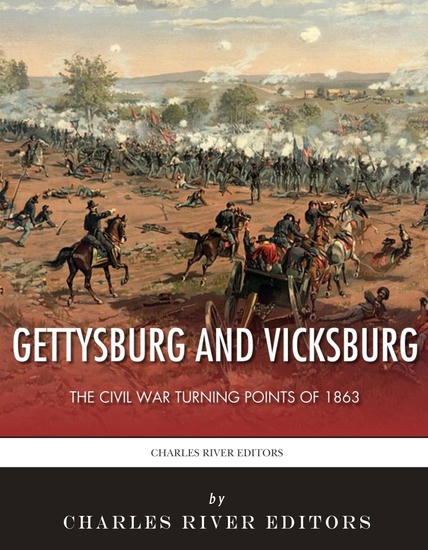
Gettysburg and Vicksburg - The Civil War Turning Points of 1863 - cover
LER

Gettysburg and Vicksburg - The Civil War Turning Points of 1863

Editors Charles River

Editora: Charles River Editors

  • 0
  • 0
  • 0

Sinopse

Without question, the most famous battle of the American Civil War took place outside of the small town of Gettysburg, Pennsylvania, which happened to be a transportation hub, serving as the center of a wheel with several roads leading out to other Pennsylvanian towns. From July 1-3, Robert E. Lee’s Confederate Army of Northern Virginia tried everything in its power to decisively defeat George Meade’s Union Army of the Potomac, unleashing ferocious assaults that inflicted nearly 50,000 casualties in all.
 
Day 1 of the battle would have been one of the 25 biggest battles of the Civil War itself, and it ended with a tactical Confederate victory. But over the next two days, Lee would try and fail to dislodge the Union army with attacks on both of its flanks during the second day and Pickett’s Charge on the third and final day. Meade’s stout defense held, barely, repulsing each attempted assault, handing the Union a desperately needed victory that ended up being one of the Civil War’s turning points.
 
After the South had lost the war, the importance of Gettysburg as one of the “high tide” marks of the Confederacy became apparent to everyone, making the battle all the more important in the years after it had been fought. While former Confederate generals cast about for scapegoats, with various officers pointing fingers at Robert E. Lee, James Longstreet, and James Stuart, historians and avid Civil War fans became obsessed with studying and analyzing all the command decisions and army movements during the entire campaign. Despite the saturation of coverage, Americans refuse to grow tired of visiting the battlefield and reliving the biggest battle fought in North America.
 
At the start of 1863, Robert E. Lee’s Army of Northern Virginia had been frustrating the Union in the Eastern theater for several months, but the situation in the West was completely different. The Confederates had lost control of several important states throughout 1862, and after New Orleans was taken by the Union, the North controlled almost all of the Mississippi River, which Confederate general James Longstreet called “the lungs of the Confederacy”. By taking control of that vital river, the North would virtually cut the Confederacy in two, putting the South in a dire situation.
 
The only domino left to fall was the stronghold of Vicksburg, and both sides knew it. The Union Army of the Tennessee, led by Ulysses S. Grant, would spend months trying to encircle the army and eventually force John Pemberton’s Confederate army to surrender. Grant eventually succeeded on July 4, 1863, but since it came a day after the climactic finish of the Battle of Gettysburg, Vicksburg was (and still is) frequently overlooked as one of the turning points of the Civil War. In fact, had the Confederate’s military leadership listened to Longstreet, who advocated detaching soldiers from Lee’s army to head west and help the Confederates deal with Grant or Rosecrans in that theater, the Battle of Gettysburg might never have happened.
 
On April 30, 1863, Grant finally launched the successful campaign against Vicksburg, marching down the western side of the Mississippi River while the navy covered his movements. He then crossed the river south of Vicksburg and quickly took Port Gibson on May 1, Grand Gulf on May 3, and Raymond on May 12.  Realizing Vicksburg was the objective, the Confederate forces under the command of Pemberton gathered in that vicinity, but instead of going directly for Vicksburg, Grant took the state capital of Jackson instead, effectively isolating Vicksburg. Pemberton’s garrison now had broken communication and supply lines. With Grant in command, his forces won a couple of battles outside Vicksburg at Champion Hill and Big Black River on May 16 and 17, forcing Pemberton’s men into Vicksburg and completely enveloping it. Soonafter, Grant and his men settled into a nearly two month long siege.
Disponível desde: 02/05/2025.
Comprimento de impressão: 124 páginas.
Outros livros que poderiam interessá-lo

  • Economic Landscape of Puerto Rico - Historical Perspectives - cover

    Economic Landscape of Puerto...

    Anya Solace

    • 0
    • 0
    • 0
    Puerto Rico’s economic landscape has been shaped by centuries of historical, political, and social transformations. From the indigenous societies that first inhabited the island to its complex relationship with Spain and the United States, the economy has evolved in response to shifting global and regional forces. Understanding Puerto Rico’s economic foundations requires an examination of its early economic structures, the colonial period’s trade policies, and the profound effects of U.S. annexation. These key moments set the stage for the challenges and opportunities that have defined the island’s development.  
    Before European colonization, the indigenous Taíno people sustained themselves through subsistence agriculture, fishing, and trade with neighboring Caribbean islands. Their economy, though not based on large-scale commerce, was well-adapted to the island’s resources. With the arrival of the Spanish in 1493, Puerto Rico was integrated into Spain’s mercantilist system, marking the beginning of an economic transformation that would prioritize colonial extraction over local prosperity. The Spanish introduced new crops such as sugarcane and coffee, which would later become vital to the island’s economy. However, strict trade regulations limited Puerto Rico’s ability to develop independently, as it was required to conduct commerce exclusively with Spain.  
    During the 18th and 19th centuries, Puerto Rico transitioned into a plantation-based economy, with sugar and coffee emerging as dominant industries. Enslaved Africans and later immigrant laborers contributed to the agricultural boom, making the island a key supplier to European and American markets. Despite periods of growth, the economy remained vulnerable to global price fluctuations, natural disasters, and restrictive colonial policies. By the time of the Spanish-American War in 1898, Puerto Rico’s economy was still largely agrarian, with limited industrial development.
    Ver livro
  • Vegetius: Epitome of Military Science - Epitome of Military Science - cover

    Vegetius: Epitome of Military...

    Flavius Vegetius Renatus

    • 0
    • 0
    • 0
    The only Latin art of war to survive, Vegetius’ Epitome was for long a part of the medieval prince’s military education. The core of his proposals, the maintenance of a professional standing army, was revolutionary for medieval Europe, while his theory of deterrence through strength remains the foundation of modern Western defence policy.
    Ver livro
  • The Last Bushrangers - cover

    The Last Bushrangers

    Anônimo

    • 0
    • 0
    • 0
    The story of Australia's last bushranging gang - the murderous Kenniffs. 
      
    Easter Sunday, 1902, deep in the Carnarvon Ranges a police constable and station manager are slain then later incinerated, their remains stuffed into saddlebags. Accused of the ghoulish crime are two members of the bushranging Kenniff gang, fast gaining notoriety as Queensland's equivalent of the Kelly gang. Yet the murders are a bold escalation from the petty fraud, horse stealing and cattle duffing the gang is known for. 
    Starving and exhausted after three long months on the run, the brothers are finally captured, and so the wheels of justice start to turn. 
    The story of the Kenniffs has fascinated Mike Munro for decades - ever since he found out these last bushrangers were his family. If not for Mike's grandfather illegally changing his name in shame from Kenniff to Munro, this major figure in Australian television would be known to us as Mike Kenniff. 
    But who were Mike's relatives? What drove them to their life of crime? And were the brothers really responsible for such terrible murders? 
    In answering these questions Mike Munro takes us back to the dawn of Federation, when bush skills and horsemanship could help outlaws escape the police, when remote pastoralists were vulnerable targets for thieves and marauders, when race and class divides were entrenched - but resented - and when brutal, feckless outlaws faced the ultimate punishment. 
    This is a story that is both gripping and personal, and an insight into an Australia just coming of age. 
    PRAISE FOR THE LAST BUSHRANGERS 
    'All families have a secret ... but Mike's is a doozy! This touching, TRUE story is a terrific read!' Di Morrissey 
    'A thoroughly informed, lively and balanced page-turner' Steven Carroll, Sydney Morning Herald
    Ver livro
  • The Little Girl Who Could Not Cry - cover

    The Little Girl Who Could Not Cry

    Lidia Maksymowicz, Paolo Luigi...

    • 0
    • 0
    • 0
    The No. 1 international bestseller, with a foreword written by His Holiness Pope Francis, who made headlines in 2021 when he kissed Lidia's Auschwitz identification tattoo.The unforgettable, moving true story of the little girl who survived Auschwitz's 'Angel of Death', Dr Mengele. Lidia was just three years old when she arrived in Auschwitz-Birkenau with her mother, a member of the partisan resistance from Belarus. The bewildered little girl was picked out by Dr Josef Mengele for his sadistic experiments and sent to the infamous children’s block, where every day was a fight for survival. In eighteen months of hell she came close to death more than once.Her mother, who risked her life to visit Lidia, gave her strength. But when the camp was liberated, her mother was gone, presumed dead. Lidia, by now deeply traumatised, was adopted by a Polish woman. But then, in 1962, she discovered that her birth parents were still alive in the USSR, and Lidia was faced with an agonising choice . . .Lidia’s extraordinary story has touched hearts around the world, and she has made it her mission to bear witness to the Holocaust so that the truth may never be forgotten. This is a powerful and ultimately hopeful account by a remarkable woman who refuses to hate those who hurt her. She says, ‘Hate only brings more hate. Love, on the other hand, has the power to redeem.’'Unforgettable' - Daily MailThe Little Girl Who Could Not Cry is also published in paperback as A Little Girl in Auschwitz.
    Ver livro
  • Thrive Women: Unleash Your Hidden Power - "Awaken your strengths with 'Thrive Women'—powerful audio lessons crafted to ignite your inner drive!"Solomon Wrecker - cover

    Thrive Women: Unleash Your...

    Solomon Wrecker

    • 0
    • 0
    • 0
    Thrive Women: Unleash Your Hidden Power  
    ⭐⭐ Simplified Guide & Explanations Included ⭐⭐  
    Are you striving to advance in your career and enhance your expertise to unlock your potential, achieve greatness, and inspire others?   
    In search of a thorough guide that encompasses everything you need to realize your aspirations?   
    Look no further!   
    This guide is your ultimate companion for deepening your insights, honing your skills, and engaging in practical activities. With this resource in hand, you're destined for success.   
    Updated to reflect the latest insights and strategies for personal growth.  
    Key features of this enriching guide:  
    - In-depth knowledge about unlocking your potential   
    - Comprehensive explanations of techniques for achieving greatness   
    - Effective strategies for preparation and execution   
    Our guide stands out through its extensive coverage, which is crucial for your path to success. Concepts are examined in detail rather than just superficially addressed.   
    Structured clearly and written in accessible language, our guide provides smooth transitions between topics. Bid farewell to complicated jargon and embrace clear, concise, and accurate content.   
    So, why wait? Click the BUY NOW button, secure your guide, and embark on your journey to achieve greatness today!   
    Thrive Women: Unleash Your Hidden Power awaits your exploration!
    Ver livro
  • Let's Eat With Grandma - cover

    Let's Eat With Grandma

    Kim Mitzo Thompson, Karen Mitzo...

    • 0
    • 0
    • 0
    Kids will love this playful story about a family having dinner together and a grandma that enjoys cooking dinner for her family. Simple sentence structures and repetitive words will encourage young children to fall in love with learning to read.  Kids will enjoy following along word-for-word with the recorded story that features sound effects and professional voices to help children develop vocabulary and improve listening skills.  This reader features adorable art showing diversity to help children form a sense of acceptance and understanding of different races and individual differences.
    Ver livro