¡Acompáñanos a viajar por el mundo de los libros!
Añadir este libro a la estantería
Grey
Escribe un nuevo comentario Default profile 50px
Grey
Suscríbete para leer el libro completo o lee las primeras páginas gratis.
All characters reduced
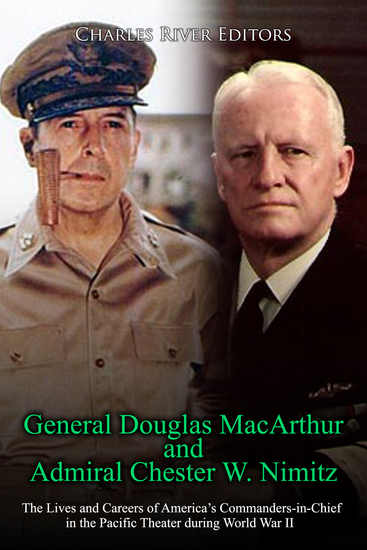
General Douglas MacArthur and Admiral Chester W Nimitz - The Lives and Careers of America’s Commanders-in-Chief in the Pacific Theater during World War II - cover

General Douglas MacArthur and Admiral Chester W Nimitz - The Lives and Careers of America’s Commanders-in-Chief in the Pacific Theater during World War II

Editors Charles River

Editorial: Charles River Editors

  • 0
  • 0
  • 0

Sinopsis

The Americans would eventually push the Japanese back across the Pacific, and one of the most instrumental leaders in the effort was Admiral Chester W. Nimitz, who commanded the U.S. Pacific Fleet and helped coordinate joint operations with the legendary General Douglas MacArthur, the Supreme Commander, Southwest Pacific Area. The ensuing strategies would lead to decisive operations at places like Midway, Iwo Jima, Okinawa, and others before the use of the atomic bombs compelled Japan’s surrender in August 1945.
 
Today, Nimitz’s name doesn’t ring as many bells as his counterpart’s, because of all the military men America produced during the 19th and 20th centuries, it’s hard to find one as important, successful, and controversial as General MacArthur. The son of a Civil War veteran, MacArthur rose to become the most instrumental commander in the Pacific Theater during World War II. His legendary return to the Philippines in 1944 made good on one of the war’s most famous vows, and it was MacArthur who fittingly oversaw the occupation and reconstruction of Japan following the war.
 
Given his long and celebrated career, MacArthur was the obvious choice to lead the newly created United Nations’ troops during the Korean War, but his arguments over war strategy and policy eventually led to his controversial firing by President Harry Truman in 1951. After that, in his own words, he “faded away,” living out his remaining days on the top floor of the Waldorf Hotel until his death in 1964. For many with a conservative disposition he remains a hero who, had he been listened to, would have prevented the current impasse with the rogue state that is modern North Korea. For some liberal thinkers he was dangerously obsessive while wholly ignorant of geopolitics, and he has been branded as a general who would have used atomic weapons and potentially triggered the third world war.
 
The truth is far more difficult to discern and much more subtle. Douglas MacArthur was one of the most intelligent soldiers America has produced, and he was also one of the most prominent statesmen of the 20th century. He made his mark from flamboyant staff officer in the Vera Cruz expedition of 1914 to United Nations Commander in the Korean War. Along the way he found fame in World War I, participated in the controversial Bonus Army incident, lost and won campaigns in World War II, and served as Army Chief of Staff, Superintendent at West Point and as effective ruler of Japan. Rarely out of the limelight, MacArthur was as much an administrator as he was a soldier and a combat commander, and in all of his endeavors he found success and controversy.
 
General Douglas MacArthur and Admiral Chester W. Nimitz: The Lives and Careers of America’s Commanders-in-Chief in the Pacific Theater during World War II chronicles the dramatic paths each one took on the way to becoming the two most important Americans in charge in the Pacific. Along with pictures of important people, places, and events, you will learn about General MacArthur and Admiral Nimitz like never before.
Disponible desde: 01/05/2025.
Longitud de impresión: 106 páginas.


Otros libros que te pueden interesar

  • The Feudal System - How Lords Vassals and Serfs Shaped Medieval Europe - cover

    The Feudal System - How Lords...

    Arlo Holders

    • 0
    • 0
    • 0
    Feudalism was a dominant social, economic, and political system in medieval Europe that shaped the lives of millions from the 9th to the 15th centuries. Rooted in the decline of the Roman Empire, it emerged as a response to the need for local defense, stability, and order. With the fall of centralized authority, particularly in the wake of the collapse of Roman imperial power, local leaders, and warriors filled the vacuum, giving rise to a new hierarchical structure that became the backbone of medieval society. 
    At the heart of feudalism was the relationship between lords and vassals, defined by a system of land ownership and mutual obligations. The land, or fief, was the most valuable asset in the feudal system. Lords, or landowners, granted portions of their land to vassals, typically in exchange for military service, loyalty, and other obligations. In return for this land, vassals swore an oath of fealty to their lord, pledging to serve him in times of war, provide counsel, and honor the lord’s authority. This bond was often formalized through ceremonies that emphasized loyalty and trust, making feudalism not just a legal arrangement but a deeply personal relationship. 
    In addition to the lord-vassal dynamic, serfs and peasants formed the labor force that sustained the feudal economy. While lords and vassals fought battles and governed lands, serfs worked the fields and managed agriculture, which was the primary source of wealth in the medieval world. Unlike slaves, serfs were bound to the land, unable to leave without their lord’s permission. In exchange for protection and the right to work the land, serfs provided a portion of their crops and other goods as rent.
    Ver libro
  • Inner Revolution Poetry 2 - Time for Surrender - cover

    Inner Revolution Poetry 2 - Time...

    Jan Wolter

    • 0
    • 0
    • 0
    This book has been compiled during pilgrimages in India and around the world capturing bhakti, the spiritual path of devotional service. 
    Herein one finds poems about the spiritual master, practicing bhakti, connecting to God and living a life of spiritual pursuit. 
    From the Foreword 
    The beauty of poetry is also practical. It is said in the Vedic scripture that to be a poet is one of the divine qualities possessed by devotees of the Lord. Like an ornament it enhances the character of a person, if he is using this poetry not for own sense gratification, but for glorification of the Supreme Person. That is the only work of a poet, namely to glorify the all-attractive person, literally Kṛṣṇa. 
    Words that do not glorify the All-attractive Person, Kṛṣṇa, are considered by saintly persons to be like places of pilgrimage for crows. Swan-like devotees who are actually residents of the kingdom of God do not derive any pleasure there. Thus, I follow in the footsteps of my spiritual teachers who were all expert poets and writers. 
    2016, as a believer and traveler I came to win back faith. Finding shelter with the wisdom texts of the Vedas, a doorway to self-realisation was opened. Self-realisation is nothing cheap, but the sole purpose of human existence. This human form of life is essentially meant for inquiring about the Absolute Truth. 
    When this mystical door opened, I had insight into spiritual truth, substantial, enlightened and blissful. In a state of meditation this spiritual drop touched my heart and I tried to get hold of it. Expressing my experiences in words of poetry helped to channel these spiritual visions and insights. 
    Hare Kṛṣṇa
    Ver libro
  • Reimagine Education: Empowering Minds for a Just Future - "Unlock your potential! Dive into engaging audio lessons that inspire a just future in education" - cover

    Reimagine Education: Empowering...

    Kellan Verity

    • 0
    • 0
    • 0
    Reimagine Education: Empowering Minds for a Just Future 
    ⭐⭐ Simplified Guide & Explanations Included ⭐⭐  
    Are you eager to advance in your career while enhancing your knowledge to unlock your potential and create impactful change for all?  
    Looking for a thorough guide that covers everything you need to succeed?  
    Your search ends here!  
    This guide acts as your ultimate resource for deepening your comprehension, applying your skills, and engaging in practical exercises, setting you on a path to success. 
    Updated for the latest 2024-2025 framework.  
    Highlights of this comprehensive guide include: 
    - In-depth insights into unlocking potential and creating impactful change for all. 
    - Comprehensive explanations surrounding the concept of empowerment through education. 
    - Effective strategies for preparation and execution. 
    Our guide stands out due to its thorough coverage, which is crucial for your success. Concepts are explored in depth rather than being glossed over.  
    Please note that this guide operates independently and is not affiliated with any official body, aiming purely to benefit you.  
    Crafted with a clear structure and accessible language, our guide ensures smooth transitions between topics. Say farewell to convoluted terminology and embrace clear, precise, and technically sound content. 
    So, why delay any longer? Click the BUY NOW button, secure your guide, and embark on your journey towards success in unlocking potential and creating impactful change for all!
    Ver libro
  • The Middle Temple Murder - cover

    The Middle Temple Murder

    J.S. Fletcher

    • 0
    • 0
    • 0
    "The Middle Temple Murder" by J. S. Fletcher is a detective novel set in the early 20th century, specifically during the post-World War I era. The story revolves around the mysterious death of an elderly man found dead in Middle Temple Lane, captivating readers with its intrigue and investigation.  
    The protagonist, Frank Spargo, is a newspaper sub-editor who becomes drawn into the murder investigation after discovering the body of the victim, John Marbury. Marbury's connection to the legal profession, as well as his association with a character named Ronald Breton, adds depth to the mystery.  
    At the beginning of the narrative, Spargo, after finishing a night shift at the newspaper office, stumbles upon a crime scene where Marbury has been reported dead. Intrigued by the circumstances, he learns that Marbury was found in a suspicious position, suggesting foul play. Spargo starts piecing together clues, including a scrap of paper found in Marbury’s pocket that bears Breton’s name and address, indicating a possible link between them. 
    As the story unfolds, it explores themes of deception, intrigue, and the complexities of the legal world, with Spargo and Breton working together to uncover the truth behind Marbury’s untimely death. The opening serves to set the stage for a complex mystery filled with unexpected connections and a quest for truth.
    Ver libro
  • The Joyous Cosmology - Adventures in the Chemistry of Consciousness - cover

    The Joyous Cosmology -...

    Alan W. Watts, Richard Alpert,...

    • 0
    • 0
    • 0
    A classic account of the psychedelic experience 


    The Joyous Cosmology is Alan Watts's exploration of the insight that the consciousness-changing drugs LSD, mescaline, and psilocybin can facilitate "when accompanied with sustained philosophical reflection by a person who is in search, not of kicks, but of understanding." More than an artifact, it is both a riveting memoir of Watts's personal experiments and a profound meditation on our perennial questions about the nature of existence and the existence of the sacred.
    Ver libro
  • The Investiture Controversy - Church Vs State - cover

    The Investiture Controversy -...

    Harris Ropes

    • 0
    • 0
    • 0
    The Investiture Controversy, one of the most defining struggles of the medieval period, had its roots in the growing tension between the secular rulers of Europe and the spiritual authority of the Church. This conflict emerged in a time when power structures were deeply intertwined, and the boundaries between church and state were neither clear nor firmly established. At the heart of the controversy was the question of who held the authority to appoint, or "invest," bishops and abbots—the emperor or the pope. 
    The Church had grown significantly in power and influence during the early Middle Ages, accumulating wealth, land, and political clout. By the 11th century, popes were increasingly assertive, seeking to reform the Church and free it from secular interference. The papacy, under reform-minded leaders, aimed to elevate the moral and spiritual authority of the Church above that of earthly rulers. This push was partly a response to widespread abuses, such as simony—the buying and selling of church offices—and lay investiture, where secular leaders granted religious titles and symbols of office to church officials. 
    On the other side, the Holy Roman Emperors viewed themselves as divinely appointed protectors of Christendom. They believed it was their right and duty to appoint bishops within their realms, not just as spiritual leaders but also as loyal administrators of imperial lands. In many parts of the empire, bishops held significant secular power and governed vast territories, making their appointment a matter of political importance as much as religious concern. For emperors like Henry IV, relinquishing control over these appointments threatened to weaken imperial unity and reduce their ability to govern effectively.
    Ver libro