¡Acompáñanos a viajar por el mundo de los libros!
Añadir este libro a la estantería
Grey
Escribe un nuevo comentario Default profile 50px
Grey
Suscríbete para leer el libro completo o lee las primeras páginas gratis.
All characters reduced
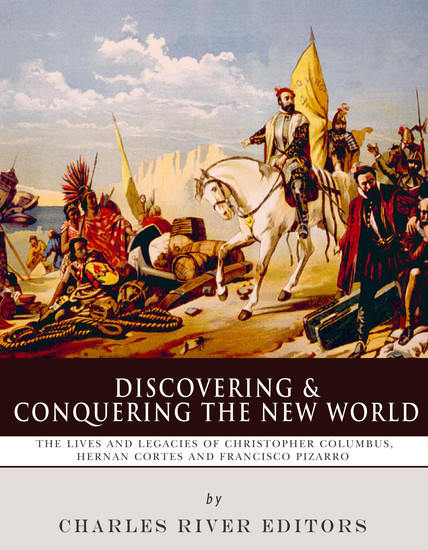
Discovering and Conquering the New World - The Lives and Legacies of Christopher Columbus Hernán Cortés and Francisco Pizarro - cover

Discovering and Conquering the New World - The Lives and Legacies of Christopher Columbus Hernán Cortés and Francisco Pizarro

Editors Charles River

Editorial: Charles River Editors

  • 0
  • 0
  • 0

Sinopsis

The most seminal event of the last millennium might also be its most controversial. As schoolchildren have been taught for over 500 years, “In 1492 Columbus sailed the ocean blue.” In October of that year, the Italian Christopher Columbus immortalized himself by landing in the New World and beginning the process of European settlement in the Americas for Spain, bringing the Age of Exploration to a new hemisphere with him. Ironically, the Italian had led a Spanish expedition, in part because the Portugese rejected his offers in the belief that sailing west to Asia would take too long.
 
Columbus had better luck with the Spanish royalty, successfully persuading Queen Isabella to commission his expedition. In August 1492, Columbus set west for India at the helm of the Nina, Pinta and Santa Maria. Befitting a legendary trip, the journey was star-crossed from the beginning. The Pinta’s rudder broke early on, and just days into the journey Columbus’ compass stopped pointing due north and started pointing to the Earth’s magnetic north pole, something the Europeans knew nothing about. Columbus knew that the uncertainty of the expedition’s destination made his crew nervous, so he hid his compass’ “malfunction” from his crew.  Additionally, after 30 days of sailing, the expedition still had not sighted land, so Columbus started lying to his crew about the distance they sailed each day, telling them they had sailed fewer miles than they actually had so as not to scare them even more. 
 
On October 7, 1492, the three ships spotted flocks of birds, suggesting land was nearby, so Columbus followed the direction in which the birds flew. On the night of October 11, the expedition sighted land, and when Columbus came ashore the following day in the Bahamas, he thought he was in Japan, but the natives he came into contact with belied the descriptions of the people and lands of Asia as wealthy and resourceful. Instead, the bewildered Columbus would note in his journal that the natives painted their bodies, wore no clothes and had primitive weapons, leading him to the conclusion they would be easily converted to Catholicism. When he set sail for home in January 1493, he brought several imprisoned natives back to Spain with him.
 
During the Age of Exploration, some of the most famous and infamous individuals were Spain’s best known conquistadors. Naturally, as the best known conquistador, Hernán Cortés (1485-1547) is also the most controversial. Like Christopher Columbus before him, Cortés was lionized for his successes for centuries without questioning his tactics or motives, while indigenous views of the man have been overwhelmingly negative for the consequences his conquests had on the Aztecs and other natives in the region. Just about the only thing everyone agrees upon is that Cortés had a profound impact on the history of North America.
 
If Columbus and Cortés were the pioneers of Spain’s new global empire, Pizarro consolidated its immense power and riches, and his successes inspired a further generation to expand Spain’s dominions to unheard of dimensions.  Furthermore, he participated in the forging of a new culture: like Cortés, he took an indigenous mistress with whom he had two mixed-race children, and yet the woman has none of the lasting fame of Cortés’s Doña Marina.  With all of this in mind, it is again remarkable that Pizarro remains one of the less well-known and less written about of the explorers of his age.
 
On the other hand, there are certain factors that may account for the conqueror of Peru’s relative lack of lasting glory.  For one, he was a latecomer in more than one sense.  Cortés’s reputation was built on being the first to overthrow a great empire, so Pizarro’s similar feat, even if it bore even greater fruit in the long run, would always be overshadowed by his predecessor’s precedent. 
Disponible desde: 20/06/2025.
Longitud de impresión: 110 páginas.

Otros libros que te pueden interesar

  • Brainwashing - Forcibly Changing Someone's Beliefs or Attitudes - cover

    Brainwashing - Forcibly Changing...

    Cito Harder

    • 0
    • 0
    • 0
    Brainwashing is a process that manipulates an individual’s thoughts, beliefs, and perceptions, often without their conscious awareness. It is rooted in psychological principles that exploit the way the human mind processes information, reacts to stress, and seeks social belonging. By systematically breaking down existing thought patterns and replacing them with new ones, brainwashing can reshape an individual’s identity, morality, and loyalty. Understanding the psychology behind this phenomenon reveals why it is so effective and why some people are more susceptible than others. 
    At its core, brainwashing relies on cognitive dissonance, a psychological state that occurs when a person holds conflicting beliefs or values. When subjected to persistent pressure, individuals experience discomfort and seek to resolve the inconsistency. This vulnerability makes them more likely to accept new ideas, especially if rejecting them would lead to further psychological distress. Manipulators use this to their advantage, gradually shifting a person’s perception by presenting them with controlled information while isolating them from opposing viewpoints. Over time, the person internalizes the new ideology, often without realizing they have been influenced. 
    Another key psychological mechanism in brainwashing is the use of repetition. The more frequently an idea is presented, the more familiar and acceptable it becomes. Studies in cognitive psychology suggest that repeated exposure to a particular message strengthens neural pathways, making certain thoughts or beliefs more automatic. This is why propaganda, advertising, and even extremist ideologies rely heavily on repetition—constant reinforcement solidifies the desired mindset. The brain, overwhelmed by a lack of alternative perspectives, begins to default to the new beliefs as truth.
    Ver libro
  • A Rare Recording of US Senator Frank Church Chairman of the Church Committee - cover

    A Rare Recording of US Senator...

    Senator Frank Church

    • 0
    • 0
    • 0
    Frank Forrester Church III (July 25, 1924 to April 7, 1984) was an American Democrat politician and lawyer. Church served as a U.S. Senator from Idaho from 1957 to 1981, and gained national prominence as chairman of the U.S. Senate Select Committee to Study Governmental Operations with Respect to Intelligence Activities, from 1975 through 1976, commonly known as the Church Committee, which conducted extensive hearings investigating extra-legal FBI and CIA intelligence-gathering and covert operations. The following recording is from a speech Church gave to the Women's Democratic League in 1975.
    Ver libro
  • Zen - The Authentic Gate - cover

    Zen - The Authentic Gate

    Yamada Koun

    • 0
    • 0
    • 0
    "Whether a beginner or at the highest level of practice, learn Zen from one of the greatest masters of the twentieth century.  
    Why practice Zen? What sets Zen apart from religion? What are its different practices?  
    These questions, and more, are examined and answered by Zen Master Koun Yamada, whose Dharma heirs include Robert Aitken, Ruben Habito, and David Loy. Through compelling stories and a systematic approach, he guides the reader through creating and sustaining a lifelong practice. Warm and ecumenical in tone, Koun uses the insights of Zen to bring a deeper understanding of faith.  
    Zen: The Authentic Gate is an easy-to-follow guide to creating an effortless and natural practice regardless of background, tradition, or religion."
    Ver libro
  • Universities on Fire - Higher Education in the Climate Crisis - cover

    Universities on Fire - Higher...

    Bryan Alexander

    • 0
    • 0
    • 0
    In 2019, intense fires in the San Francisco Bay Area closed universities and drove afflicted people to shelter at other campuses. At the same time, extraordinary fires ravaged eastern Australia. Several universities responded by promising material and research support to damaged businesses while also hosting refugees and emergency response teams in student residence halls. This was an echo of the devastation wreaked by Hurricane Katrina on Tulane University in 2005.In Universities on Fire, futurist Bryan Alexander explores higher education during an age of unfolding climate crisis. Powered by real-world examples and the latest research, Alexander assesses practical responses and strategies by surveying contemporary programs and academic climate research from around the world. He establishes a model of how academic institutions may respond and offers practical pathways forward for higher education. How will the two main purposes of education—teaching and research—change as the world heats up? Alexander positions colleges and universities in the broader social world, from town-gown relationships to connections between how campuses and civilization as a whole respond to this epochal threat.Current studies of climate change trace the likely implications across a range of domains, from agriculture to policy, urban design, technology, culture, and human psychology. However, few books have predicted or studied the effects of the climate crisis on colleges and universities. By connecting climate research to a deep, futures-informed analysis of academia, Universities on Fire explores how climate change will fundamentally reshape higher education.
    Ver libro
  • Revolutionary Movements and Their Outcomes - The Rise and Fall of Revolutionary Ideals (4 in 1) - cover

    Revolutionary Movements and...

    Arlo Holders

    • 0
    • 0
    • 0
    This book contains these 4 titles: 
    - The Rise of Anarchism  
    - The Populist Wave   
    - The Communist Experiment  
    - The Fall of Communism
    Ver libro
  • The Therapeutic School Approach - How to Embed Trauma-Informed Attachment-Aware Practices to Improve Outcomes for All Children - cover

    The Therapeutic School Approach...

    Shahana Knight

    • 0
    • 0
    • 0
    The Therapeutic School Approach offers teachers and school leaders a step-by-step guide to embedding a trauma-informed approach that is tangible, practical, and brings the underpinning science to life in a way that is relatable and relevant. Placing a keen focus on moving towards a more inclusive way of working, it advocates for a culture that puts wellbeing and mental health at the core of teaching and school life. 


    This whole school approach gives listeners the tools needed to support children when they are dysregulated by reframing 'difficult' behavior. The book evidences the 'why' behind the approach, exploring childhood trauma, attachment theory and stress, and explaining how these factors are impacting children today. It then introduces the 'how', looking in detail at trauma-informed responses, behavior policies, relationships, and the power of the environment. 


    With real life case studies and scenarios woven throughout, this empowering book challenges perspectives, raises awareness, and inspires the listener to reevaluate the norm to make a true difference to the children in their care. It will be an essential guide for primary school teachers, head teachers, SENCOs, and support staff who want to put children's wellbeing at the core of their practice.
    Ver libro