Junte-se a nós em uma viagem ao mundo dos livros!
Adicionar este livro à prateleira
Grey
Deixe um novo comentário Default profile 50px
Grey
Assine para ler o livro completo ou leia as primeiras páginas de graça!
All characters reduced
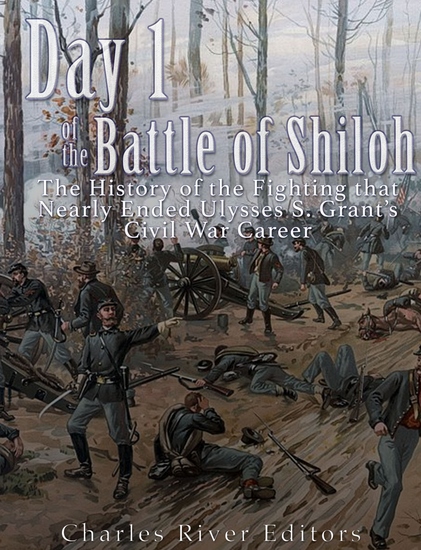
Day 1 of the Battle of Shiloh - The History of the Fighting that Nearly Ended Ulysses S Grant’s Civil War Career - cover
LER

Day 1 of the Battle of Shiloh - The History of the Fighting that Nearly Ended Ulysses S Grant’s Civil War Career

Editors Charles River

Editora: Charles River Editors

  • 0
  • 0
  • 0

Sinopse

“The turning point of our fate." – Jefferson Davis on the death of Albert Sidney Johnston at Shiloh


“Probably no single battle of the war gave rise to such wild and damaging reports.” – William Tecumseh Sherman


After Union General Ulysses S. Grant captured Fort Henry and Fort Donelson in early 1862, Confederate General Albert Sidney Johnston, widely considered the Confederacy’s best general, concentrated his forces in northern Georgia and prepared for a major offensive that culminated with the biggest battle of the war to that point, the Battle of Shiloh. On the morning of April 6, Johnston directed an all out attack on Grant’s army around Shiloh Church, and though Grant’s men had been encamped there, they had failed to create defensive fortifications or earthworks. They were also badly caught by surprise. With nearly 45,000 Confederates attacking, Johnston’s army began to steadily push Grant’s men back toward the river.  


As fate would have it, the Confederates may have been undone by friendly fire at Shiloh. Johnston advanced out ahead of his men on horseback while directing a charge near a peach orchard when he was hit in the lower leg by a bullet that historians now widely believe was fired by his own men. Nobody thought the wound was serious, including Johnston, who continued to aggressively lead his men and even sent his personal physician to treat wounded Union soldiers taken captive. But the bullet had clipped an artery, and shortly after being wounded Johnston began to feel faint in the saddle. With blood filling up his boot, Johnston unwittingly bled to death. The delay caused by his death, and the transfer of command to subordinate P.G.T. Beauregard, bought the Union defenders critical time on April 6, and the following day Grant’s reinforced army struck back and pushed the Confederate army off the field.


The Battle of Shiloh lasted two days, but the battle over the battle had just begun. Grant’s army had just won the biggest battle in the history of North America, with nearly 24,000 combined casualties among the Union and Confederate forces. Usually the winner of a major battle is hailed as a hero, but Grant was hardly a winner at Shiloh. The Battle of Shiloh took place before costlier battles at places like Antietam and Gettysburg, so the extent of the casualties at Shiloh shocked the nation. Moreover, at Shiloh the casualties were viewed as needless; Grant was pilloried for allowing the Confederates to take his forces by surprise, as well as the failure to build defensive earthworks and fortifications, which nearly resulted in a rout of his army. Speculation again arose that Grant had a drinking problem, and some even assumed he was drunk during the battle. Though the Union won, it was largely viewed that their success owed to the heroics of General Sherman in rallying the men and Don Carlos Buell arriving with his army, and General Buell was happy to receive the credit at Grant’s expense.


As a result of the Battle of Shiloh, Grant was demoted to second-in-command of all armies in his department, an utterly powerless position. And when word of what many considered a “colossal blunder” reached Washington, several congressmen insisted that Lincoln replace Grant in the field. Lincoln famously defended Grant, telling critics, “I can’t spare this man. He fights.”


Day 1 of the Battle of Shiloh: The History of the Fighting that Nearly Ended Ulysses S. Grant’s Civil War Career explains the campaign and events that led up to the controversial first day of the battle, and how the fighting that day affected the careers of the major generals involved. Accounts of the battle by important leaders like Sherman, Grant, and Braxton Bragg are included, along with analysis of the generals and fighting. 
 
 
Disponível desde: 01/05/2025.
Comprimento de impressão: 49 páginas.
Outros livros que poderiam interessá-lo

  • Poetry in Balance - The Equilibrist Series: Vol V - cover

    Poetry in Balance - The...

    Erasmus Cromwell-Smith II

    • 0
    • 0
    • 0
    This fifth and final volume of The Orloj is a compilation of all poems, essays, and fables of the first four books. A precious craft of artful verses that are straight forward, easy to understand. Through art that speaks to all, the author seeks to elicit emotions while provoking reflection. With verses that jump with ease out of the pages of the book, enrapturing anyone's heart, Cromwell-Smilh tackles a full circle of life with subjects like Perseverance, Grit, Kindness, Discipline, Impetus, Tenacity, Greatness, etc. 
     ... Through free-verse poetry ... over 60 thought-provoking poems and reflections ... addressing such concepts as Letting go of the past, finding Inspiration, dealing with a loss, and ultimately living a happy, blissful life ... In choosing to explore universal concerns ... Cromwell-Smith II strikes an ideal balance ...  
    Bluelnk (starred Review)
    Ver livro
  • Prehistoric Warfare: The History of Early Human Conflicts - cover

    Prehistoric Warfare: The History...

    Editors Charles River

    • 0
    • 0
    • 0
    Raymond C. Kelly, an anthropologist and ethnologist who has written extensively on societal inequality and subsequent warfare suggests that among the hunter-gatherer groups of Homo erectus, the population density was low enough to avoid armed conflict in most cases. In the same vein, a perception has persisted that during this less populated time of Earth’s history, life among the Homo species was relatively peaceful. Archaeologists have supported this theory through early cave art, little of which ever depicts humans hunting or killing each other explicitly. Kelly theorized that the migration out of Africa by Homo erectus 1.8 million years ago was “a natural consequence of conflict avoidance.” He believes that this general period of “Paleolithic warlessness” was to persist until the appearance of Homo sapiens approximately 350,000 years ago, and that it began with the occurrence of “economic and social shifts associated with sedentism.” 
    However, depictions of humans pierced with arrows began to appear in the Aurignacian-Périgordian eras (30,000 years ago), and in the early Magdalenian era (17,000 years ago). A work of Mesolithic art (20,000 to 10,000 years ago) shows an explicit battle between groups of archers, and in Valencia, a group of three archers are seen surrounded by four of the similarly armed enemy in the Cova del Roure la Vella in Castellón. In the Ares del Maestrat in Alcañiz of Aragon, another work depicts warriors fleeing a group of eight archers, while a similar work at Val del Charco del Agua in Aragon shows seven archers with plumed headgear. Other examples show warriors in lines and columns with a “distinctly garbed leader at the front.”
    Ver livro
  • Fans Have More Friends - cover

    Fans Have More Friends

    David Sikorjak, Ben Valenta,...

    • 0
    • 0
    • 0
    In Fans Have More Friends, sports fans, dads, and data analysts David Sikorjak and Ben Valenta argue that fandom can not only increase our sense of belonging but also serves as a powerful antidote to loneliness because sports fans experience increased social connection. What they didn't realize was how deep that connection was, the potential it carried for individual and societal wellness, or the opportunities it offered for adult friendships, making and keeping friends, and family ties. 


    Their theory is simple: if we want to be less lonely, we need to belong to a community or something greater than ourselves. Over the course of two years, countless in-person interviews and rigorously designed surveys, Ben Valenta and David Sikorjak have the proof that being a fan can lead to: improved social connections; stronger community ties; enhanced well-being; a greater sense of belonging; and more friends. 


    The common thread in all of these personal stories is friendship, community, and belonging—a feeling research can't reveal as well as stories can. Fans Have More Friends will make you think differently about sports and reminds all of us of the essential animating quality of fandom: We're in this together. Sports is not always about what's happening on the field but what's happening in the stands.
    Ver livro
  • The CQ Edge - How to Ignite Confidence Eliminate Anxiety and Maximize Your Communication Intelligence - cover

    The CQ Edge - How to Ignite...

    Su Bridgman

    • 0
    • 0
    • 0
    Tap into the empowering strategies in The CQ Edge to unleash your potential and elevate your communicative presence. Su Bridgman presents groundbreaking principles that synthesize profound insights, actionable strategies, and practical exercises to cultivate a resilient, captivating communicative essence.Whether it’s a high-stakes presentation or any other situation in which you speak to an audience, The CQ Edge empowers you to express with confidence, resonate with authenticity, and create the impact you want to achieve with every word spoken. It’s more than a learning experience; it’s a metamorphosis into the communicator you aspire to be, transforming not just the way you speak, but the way you are heard and remembered.It’s time to redefine the boundaries of your communicative landscape. Let The CQ Edge show you the way to becoming the speaker you always wished you could be.
    Ver livro
  • Tone Setters in the Academy - How to Build an Inspired Life as a University Administrator - cover

    Tone Setters in the Academy -...

    Andrew Tracy Ceperley

    • 0
    • 0
    • 0
    A North Star for anyone navigating a career in college and university administration 
    Are you feeling stuck in your role at a college or university, exhausted by the daily grind, or disillusioned with your work? You're not alone. Many of the 4.7 million people employed in higher education face challenges like navigating complex campus politics, lacking promotional opportunities, and struggling with workplace dynamics. 
    Tone Setters in the Academy is your guide to transforming these challenges into opportunities. Discover the power of becoming a "tone setter"—someone who shapes their environment with positivity and wisdom. This book offers practical strategies, known as "tone setter mindsets," to help you cultivate your unique tone, manage energy, and build resilience. Whether you're early in your career or contemplating a pivot, you'll find actionable insights to elevate your experience and effectiveness. 
    Dive into inspiring stories, methodologies, and mindsets that will help you soften rough edges, embrace personal growth, and fully express your potential. Each chapter ends with a thought-provoking question, guiding you to apply these principles and enhance your campus life. Unlock a fulfilling and dynamic career in higher education with Tone Setters in the Academy.
    Ver livro
  • Child Soldiers - The Tragic Exploitation of Youth in Armed Conflicts - cover

    Child Soldiers - The Tragic...

    Marcus Klein

    • 0
    • 0
    • 0
    The use of child soldiers in armed conflicts represents one of the most tragic and pervasive human rights violations of our time. Children, often as young as eight or nine, are forcibly recruited or manipulated into participating in violent wars, often by rebel groups or government forces. These young individuals, deprived of their innocence and forced to endure unimaginable hardships, are exploited in ways that not only strip them of their childhoods but also leave lasting scars on their bodies, minds, and spirits. 
      
    Across the world, from Africa to Asia and Latin America, countless children are caught in the crossfire of conflicts they did not cause and cannot escape. In some cases, they are coerced into combat, while in others, they are used as spies, messengers, or even sex slaves. The armed groups that recruit them often promise protection, a sense of belonging, or even power, but in reality, these promises are hollow. The children are left to survive in brutal conditions, with little support or hope for a future beyond the war. 
      
    The impact of this exploitation is not confined to the battlefield. The psychological trauma experienced by child soldiers is profound, with many carrying the weight of their experiences throughout their lives. Victims often struggle with severe emotional issues such as post-traumatic stress disorder (PTSD), depression, and anxiety. In addition to these mental health challenges, the physical toll of war—ranging from injuries sustained in combat to malnutrition and disease—further complicates their ability to recover.
    Ver livro