Junte-se a nós em uma viagem ao mundo dos livros!
Adicionar este livro à prateleira
Grey
Deixe um novo comentário Default profile 50px
Grey
Assine para ler o livro completo ou leia as primeiras páginas de graça!
All characters reduced
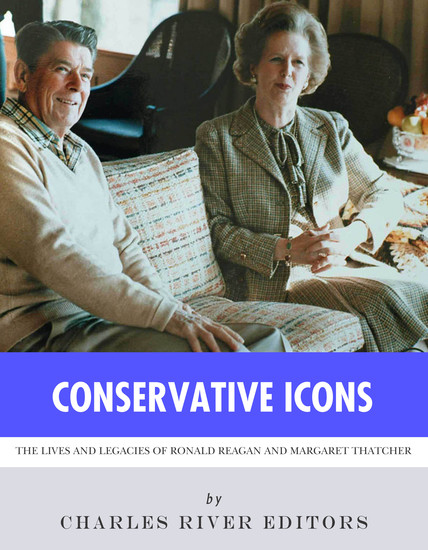
Conservative Icons - The Lives and Legacies of Ronald Reagan and Margaret Thatcher - cover
LER

Conservative Icons - The Lives and Legacies of Ronald Reagan and Margaret Thatcher

Editors Charles River

Editora: Charles River Editors

  • 0
  • 0
  • 0

Sinopse

"The nine most terrifying words in the English language are: 'I'm from the government and I'm here to help.'" – Ronald Reagan
 
In the famous movie Back to the Future, Marty McFly travels back to 1955, and, in an attempt to convince his friend Doc Brown that he is from 1985, tells the 1955 version of Doc Brown that Ronald Reagan is president. Doc looks at him incredulously and laughs, chortling, “Ronald Reagan? The actor?” In a story that could have come straight out of Hollywood, the golden actor rose through California politics to become California governor and eventually the 40th President.
 
The 70+ year old former actor then went on to have one of the most consequential presidencies of the 20th century, unquestionably making him one of the most influential men of the last 50 years. And his name is still as relevant in American politics today, with every politician with an R next to his or her name trying to claim Ronald Reagan’s conservative mantle. In the Republican presidential nomination debates in 2011, Reagan’s name was invoked an average of over 5 times per debate, more than every other president combined. Meanwhile, Americans of all stripes continue to debate the merits of “Reaganomics” more than 30 years after Reagan was elected. 
 
Sir Winston Churchill is often cited as Britain’s greatest prime minister for leading the United Kingdom against Hitler’s Nazi war machine during World War II, and indeed he was the idol of the one person who many think might have surpassed him: Margaret Thatcher. Thatcher not only became Britain’s first female prime minister, she also became its longest serving prime minister.
 
The political precedents Thatcher set as a woman would be enough of a legacy in its own right, but Thatcher effectively wielded her power in a way that made a lasting contribution both to geopolitics and the perception of female politicians in general. Thatcher is widely credited, along with Ronald Reagan, as one of the principal Cold Warriors who brought about the demise of the Soviet Union, whose leaders gave her the famous nickname “Iron Lady”. And of course, Thatcher was recently in the spotlight again with the release of the critically acclaimed movie The Iron Lady, starring Meryl Streep.
 
With the success of that movie, Thatcher has undergone a cultural revival and re-iconization in many quarters for her political stances and political achievements. At the same time, however, the role she played as a woman is now often overlooked out of the expedience of political correctness, and it is considered uncivil to analyze Thatcher’s political rise through the prism of sex. In fact, at times the former Prime Minister claimed to understand an issue better due to her sex and sometimes used her sex more subliminally
Disponível desde: 05/05/2025.
Comprimento de impressão: 61 páginas.

Outros livros que poderiam interessá-lo

  • I'd Trade Him Again - cover

    I'd Trade Him Again

    Terry McConnell

    • 0
    • 0
    • 0
    August 8, 2023 marks the 35th anniversary of the news conference during which THE TRADE was announced, and in the annals of professional hockey, no incident has resulted in such furor, such angst among Canadians as did the decision by team owner Peter Pocklington to trade Edmonton Oiler Wayne Gretzky to the Los Angeles Kings. Pocklington's biographers focus on the relationship between the two men, today and during the heady heydays of the five-time Stanley Cup champion team.Peter Pocklington brought the people of Edmonton a winning franchise and the most skilled player in hockey history: The Great One, Wayne Gretzky. This book tells the fascinating story of the flamboyant entrepreneur's tenure of the Edmonton Oilers, from its origins as a WHA team to its heights as an NHL powerhouse."I'D TRADE HIM AGAIN: WAYNE GRETZKY & PETER POCKLINGTON" is an easy-to-read "must read" for hockey fans on both sides of the border. Get inside details from the major players in this dramatic tale.
    Ver livro
  • The Mother of All Degrassi - A Memoir - cover

    The Mother of All Degrassi - A...

    Linda Schuyler

    • 0
    • 0
    • 0
    When a schoolteacher decides to teach her Grade 8 class about filmmaking and creates a documentary that ends up being broadcast internationally, she sets in motion a career of storytelling for an age group largely ignored by TV executives . . . and creates one of the most-loved television franchises of all time 


    Linda Schuyler, co-creator and executive producer of the long-running Degrassi series, shares her personal stories about the grit and determination necessary to make it as a woman entrepreneur in the bourgeoning independent Canadian television industry of the early 1980s. 


    After surviving a near-fatal car accident in 1968, Linda found her life continuing to veer in unexpected directions, ultimately leading her to use her innate abilities as an educator to become a successful storyteller and businesswoman. 


    Linda's deep fondness for teenagers has made her a champion for adolescents. In The Mother of All Degrassi, she shares her strong belief that television is all about the story, and a good story is all about making the political personal. Through anecdotes and introspection, Linda examines her philosophy to dream big, think small, meet life head-on, and always keep an open heart.
    Ver livro
  • Alfred Hitchcock’s Legendary Leading Ladies: The Lives of Grace Kelly Ingrid Bergman Joan Fontaine and Kim Novak - cover

    Alfred Hitchcock’s Legendary...

    Editors Charles River

    • 0
    • 0
    • 0
    Considering that her film career lasted just six years, it would seem as though the reputation of Grace Kelly far outweighs her actual output. Indeed, from the time of her arrival in Hollywood in 1951 through her final film, High Society, in 1956, Kelly acted in just 11 films, leaving viewers to wonder whether Kelly was still in the beginning of her career or whether High Society was a proper culmination to an extraordinarily brief stay in the film industry? Ultimately, it is might be most accurate to state that Kelly was still in the prime of her career, but it’s unclear what direction her career would have taken, as well as who inherited the void she left. 
    Ingrid Bergman’s fame cannot be doubted, but the international quality of her career has prevented most people from gaining a complete understanding of her filmography. Moreover, the immense success of her most famous films obscured her other achievements; one of Bergman’s persistent lamentations late in her career was that even though she appeared in other films she deemed more significant, the only film of hers that people wanted to discuss was Casablanca.  
    Although Fontaine and de Havilland would make history by becoming the only sisters to both win an Academy Award for Best Actress, that anecdote was just one of the various stories about the siblings that has shed light on their notoriously contentious and complicated relationship. As Fontaine once put it, “I married first, won the Oscar before Olivia did, and if I die first, she'll undoubtedly be livid because I beat her to it!"  
    Kim Novak’s most famous role was as one of Alfred Hitchcock’s legendary “icy blondes” in Vertigo (1958), beguiling Jimmy Stewart’s character to the point of madness in what is widely considered one of the greatest films ever made. The girl who originally wanted to be an artist reached the upper echelon of Hollywood itself before she had even turned 30.
    Ver livro
  • Nerva-Antonine Dynasty The: The History and Legacy of the Emperors Who Ruled the Roman Empire at Its Peak - cover

    Nerva-Antonine Dynasty The: The...

    Editors Charles River

    • 0
    • 0
    • 0
    “The Five Good Emperors,” a reference to the five emperors who ruled the Roman Empire between 96 and 180 CE (Nerva, Trajan, Hadrian, Antoninus Pius, and Marcus Aurelius), was a term first coined by Machiavelli and later adopted and popularized by historian Edward Gibbon, who said that under these men, the Roman Empire “was governed by absolute power under the guidance of wisdom and virtue.”  
    	This period of 84 years is generally regarded as the high point of the Roman Empire, at least after Augustus, but what is uncertain and a matter of ongoing debate is whether the five emperors were personally responsible for the situation and the accompanying prosperity enjoyed throughout the empire at the time or if they were simply the beneficiaries of the Pax Romana, inaugurated by Augustus in the early part of the 1st century CE. In other words, historians have wondered whether anyone in power during those years would have enjoyed the same rewards.  
    	The description of these rulers as “good” is also a matter of interpretation, with some scholars suggesting they were only “good” in comparison to the preceding emperor (Domitian) and the emperor who followed Marcus Aurelius (Commodus). Both of them were horrible rulers in every aspect, making their near contemporaries look all the better.  
    	Regardless, it is clear that the era of the Five Good Emperors was one of unparalleled success and wealth, and the reasons Rome reached its zenith at this time are worthy of scrutiny. Perhaps most noteworthy is that none of these five emperors were blood relatives - while the final two are often referred to as the Antonines, they were not, in fact, related except by adoption, a practice that may in itself provide at least part of the answer to the question as to why this particular period was so magnificent.
    Ver livro
  • Nor Fish Nor Fowl: From Deckhand to Flight Lieutenant - The Story of a Merchant Navy seaman in the Royal Air Force Marine Branch - cover

    Nor Fish Nor Fowl: From Deckhand...

    Colin Yorke

    • 0
    • 0
    • 0
    In 1934, after five years travelling the world as a Merchant Seaman, my father, aged 21, enlisted in the British Royal Air Force to escape the Depression. Entering the Marine Branch, he swapped big ships for small fast boats - Seaplane Tenders, Armoured Target Boats and High Speed Launches. 
    In 1940, when the Air Sea Rescue service was formed, he joined the crew of High Speed Launch 102 (now fully restored and based at Portsmouth) as a Coxswain, stationed at Blyth. Three busy years on the "Spitfires of the Sea" followed, before his leg was "smashed" in heavy seas. 
    On recovery, he spent time in the Faroe Islands and in the English Channel, after "D-Day", and before being commissioned. The war's end found him in West Africa. After VJ Day he was demobbed, then recalled and posted to Egypt. 
    After a brief unhappy spell in "Civvy Street", he re-enlisted in the RAF as an acting corporal. First on the scene when HSL 2555 blew up, he was commended and subsequently carried the RAF ensign at the 1950 Battle of Britain celebrations in Paris, France. On return to the UK he was once again commissioned. 
    In Malta, during the Suez Crisis, he supervised a flying boat airlift of families and service personnel through Malta as the Canal Zone was evacuated. Later, serving in Cold War Germany, he skippered German boats with mixed German/British crews and was present when the Unit was handed back to the Germans. 
    In 1961, aged just 48, injuries forced his retirement from the RAF. 
    Now, fittingly narrated by my actor daughter, this book reveals a great deal of the little known story of the RAF Marine Branch, its boats and the life of a British serviceman's family in war and peace.
    Ver livro
  • Tupac Amaru II: The Life and Legacy of the Peruvian Leader Who Rebelled against the Spanish Empire - cover

    Tupac Amaru II: The Life and...

    Editors Charles River

    • 0
    • 0
    • 0
    The Incas had consolidated their empire only a century before Pizarro and his Spanish conquistadores took control of Inca lands in the 1530s. The Incan heartland was the Andes Mountains from Ecuador down through Peru into parts of northern Chile, including what is now Bolivia, some of Argentina, and in the north, bits of what is now Colombia. It covered about 770,000 square miles, far larger than Spain, and held an estimated 14 million people, more than in Spain, comprised of many different indigenous groups.  
    	Lima was the seat of the Viceroyalty of Peru, which included almost all of the Spanish colonial region in South America. Then, Peru meant today’s Peru, Ecuador, and parts of Chile, and in the mid-18th century, a new Viceroyalty of La Plata was set up, based in what is now Buenos Aires. Upper Peru was centered on La Paz and Chuquisaca (since renamed Sucre after the hero of independence), and Peru was centered on Lima and Cuzco. The addition of La Plata as a viceroyalty refocused the necessary slow of silver from Lima and Peru to Buenos Aires and the Atlantic. The Audiencia of Charcas (Bolivia) was placed under La Plata’s authority. 
    	In one sense, the Spanish conquest was simply a shift of empires for the indigenous peoples. The Incas were as imperialistic as Spain, and they put down rebellions with the same ferocity. However, Incan rule was generally mild and concerned with the welfare of the empire’s people. The indigenous people chafed under Spanish rule, and the lost Incan days were idolized in popular memory. This set the stage for one of the most famous and mythologized conflicts in the history of the Americas. 
    Ver livro