

Junte-se a nós em uma viagem ao mundo dos livros!
Adicionar este livro à prateleira
Grey
Deixe um novo comentário Default profile 50px
Grey
Assine para ler o livro completo ou leia as primeiras páginas de graça!
All characters reduced
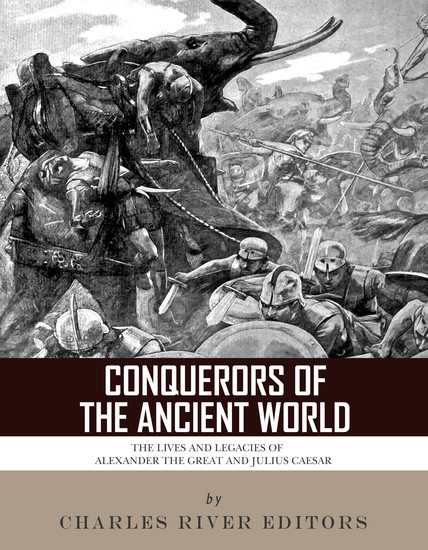
Conquerors of the Ancient World - The Lives and Legacies of Alexander the Great and Julius Caesar - cover
LER

Conquerors of the Ancient World - The Lives and Legacies of Alexander the Great and Julius Caesar

Editors Charles River

Editora: Charles River Editors

  • 0
  • 0
  • 0

Sinopse

“There is nothing impossible to him that will but try” – Alexander
 
Over the last 2,000 years, ambitious men have dreamed of forging vast empires and attaining eternal glory in battle, but of all the conquerors who took steps toward such dreams, none were ever as successful as antiquity’s first great conqueror. Leaders of the 20th century hoped to rival Napoleon’s accomplishments, while Napoleon aimed to emulate the accomplishments of Julius Caesar. But Caesar himself found inspiration in Alexander the Great (356-323 B.C.), the Macedonian King who managed to stretch an empire from Greece to the Himalayas in Asia at just 30 years old. It took less than 15 years for Alexander to conquer much of the known world.
 
As fate would have it, Alexander died of still unknown causes at the height of his conquests, when he was still in his early 30s. Although his empire was quickly divided, his legacy only grew, and Alexander became the stuff of legends even in his own time. Alexander was responsible for establishing 20 cities in his name across the world, most notably Alexandria in Egypt, and he was directly responsible for spreading Ancient Greek culture as far east as modern day India and other parts of Asia. For the ancient world, Alexander became the emblem of military greatness and accomplishment; it was reported that many of Rome’s greatest leaders, including Pompey the Great, Augustus, and Caesar himself all visited Alexander’s tomb in Alexandria, a mecca of sorts for antiquity’s other leaders.
 
Possibly the most important man of antiquity, and even all of history, was Julius Caesar. Alexander Hamilton, the famous American patriot, once remarked that “the greatest man who ever lived was Julius Caesar”. Such a tribute, coming from one of the Founding Fathers of the quintessential modern democracy in reference to a man who destroyed the Roman Republic, is testament to the enduring mark that Caesar left upon the world. The ultimate conqueror, statesman, dictator, visionary, and opportunist, during his time in power Caesar expanded the borders of Rome to almost twice their previous size, revolutionized the infrastructure of the Roman state, and destroyed the Roman Republic for good, leaving a line of emperors in its place. His legacy is so strong that his name has become, in many languages, synonymous with power: the Emperors of Austria and Germany bore the title Kaiser, and the Czars of Russia also owe the etymology of their title to Caesar. His name also crept further eastward out of Europe, even cropping up in Hindi and Urdu, where the term for “Emperor” is Kaisar.
 
Even in his time, Caesar was in many ways larger than life, and because of his legacy as virtual founder of the Roman Empire, much of what was written about – and by – him during his life and immediately after his assassination was politically motivated. His successor, Octavian Augustus, had a strong interest in ensuring that Caesar’s life be painted in a favorable light, while Caesar’s political enemies attempted to paint him as a corrupt, undemocratic dictator who was destroying the old order of the Republic. This makes it exceedingly difficult to separate historical fact from apocryphal interjection, as the writings of Cicero (a rival of Caesar’s) and the later biographies of Suetonius and Plutarch can be misleading. Nonetheless, along with Caesar’s De Bello Gallico, his famous notes on his campaign against the Gauls, they remain our chief sources for Caesar’s life – a life everyone agreed was nothing short of remarkable and changed the course of history forever.
Disponível desde: 04/05/2025.
Comprimento de impressão: 56 páginas.

Outros livros que poderiam interessá-lo

  • The Wise Hours - A Journey into the Wild and Secret World of Owls - cover

    The Wise Hours - A Journey into...

    Miriam Darlington

    • 0
    • 0
    • 0
    Owls have existed for over sixty million years, and in the relatively short time we have shared the planet with these majestic birds they have ignited the human imagination. But even as owls continue to captivate our collective consciousness, celebrated British nature writer Miriam Darlington finds herself struck by all she doesn't know about the true nature of these enigmatic creatures. 


    Darlington begins her fieldwork in the British Isles with her teenage son, Benji. As her avian fascination grows, she travels to France, Serbia, Spain, Finland, and the frosted Lapland borders of the Arctic for rare encounters with the barn owl, tawny owl, long-eared owl, pygmy owl, snowy owl, and more. But when her son develops a mysterious illness, her quest to understand the elusive nature of owls becomes entangled with her search for finding a cure. 


    In The Wise Hours, Darlington watches and listens to the natural world and to the rhythms of her home and family, inviting listeners to discover the wonders of owls alongside her while rewilding our imagination with the mystery, fragility, and magnificence of all creatures.
    Ver livro
  • Academy Award Winning Sisters: The Lives of Olivia de Havilland and Joan Fontaine - cover

    Academy Award Winning Sisters:...

    Editors Charles River

    • 0
    • 0
    • 0
    Olivia de Havilland was one of the last living actresses who worked during the Golden Era of Hollywood, but also one of the most decorated, winning dozens of awards over the course of a 50 year career. Among those, she most notably won the Academy Award for Best Actress for To Each His Own (1946) and The Heiress (1949), more than a decade after she got her start as an 18 year old in Hollywood. 
    Of course, de Havilland isn’t well remembered for any of those accolades or other movies but because she played Melanie Hamilton in Gone With the Wind (1939), perhaps the most famous movie in American history. Although she was a veteran actress at the time, de Havilland’s career hadn’t progressed much since she started, and rumor has it that she eventually got the role after her own sister, Joan Fontaine, was asked to audition for the part and recommended Olivia instead. 
    Although Fontaine and de Havilland would make history by becoming the only sisters to both win an Academy Award for Best Actress, that anecdote was just one of the various stories about the siblings that has shed light on their notoriously contentious and complicated relationship. As Fontaine once put it, “I married first, won the Oscar before Olivia did, and if I die first, she'll undoubtedly be livid because I beat her to it!" De Havilland herself once said, "Joan is very bright and sharp and can be cutting." 
    Meanwhile, Joan Fontaine won the Oscar for Best Actress for her role in Alfred Hitchcock’s Suspicion (1941). She also earned a nomination for her performance in The Constant Nymph (1943), and in a television career that spanned several decades, she earned an Emmy nomination for her work on Ryan’s Hope in 1980, nearly 40 years after winning the Academy Award for Suspicion. Fontaine even appeared on Broadway in a couple of productions that ran for several years. 
    Ver livro
  • Squanto - A Native Odyssey - cover

    Squanto - A Native Odyssey

    Andrew Lipman

    • 0
    • 0
    • 0
    Taken to Europe as a slave, he found his way home and changed the course of American history 


    American schoolchildren have long learned about Squanto, the welcoming Native who made the First Thanksgiving possible, but his story goes deeper than the holiday legend. Born in the Wampanoag-speaking town of Patuxet in the late 1500s, Squanto was kidnapped in 1614 by an English captain, who took him to Spain. From there, Englishmen brought him to London and Newfoundland before sending him home in 1619, when Squanto discovered that most of Patuxet had died in an epidemic. A year later, the Mayflower colonists arrived at his home and renamed it Plymouth. 


    Prize-winning historian Andrew Lipman explores the mysteries that still surround Squanto: How did he escape bondage and return home? Why did he help the English after an Englishman enslaved him? Why did he threaten Plymouth's fragile peace with its neighbors? Was it true that he converted to Christianity on his deathbed? Drawing from a wide range of evidence and newly uncovered sources, Lipman reconstructs Squanto's upbringing, his transatlantic odyssey, his career as an interpreter, his surprising downfall, and his enigmatic death. The result is a fresh look at an epic life that ended right when many Americans think their story begins.
    Ver livro
  • Oscar Wilde - Chapter & Verse - Poetry and prose together from literary greats - cover

    Oscar Wilde - Chapter & Verse -...

    Oscar Wilde

    • 0
    • 0
    • 0
    Literature is a world of words and wonder, able to take us on almost unimaginable journeys from the wild and fantastic to the grind and minutiae of life. 
     
    An author’s ideas are his building blocks, his architecture of the mind, building a structure on which all else will rest; the narrative, the characters, the words - those few words that begin the adventure. 
     
    In this series we look at some of our leading classic authors across two genres: the short story and the poem.  In this modern world there is an insatiable need to categorise and pigeon-hole everyone and everything.  But ideas, these grains and saplings of the brain, need to roam, to explore and find their perfect literary use vehicle.  Our authors are masters of many literary forms, perhaps known for one but themselves favouring another. 
     
    Story. Poems. Story.  Within these boundaries come all manner of invention and cast of characters.  And, of course, each author has their own way of revealing their own chapter and verse.    
     
    1 - Chapter & Verse - Oscar Wilde 
    2 - The Devoted Friend by Oscar Wilde 
    3 - The Ballad of Reading Gaol by Oscar Wilde 
    4 - Sonnet to Liberty by Oscar Wilde 
    5 - Sonnet on Approaching Italy by Oscar Wilde 
    6 - Easter Day by Oscar Wilde 
    7 - Helas! by Oscar Wilde 
    8 - Serenade by Oscar Wilde 
    9 - Endymon by Oscar Wilde 
    10 - Her Voice by Oscar Wilde 
    11 - Impression du Matin by Oscar Wilde 
    12 - Requescat by Oscar Wilde 
    13 - A Vision by Oscar Wilde 
    14 - The Grave of Shelley by Oscar Wilde 
    15 - The Canterville Ghost - Part 1 by Oscar Wilde 
    16 - The Canterville Ghost - Part 2 by Oscar Wilde
    Ver livro
  • Politics Power and Principle - Insights from Shakespeare - cover

    Politics Power and Principle -...

    Ismail Serageldin

    • 0
    • 0
    • 0
    I am one of the many admirers of Shakespeare's genius. I have even written a book about his unique ability to remain relevant to our contemporary concerns. The work was titled The Modernity of Shakespeare1 and it was very well received, and even earned a very laudatory foreword by W ole Soyinka, Nobel laureate in Literature, and professor of English literature. So it is no surprise that when I founded the New Library of Alexandria in Egypt, I also organized an annual Shakespeare event - usually organized on the 23rd of April if at all possible - in which many eminent literary critics participated. And as we focused on the plays rather than the long poems or the sonnets, some actors and occasionally cinematographers also participated. Students from the departments of English in many universities across Egypt, also invariably participated.
    At that annual event I usually presented a special lecture on Shakespeare. This went on for almost 15 years.
    Ver livro
  • Monsters Among Us: Serial Killers of Russia - cover

    Monsters Among Us: Serial...

    Edward Halcroft

    • 0
    • 0
    • 0
    This audiobook is narrated by an AI Voice.   
    Monsters Among Us: Serial Killers of Russia is a chilling, meticulously researched true crime exploration of the darkest criminal minds in modern Russian history. From notorious predators like Andrei Chikatilo to the state-shielded brutality of Yevgeny Chuplinsky, this book unearths the brutal stories of killers who thrived in the shadows of secrecy and denial. Drawing on public records, legal documents, and journalistic accounts, author Edward Halcroft weaves together each case with psychological depth and narrative intensity. Gripping and disturbing in equal measure, this audiobook exposes a side of Russia rarely acknowledged—where monsters walked unnoticed among everyday people. A must-listen for fans of dark true crime, criminal psychology, and unsolved mysteries.
    Ver livro
