¡Acompáñanos a viajar por el mundo de los libros!
Añadir este libro a la estantería
Grey
Escribe un nuevo comentario Default profile 50px
Grey
Suscríbete para leer el libro completo o lee las primeras páginas gratis.
All characters reduced
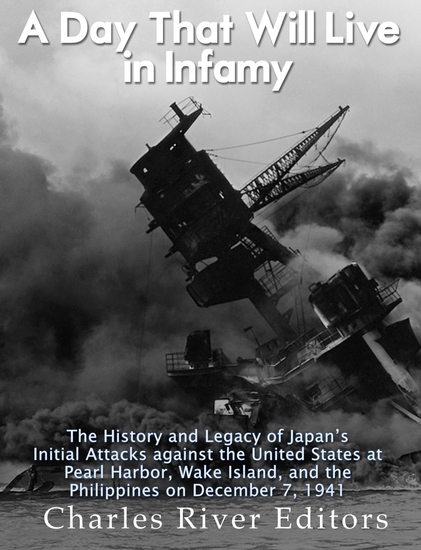
A Day That Will Live in Infamy - The History and Legacy of Japan’s Initial Attacks against the United States at Pearl Harbor Wake Island and the Philippines on December 7 1941 - cover

A Day That Will Live in Infamy - The History and Legacy of Japan’s Initial Attacks against the United States at Pearl Harbor Wake Island and the Philippines on December 7 1941

Editors Charles River

Editorial: Charles River Editors

  • 0
  • 0
  • 0

Sinopsis

All Americans are familiar with the “day that will live in infamy.” At 9:30 a.m. on Sunday, December 7, 1941, Pearl Harbor, the advanced base of the United States Navy’s Pacific Fleet, was ablaze. It had been smashed by aircraft launched by the carriers of the Imperial Japanese Navy. All eight battleships had been sunk or badly damaged, 350 aircraft had been knocked out, and over 2,000 Americans lay dead. Indelible images of the USS Arizona exploding and the USS Oklahoma capsizing and floating upside down have been ingrained in the American conscience ever since. In less than an hour and a half the Japanese had almost wiped out America’s entire naval presence in the Pacific.
 
Less than 24 hours earlier, Japanese and American negotiators had been continuing their diplomatic efforts to stave off conflict in the region, but as they did, President Roosevelt and his inner circle had seen intelligence reports strongly suggesting an imminent attack - though they did not know where. The U.S. rightly believed that Japan would take action to prevent the Americans from interfering with their military activities in Southeast Asia, and American military forces in the Philippines were already bracing for a potential attack. However, as the negotiations were ongoing, the powerful Japanese carrier fleet had been surging southwards through the Pacific while maintaining radio silence, preparing to strike the blow that would ignite war in an area spanning half the globe. Navy Commander-in-Chief Isoroku Yamamoto, whose code of honor demanded that the Japanese only engage enemies after a formal declaration of war, had been given assurances that his nation would be formally at war with the United States prior to the arrival of his planes over Pearl Harbor.
 
As it turned out, those assurances were worth nothing, and Yamamoto had been misled by extremists in his government just as the Americans were misled. In fact, the Japanese would infamously deliver documents formally cutting off negotiations with the American government after the attack on Pearl Harbor had already been conducted. Far from a formal declaration of war, America was attacked without warning, plunging the world’s largest democracy into history’s deadliest conflict.
 
Posted on the other side of the world, it was early on the morning of December 8 in the Philippines when American general Douglas MacArthur received news of the Japanese attack on Pearl Harbor hours earlier. With that, it could only be a matter of time before the Japanese attacked the Philippines.
 
Although MacArthur and Allied forces tried to hold out, they could only fight a delaying action, and the Japanese managed to subdue all resistance by the spring of 1942. However, in the aftermath of Japan’s successful invasion, as the nation’s military strategists began preparations for the next phase of military actions in the theater, their forces had to deal with a critical logistical problem they had not foreseen. The Japanese had to deal with large numbers of Filipino and American soldiers who had surrendered after a lengthy defense in the Bataan peninsula, but they were not prepared for so many prisoners of war because their own military philosophy emphasized rigid discipline and fighting until the end. They could not imagine a situation in which Japanese soldiers would willingly surrender, so they assumed that no other combatants would do so either. On the night of March 12, 1942, MacArthur, his family and closest advisors were smuggled out of Corregidor on PT boats. From there they surged across the black ocean to Mindanao and were picked up by American B-17 bombers. They stealthily flew to northern Australia, a dangerous flight over Japanese-held territory, during which MacArthur casually remarked to General Sutherland, “It was close; but that's the way it is in war. You win or lose, live or die, and the difference is just an eyelash.”  
Disponible desde: 01/05/2025.
Longitud de impresión: 59 páginas.

Otros libros que te pueden interesar

  • When Women Defined Fashion Power - "Unleash the power of fashion! Access dynamic audio lessons that celebrate women's influence on style" - cover

    When Women Defined Fashion Power...

    Tiberius Thistledown

    • 0
    • 0
    • 0
    When Women Defined Fashion Power 
    ⭐⭐ A Simplified Guide & Explanations Included ⭐⭐ 
    Are you ready to elevate your career and deepen your knowledge by mastering the insights into how ambition shaped culture and transformed society? 
    Searching for a thorough guide that encompasses everything you need to navigate this dynamic subject? 
    Your search ends here! 
    This guide is your ultimate resource for enhancing your understanding, applying your skills, and engaging in practical exercises. With this material, you'll be well-equipped for success. 
    Updated for the latest trends in cultural influence and social transformation. 
    Key features of this enhanced guide: 
    - In-depth insights into how ambition has shaped culture and influenced society 
    - Comprehensive analysis of the impact of women's empowerment on fashion 
    - Effective strategies for grasping the concepts and applying them to real-life scenarios 
    Our guide stands out with its exhaustive coverage, which is vital for your understanding and appreciation of the topic. Concepts are not merely touched upon; they are explored in detail. 
    Crafted with a clear structure and easy-to-follow language, our guide ensures smooth transitions between sections. Bid farewell to complex jargon and embrace clear, accurate, and insightful content. 
    So, why hesitate? Click the BUY NOW button, secure your guide, and embark on your journey to understanding how ambition has defined culture and transformed society! 
    Each section provides an enriching perspective on women’s roles in fashion and culture.
    Ver libro
  • Beyond Ethnic Loneliness - The Pain of Marginalization and the Path to Belonging - cover

    Beyond Ethnic Loneliness - The...

    Prasanta Verma

    • 0
    • 0
    • 0
    "So what are you? Go back where you belong!" 


    Majority white American culture has historically marginalized people of color, who at times feel invisible and alienated and at other times are traumatized by oppression and public discrimination. This reality leads to a particular kind of aloneness: ethnic and racial loneliness. 


    An Indian American immigrant who grew up in white Southern culture, Prasanta Verma names and sheds light on the realities of ethnic loneliness. She unpacks the exhausting effects of cultural isolation, the dynamics of marginalization, and the weight of being other. In the midst of disconnection and erasure, she points to the longing to belong, the need to share our stories, and the hope of finding safe friendships and community. Our places of exile can become places where we find belonging—to ourselves, to others, and to God.
    Ver libro
  • The Permanent Husband - A Gripping Tale of Betrayal Guilt and the Burden of the Past - cover

    The Permanent Husband - A...

    Fyodor Dostoevsky, Tim Zengerink

    • 0
    • 0
    • 0
    What if the man you wronged refused to let you forget? 
    The Permanent Husband unfolds as a taut confrontation between suave Ivan Velchaninov and brooding Pavel Trusotsky, who arrives bearing the ghost of betrayal—and perhaps a child conceived in that very betrayal.  
    Their conversations crackle with hidden barbs, exposing wounds neither is willing to heal. Dostoevsky’s concise masterpiece becomes an immersive listening experience, rich with irony, tension, and unexpected flashes of dark humor. 
    What you’ll hear inside: 
    - A Psychological Chess Match – Every word a move, every pause a threat. 
    - Portraits of Guilt and Jealousy – Voices that reveal trembling pride and desperate vulnerability. 
    - A Modern Performance – Clear, dynamic narration that brings nineteenth-century St. Petersburg to life. 
    - A Story That Haunts Long After the Final Sentence – Perfect for listeners who crave moral complexity in under three hours. 
    Total listening time: approximately 2 hours 30 minutes—ideal for a single suspense-filled evening.
    Ver libro
  • Normandy - From Cotentin to Falaise June–July 1944 - cover

    Normandy - From Cotentin to...

    Friedrich Hayn

    • 0
    • 0
    • 0
    A German perspective of D-Day, written by an Army Corps intelligence officer in Normandy when the Allies invaded, published in English for the first time. A unique perspective on the decisive early weeks of the invasion in 1944, written by a German Army Corps Intelligence officer stationed in Normandy at the time of the Allied invasion, who during the invasion was the department head for enemy messages processing (Ic) in the staff of the LXXXIV AK. It discusses in detail the events leading up to the creation of Falaise Pocket, described by the author as a “tragic turning point of an entire front.” It discusses in detail the conditions in the American landing section and explains how the German troops based there came to be defeated.Praise for Normandy “Should be read by scholars working on the fighting between the Americans and Germans on the western side of the Normandy front.” —Journal of Military History “The interaction among German command is interesting as it scrambles to patch lines. The book covers battles over D-Day beaches, U.S. paratrooper drops, Cherbourg, hedgerows, Operations Cobra and Luttich, and Falaise Pocket formation and collapse.” —Historical Miniatures Gaming Society “[A] unique, informative, and inherently fascinating study . . . absolutely essential and core addition to personal, professional, community, college, and university library World War II history collections.” —Midwest Book Review
    Ver libro
  • Brief History of the Antarctic Exploration - cover

    Brief History of the Antarctic...

    Gerardo Bartolome

    • 0
    • 0
    • 0
    Antarctica, a continent like no other. Not only because of its beauty but also because of its unique history, without wars, kings or indigenous cultures. This book delves into its exploration, offering key insights into events and motivations. A concise overview, it's designed for those preparing for an Antarctic journey or seeking quick insights into its history. With over 150 images, it captures the essence of this exceptional place. For more in-depth explorations, additional resources are suggested in the final appendix. Explore Antarctica's history through a succinct and enjoyable reading experience.
    Ver libro
  • Boy Who Harnessed the Wind The: Book Summary & Analysis - cover

    Boy Who Harnessed the Wind The:...

    Briefly Summaries

    • 0
    • 0
    • 0
    This is a concise summary and analysis of The Boy Who Harnessed the Wind, by William Kamkwamba and Bryan Mealer.
     
    It is not the original book and is not affiliated with or endorsed by William Kamkwamba and Bryan Mealer.
     
    Ideal those seeking a quick and insightful overview.
    The Boy Who Harnessed the Wind is an inspiring true story of a young boy from Malawi who, against all odds, builds a windmill to provide electricity for his village. With limited resources and formal education, he uses his ingenuity and determination to overcome poverty and drought, transforming his community. The book highlights themes of perseverance, innovation, and the power of education to change lives.
    Ver libro