Junte-se a nós em uma viagem ao mundo dos livros!
Adicionar este livro à prateleira
Grey
Deixe um novo comentário Default profile 50px
Grey
Assine para ler o livro completo ou leia as primeiras páginas de graça!
All characters reduced
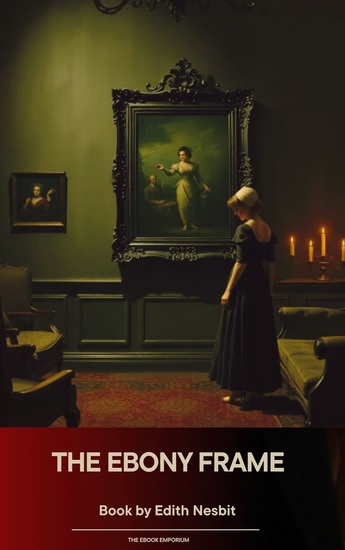
The Ebony Frame - cover
LER

The Ebony Frame

Edith Nesbit

Editora: The Ebook Emporium

  • 0
  • 0
  • 0

Sinopse

"I have waited for you for three hundred years."

When a young man inherits a grand, ancient house from a distant relative, he discovers a striking portrait of a beautiful woman, encased in a magnificent, intricately carved ebony frame. Drawn to her haunting gaze, he soon realizes that the woman in the painting is more than mere oil and pigment. She is a soul from the past, bound by a dark pact and a love that refuses to stay buried. As the boundary between the present and the Elizabethan era begins to dissolve, he must decide if he is willing to sacrifice his reality for a phantom bride.

A Masterpiece of Atmospheric Horror: Before she became a pioneer of children's fantasy, Edith Nesbit was a master of the "shilling shocker." The Ebony Frame is a quintessential example of the Fin de Siècle ghost story, blending the elegance of Victorian prose with a visceral sense of dread. It explores the dangerous allure of nostalgia and the terrifying possibility that our ancestors' lives are never truly finished.

The Curse of the Unliving: Nesbit expertly weaves elements of the occult and the "femme fatale" archetype into this taut narrative. The ebony frame itself acts as a portal, a physical manifestation of the barrier between life and death. As the protagonist is pulled deeper into the lady's spell, the reader is left to wonder: is this a romantic reunion of soulmates, or a predatory haunting designed to steal a living soul?

True love never dies—it waits. Purchase "The Ebony Frame" today and step into a world of spectral romance.
Disponível desde: 06/01/2026.
Comprimento de impressão: 33 páginas.
Outros livros que poderiam interessá-lo

  • A Scene from the Ghetto of Venice - From their pens to your ears genius in every story - cover

    A Scene from the Ghetto of...

    Rainer Maria Rilke

    • 0
    • 0
    • 0
    René Karl Wilhelm Johann Josef Maria Rilke was born into a troubled marriage on the 4th December 1875 in Prague, then part of the Austro-Hungarian Empire.  His mother, having previously lost a baby girl, would dress the young boy up in girl’s clothing.   
    Later his father dispatched him to a military academy at age 10 but after a miserable 5 years the young Rilke left due to illness and instead entered first Prague and then Munich and finally Berlin university to study art history, philosophy and literature. 
    His initial forays into literature was in poetry.  His intense, mystical and lyrical style was much admired and over time inspired many in succeeding generations.    
    His short prose collection ‘Stories of God’, written in an impassioned burst over several nights was published in 1900 and offers a beguiling view of much of Rilke’s influences and outlook.  
    The following year he married the pioneering sculptor and artist Clara Westhoff.  The union produced one child, a daughter Ruth.   
    He lived in Paris for most of the Century’s first decade where he mixed with many great minds of the time.  Although he continued to write he also worked as a secretary to the sculptor, Rodin.   
    It was only after they settled in Switzerland in 1919 that his writing output was in full flow.  Here he wrote profusely in both German and French, which included much on his previous travels, his left-wing sympathies, his religious and existential thoughts, all part of a unique and consummate style. 
    From 1923 on, Rilke increasingly struggled with his health which was now in constant decline and often spent time rehabilitating at a sanatorium.   
    Rainer Maria Rilke died of leukaemia on the 29th December 1926 in Montreux, Switzerland.  He was 51.
    Ver livro
  • The Fall of the House of Usher - cover

    The Fall of the House of Usher

    Edgar Allan Poe

    • 0
    • 0
    • 0
    "A dull, dark, and soundless day... where the clouds hung oppressively low."
    
    When an unnamed narrator arrives at the ancestral estate of his childhood friend, Roderick Usher, he finds a house that seems to possess a life of its own. Roderick, suffering from a hypersensitivity of the senses and a profound "mental disorder," lives in a state of perpetual terror alongside his dying twin sister, Madeline. As the physical structure of the mansion mirrors the crumbling sanity of its inhabitants, the narrator is drawn into a nightmare of subterranean vaults, haunting melodies, and a family secret that refuses to stay buried. This is Poe at the height of his powers, weaving a story where every shadow, every sound, and every stone contributes to a singular effect of overwhelming gloom.
    
    One of the most chilling elements of the story is Roderick's belief that the very stones of his house are sentient. Poe uses this to create a "Gothic atmosphere" where the environment itself is a character, conspiring against the Ushers to bring about their total annihilation.
    
    From the "barely perceptible fissure" zig-zagging down the front of the mansion to the storm that rages during the climax, Poe uses the physical world to represent the internal collapse of the human mind. The "Fall" of the title refers simultaneously to the destruction of the building, the death of the family line, and the descent into madness.
    
    The Fall of the House of Usher established the tropes that would define horror for nearly two centuries. It is a psychological puzzle that invites endless interpretation—is it a ghost story, a study of incestuous decay, or a journey into a dying mind? Poe's rhythmic, hypnotic prose ensures that once you enter the House of Usher, you never truly leave.
    
    Enter the mansion of madness. Purchase "The Fall of the House of Usher" today.
    Ver livro
  • The Landlady - cover

    The Landlady

    Fyodor Dostoevsky

    • 0
    • 0
    • 0
    The Landlady (Russian: Хозяйка, Khozayka) is a novella by Russian author Fyodor Dostoevsky, written in 1847. Set in Saint Petersburg, it tells of an abstracted young man, Vasily Mikhailovich Ordynov, and his obsessive love for Katerina, the wife of a dismal husband whom Ordynov perceives as a malignant fortune-teller or mystic. The story has echoes of Russian folklore and may contain autobiographical references. In its time The Landlady had a mixed reception, more recently being seen as perhaps unique in Dostoevsky's oeuvre. The first part of the novella was published in October 1847 in Notes of the Fatherland, the second part in November that year.
    Ver livro
  • Before the Supreme Court - From their pens to your ears genius in every story - cover

    Before the Supreme Court - From...

    Lafcadio Hearn

    • 0
    • 0
    • 0
    Lafcadio Hearn was born on the 27th June 1850 on the Ionian isle of Levkás in Greece to a British Army officer and a Greek Mother. 
    His father, fearing for his career prospects at being married to a Greek Orthodox wife, sent them to Dublin whilst he continued to advance his career with further postings.  Life there was difficult for mother and son.  His father returned, wounded and traumatised, when Lafcadio was three.  He annulled the marriage and she remarried but had to give up care of Lafcadio to her sister-in law.   
    After brief periods for Catholic education in England and France he emigrated to Ohio in the United States when he was 19, taking on a series of casual jobs before embarking on a career as a journalist, publishing poems and essays in Cincinnati.  It was whilst here that he began a side-line in translating, starting with Gautier and Flaubert.  He married in 1874 to a 20 year old African-American woman in violation of Ohio's anti-miscegenation law.  The marriage soon failed. 
    In 1877 he relocated to New Orleans to write on a variety of themes before picking up a two year assignment from Harper’s to write in the West Indies, where he also wrote his first novel. 
    In 1890 Harper’s sent him to Japan.  Here he left journalism and took the remarkable decision to become a schoolteacher in the north of Japan.   Enraptured by the culture he was driven to explain it in various Western publications to those who had little, if any, knowledge of its culture.  Within the year he had fallen in love with, and married, a high-born Japanese lady, together they would have four children.   
    In 1895 he became a Japanese national and took the name Koizumi Yakumo, Koizumi being his wife’s family name. 
    The following few years, whilst a professor of Literature at the Imperial University of Japan, were his most creative and admired period.   
    Lafcadio Hearn died of heart failure on the 26th of September 1904, in Tokyo, Japan shortly before leaving to deliver a series of lectures at Cornell University in New York State.  He was 54.
    Ver livro
  • The Tragedy of Timon of Athens - cover

    The Tragedy of Timon of Athens

    William Shakespeare

    • 0
    • 0
    • 0
    The Tragedy of Timon of Athens (The Life of Tymon of Athens) is a play by William Shakespeare, probably written in collaboration with Thomas Middleton in about 1605–1606, which was published in the First Folio in 1623. It is about the fortunes of an Athenian named Timon. The central character is a beloved citizen of Athens who through tremendous generosity spends his entire fortune on corrupt hangers-on only interested in getting the next payout.
    The earliest-known production of the play was in 1674, when Thomas Shadwell wrote an adaptation under the title The History of Timon of Athens, The Man-hater. Multiple other adaptations followed over the next century, by writers such as Thomas Hull, James Love and Richard Cumberland. The straight Shakespearean text was performed at Smock Alley in Dublin in 1761, but adaptations continued to dominate the stage until well into the 20th century.
    ... Flavius arrives. He wants the money as well, but he also wants Timon to come back into society. Timon acknowledges that he has had one true friend in Flavius, a shining example of an otherwise diseased and impure race, but laments that this man is a mere servant. He invites the last envoys from Athens, who hoped Timon might placate Alcibiades, to go hang themselves, and then dies in the wilderness. Alcibiades, marching on Athens, then throws down his glove, and ends the play reading the bitter epitaph Timon wrote for himself, part of which was composed by Callimachus:
    "Here lies a wretched corpse of wretched soul bereft:
    Seek not my name: a plague consume you wicked caitiffs left!"
    Here lie I, Timon, who alive, all living men did hate,
    Pass by, and curse thy fill, but pass and stay not here thy gait...
    Among the most significant works William Shakespeare: Hamlet, Othello, King Lear, Macbeth, Orpheus, Romeo and Juliet, Julius Caesar, Troilus and Cressida, The Tempest, Venus and Adonis, Antony and Cleopatra, Measure for Measure, The Winter's Tale and many more.
    Ver livro
  • Actor's End An - cover

    Actor's End An

    Anton Chekhov

    • 0
    • 0
    • 0
    "The noble father and simpleton Shchiptsov, a tall, stocky old man, famous not so much for his stage talents as for his extraordinary physical strength, had a huge fight with the manager during the performance and in the midst of the swearing suddenly felt that something had snapped in his chest ...
    Ver livro