Junte-se a nós em uma viagem ao mundo dos livros!
Adicionar este livro à prateleira
Grey
Deixe um novo comentário Default profile 50px
Grey
Assine para ler o livro completo ou leia as primeiras páginas de graça!
All characters reduced
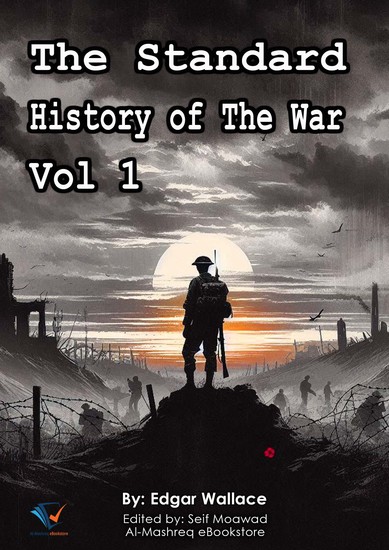
The Standard History of The War Vol 1 - cover
LER

The Standard History of The War Vol 1

Edgar Wallace

Editora: Al-Mashreq eBookstore

  • 0
  • 1
  • 0

Sinopse

The Standard History of The War, Vol 1 by Edgar Wallace is an in-depth, gripping account of one of the most tumultuous times in world history. Through Wallace's sharp writing and detailed research, this first volume takes readers to the frontlines, offering a vivid and harrowing look at the battles, strategies, and leaders that shaped the course of the war. From the tense political maneuvers to the brutal realities faced by soldiers, this book immerses readers in a pivotal moment in time, capturing the complexity of war and its far-reaching consequences. A must-read for history enthusiasts looking to gain a deeper understanding of this global conflict.
Disponível desde: 12/09/2024.
Comprimento de impressão: 280 páginas.


Outros livros que poderiam interessá-lo

  • The Save of My Life - My Journey Out of the Dark - cover

    The Save of My Life - My Journey...

    Corey Hirsch, Sean Patrick Conboy

    • 0
    • 0
    • 0
    A riveting look behind the mask of an NHL goalie, The Save of My Life offers understanding and hope to anyone living with mental illness 
    By the time he was twenty-two years old, goaltender Corey Hirsch had realized his childhood dream of playing in the NHL, won an Olympic medal and drunk from the Stanley Cup. While he excelled on the ice, out of the net Hirsch was plagued by persistent dark thoughts and ceaseless anxiety. On days when he could barely get out of bed, he was able to push aside the endless loop of dark thoughts running inside his brain long enough to win a game. But as soon as he got back home, the agonizing cycle started all over again. And it continued, until finally he was able to confide in a team trainer who helped him get the professional treatment he needed. Diagnosed with obsessive-compulsive disorder, Hirsch was able to embark on the rocky road to recovery. As one of the first professional athletes to talk openly about mental health, Hirsch wrote about his OCD for the Players’ Tribune. His piece remains one of their most-read articles ever. 
    As Hirsch says, “I am not insane. I am not a bad person. I am not weak. I have an illness, and there is a treatment.” 
    Ver livro
  • Biggest Tank Battles of the World Wars The: Tank Warfare in History’s Deadliest Conflicts - cover

    Biggest Tank Battles of the...

    Charles River Editors

    • 0
    • 0
    • 0
    World War I was the first truly industrial war, and it created a paradigm which reached its zenith with World War II and towards which virtually all equipment, innovation and training were dedicated throughout the Cold War and the remainder of the 20th century. To this day, modern warfare remains synonymous with tanks and mass infantry battles, although a confrontation of this nature has not occurred (except briefly during Operation Desert Storm) since World War II.  
    	One of the most important breakthroughs in military technology associated with World War I, and certainly the one that continues to capture the public imagination, was the introduction of a war machine that came to dominate the face of land battles throughout most of the 20th century: the tank. As a concept, it was not revolutionary; in fact, it harkened back to classical antiquity and to the Middle Ages, such as the covered battering rams and testudos which had made frequent appearances on ancient battlefields. In essence, it was designed to solve the age-old problem of protecting infantry from enemy projectiles while remaining mobile.  
    	The development of both modern artillery and machine guns, as well as the stalemate engendered by heavy fortifications and entrenchments, had hamstrung the mobility of infantry and cavalry and also left them both utterly vulnerable to defensive firepower. Since they were incapable of replying in kind, the tank was designed to bridge that gap. The tank’s armor, thick enough to withstand lateral fragmentation from exploding shells (although not direct hits) also made it virtually invulnerable to enemy rifle and machine gun fire, and its large tread meant that it could bridge trenches which would, at the very least, have delayed infantry substantially. As for the barbed wire entanglements and obstacles that severely delayed infantry and exposed them to enemy fire, tanks could simply drive right through it. 
    Ver livro
  • City on Fire - A Boyhood in Aligarh - cover

    City on Fire - A Boyhood in Aligarh

    Zeyad Masroor Khan

    • 0
    • 0
    • 0
    'An intimate new memoir about growing up amid everyday communalism' - The Hindu 
     
    Zeyad Masroor Khan was four years old when he realized that an innocent act of clicking a switch near a window overlooking the street could trigger a riot. As the distant thud of a crowd grew closer and calls for murder rent the air, he got his first taste of growing up in Upar Kot, a Muslim ghetto in Aligarh. Khan's world was far-removed from the Aligarh of popular imagination-of poets, tehzeeb and the intellectual corridors of the Aligarh Muslim University. His was a city where serpentine lanes simmered with violence, homes fervently prayed to dispel the omnipresent fear of a family member turning up dead, and the soft breeze that blew over crowded terraces carried rumours of a bloodthirsty mob on the prowl.  
    In his coming-of-age memoir, Khan writes, with searing honesty and raw power, about the undercurrents of religious violence and the ensuing 'othering' that followed him everywhere he went: from his schooldays in Aligarh, when hopping over to the lending library to the 'Hindu' part of town to find his favourite comic book or lighting candles with neighbours on Diwali was fraught with tension; through his years as a college student in Delhi, where being denied apartments because of his name was the norm; to ultimately becoming a journalist documenting history of his country as it happened.  
    City on Fire is a rare, visceral portrait of how everyday violence and hate become a part of our lives and consciousness; a society where name and clothes mark out a person as the 'other'. It is as much an incisive examination of religion and violence, imagined histories and fractured realities, grief and love in today's India, as it is a paean to the hope of continued unity, to an idea of India
    Ver livro
  • Lawyer Jailer Ally Foe - Complicity and Conscience in America's World War II Concentration Camps - cover

    Lawyer Jailer Ally Foe -...

    Eric L. Muller

    • 0
    • 0
    • 0
    It is 1942, and World War II is raging. In the months since Pearl Harbor, the US has plunged into the war overseas—and on the home front, it has locked up tens of thousands of innocent Japanese Americans in concentration camps, tearing them from their homes on the West Coast with the ostensible goal of neutralizing a supposed internal threat. 
     
    At each of these camps the government places a white lawyer with contradictory instructions: provide legal counsel to the prisoners, and keep the place running. Within that job description are a vast array of tasks, and an enormous amount of discretion they can use for good or for ill. They fight to protect the property the prisoners were forced to leave behind; they help the prisoners with their wills and taxes; and they interrogate them about their loyalties, sometimes driving them to tears. Most of these lawyers think of themselves as trying to do good in a bad system, and yet each ends up harming the prisoners more than helping them, complicit in a system that strips people of their freedoms and sometimes endangers their lives. 
     
    In Lawyer, Jailer, Ally, Foe, Eric L. Muller brings to vivid life the stories of three of these men, illuminating a shameful episode of American history through imaginative narrative deeply grounded in archival evidence. As we look through the lawyers’ sometimes-clear and sometimes-clouded eyes, what emerges is a powerful look at the day-by-day, brick-by-brick perpetration of racial injustice—not just by the system itself, but by the men struggling to do good within it.
    Ver livro
  • 300 per hour - The price for my freedom - cover

    300 per hour - The price for my...

    Mathilde Davril

    • 0
    • 0
    • 0
    "I am Mathilde, alias Mathilda. I am 37 years old and I prostitute myself to be a free woman. I have been an executive assistant, a sales manager in media, a communication manager for an employers' confederation and a company director in business aviation. But I was a precarious woman, being used for a low price, like a great majority of women in France. In parallel to my work activities, I became an escort to get out of my social condition and not be a free and disposable object anymore. I have been leading this double life for 10 years in Lyon; and today men, but also women, respect me for what I am. I like this life and I embrace it fully."
    Like 5% to 10% prostitutes in France (and certainly many more), Mathilde engages in this profession freely and without constraint, to no longer be the prey of males and a patriarchal society. Free, authentic and without pretense, she takes the reader on a journey of discovery of a profession that fascinates and that no one talks about in this way. With a provocative but always human tone, she reveals with strength and fragility her non-conformist universe and her atypical personality. From her family to her friends, from her lovers to her clients, from her jobs to her first trick, Mathilde shares her way of life openly because her reality does not need to be hidden.
    Ver livro
  • Nature & Culture - A change empowered by joy! - cover

    Nature & Culture - A change...

    Eco-Philosophy The Council for

    • 0
    • 0
    • 0
    Dalai Lama (2000) believes that seeking happiness "lies in our nature": The desire or need to be happy knows no bounds. It is something that lies in our nature. As such, it needs no grounds and it is justified by the simple fact that it is something we rightly want out of our nature. One has also asked if happiness is as important in all cultures. The answer is that happiness is at the top of the wish-list in every country; It is more important than wealth and to come to heaven, and as important as love (Diener and Biswas-Diener, 2008)...what makes us richer has been costly. The wealth, or what has been the prerequisite for wealth, has reduced a quieter life, close and stable relationships, we are moving apart. A materialistic lifestyle has a negative connection with happiness (Hellevik, 2003). NEF (2016) has calculated values on Happy Planet Index for 140 countries. Highest ranks Costa Rica and a number of other countries in Latin America. The population of Costa Rica has high values for happiness and longevity, and they have low values of ecological footprints. Norway has very high values of happiness and longevity, but also of footprints. In total, Norway is ranked twelfth and therefore highest among European countries, but closely followed by Albania. The United Kingdom is at thirty-fourth place, Canada number eighty-five and the United States number 108.
    Ver livro