Join us on a literary world trip!
Add this book to bookshelf
Grey
Write a new comment Default profile 50px
Grey
Subscribe to read the full book or read the first pages for free!
All characters reduced
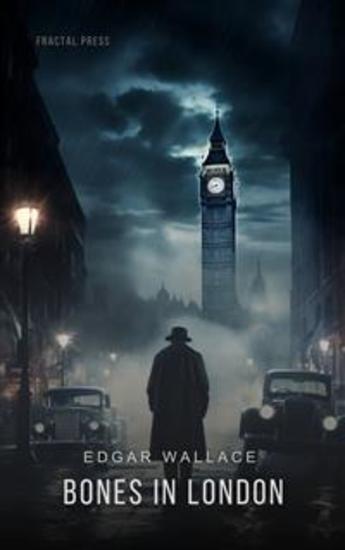
Bones in London - cover

Bones in London

Edgar Wallace

Publisher: Interactive Media

  • 0
  • 0
  • 0

Summary

"Bones in London" by Edgar Wallace is a riveting detective tale where Chief Inspector Larry Holt investigates a sinister plot involving stolen banknotes. As he navigates the criminal underworld, the story unfolds with suspense, humor, and unexpected twists. Wallace's narrative blends crime, mystery, and wit, revealing the complexities of the investigation. With vivid characters and a captivating plot, the novel showcases the author's mastery in creating a compelling and entertaining detective story set against the backdrop of London's gritty streets.
Available since: 11/25/2023.
Print length: 220 pages.

Other books that might interest you

  • Aristopia: a Romance-History of the New World - cover

    Aristopia: a Romance-History of...

    Castello Newton Holford

    • 0
    • 0
    • 0
    "Aristopia: A Romance-History of the New World is an 1895 utopian novel written by Castello Holford. It holds the distinction of being considered the first novel-length alternate history in English and is among the earliest examples of alternate histories in general1.    In this captivating tale, Ralph Morton, an early settler in Virginia, stumbles upon a reef made of solid gold. Rather than squandering his newfound wealth, Morton shrewdly uses it to establish a planned society called Aristopia (derived from the Greek word for "the best place"). Drawing inspiration from Sir Thomas More's Utopia, Morton introduces his own innovations and adaptations.    Here are some key features of Aristopia:    Land Ownership: In Aristopia, all land is owned by the government, which then leases it to businesses and private citizens.  Monopolized Trade: Large-scale trade is monopolized by the state.  Wealth Limitations: Inherited wealth is limited.  Productive Refugees: Morton welcomes productive refugees from European conflicts, including Huguenots, Irish fugitives, and skilled artisans from northern Italy and Switzerland.  Prosperity and Expansion: The colony thrives, expands westward, and even supports the American Revolution. Eventually, Aristopia conquers Canada and comes to dominate all of North America north of Mexico.  This novel offers a unique twist on the utopian genre by imagining an alternate history where the United States was founded under different circumstances, leading to a superior society in the author's own time"
    Show book
  • In Our Time - cover

    In Our Time

    Ernest Hemingway

    • 0
    • 0
    • 0
    In Our Time is the title of Ernest Hemingway's first collection of short stories, published in 1925. The collection is known for its spare language and oblique depiction of emotion, through a style known as Hemingway's "theory of omission". In Our Time was widely praised for its simple and precise use of language to convey a wide range of complex emotions, and earned Hemingway a place among the most promising American writers of that period. Now recognized as one of the most important short story collections of twentieth-century literature, In Our Time provides key insights into Hemingway's later works.
    Show book
  • Eyes for the Blind - From their pens to your ears genius in every story - cover

    Eyes for the Blind - From their...

    Frederick Cowles

    • 0
    • 0
    • 0
    Frederick Ignatius Cowles was born in 1900 in Cambridge, England. 
    This unfamiliar name is one of the gems of English supernatural fiction as well as several other works of travelogues, history, folklore, and children's books.  
    When his supernatural short stories, and some are very short indeed, were first published they were compared to the works of M R James and EF Benson, yet unlike those two authors he fell, unfairly, into obscurity. 
    In all he wrote perhaps 60 short stories with weird and supernatural themes. 
    Frederick Cowles died in 1948 although some accounts offer that it was 1949.
    Show book
  • O Russet Witch! - cover

    O Russet Witch!

    F. Scott Fitzgerald

    • 0
    • 0
    • 0
    O Russet Witch! - one of the stories, which entered in a collection of eleven short stories by F. Scott Fitzgerald "Tales of the Jazz Age" (1922). 
    This story was written just after the author completed the first draft of his second novel. However it may seem, the story was supposed to be in the present time/tense. It was published in the "Metropolitan".
    At the end of the story, Merlin deeply regrets not following his dreams. Caroline represents the life that Merlin always wanted, but he chooses to ignore these dreams. Merlin convinces himself that Caroline is nothing more than a witch that appears only to tempt him away from the safe life he has chosen. However, as soon as this false illusion of Caroline is shattered, Merlin falls apart. As an old man, Merlin finally realizes that he has not pursued any of his dreams and therefore his whole life has been a waste.
    Show book
  • Exchange is Robbery - From their pens to your ears genius in every story - cover

    Exchange is Robbery - From their...

    Richard Marsh

    • 0
    • 0
    • 0
    Richard Bernard Heldmann was born on 12th October 1857, in St Johns Wood, North London.  
    By his early 20’s Heldmann began publishing fiction for the myriad magazine publications that had sprung up and were eager for good well-written content.  
    In October 1882, Heldmann was promoted to co-editor of Union Jack, a popular magazine, but his association with the publication ended suddenly in June 1883.  It appears Heldman was prone to issuing forged cheques to finance his lifestyle.  In April 1884 he was sentenced to 18 months hard labour. 
    In order to be well away from the scandal and the damage that this had caused to his reputation Heldmann adopted a pseudonym on his release from jail.  Shortly thereafter the name ‘Richard Marsh’ began to appear in the literary periodicals.  The use of his mother’s maiden name as part of it seems both a release and a lifeline. 
    A stroke of very good fortune arrived with his novel ‘The Beetle’ published in 1897.  This would turn out to be his greatest commercial success and added some much-needed gravitas to his literary reputation.   
    Marsh was a prolific writer and wrote almost 80 volumes of fiction as well as many short stories, across many genres from horror and crime to romance and humour.   His unusual characters, plotting devices and other literary developments have identified his legacy as one of the best British writers of his time.   
    Richard Marsh died from heart disease in Haywards Heath in Sussex on 9th August 1915.  He was 57.
    Show book
  • Crime and Punishment - cover

    Crime and Punishment

    Fyodor Dostoyevsky

    • 0
    • 0
    • 0
    tbc
    Show book