¡Acompáñanos a viajar por el mundo de los libros!
Añadir este libro a la estantería
Grey
Escribe un nuevo comentario Default profile 50px
Grey
Suscríbete para leer el libro completo o lee las primeras páginas gratis.
All characters reduced
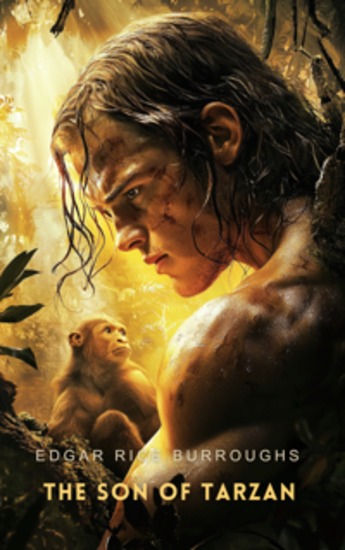
The Son of Tarzan - cover

The Son of Tarzan

Edgar Rice Burroughs

Editorial: Interactive Media

  • 0
  • 0
  • 0

Sinopsis

Son of Tarzan tells the story of Tarzan's son, Korak, and his efforts to rescue his mate and infant son from captivity. The novel is notable for its fast-paced action and dramatic scenes, as well as its use of academic jargon to describe the animals and locations in the story.
Disponible desde: 08/04/2022.
Longitud de impresión: 258 páginas.
Otros libros que te pueden interesar

  • Aunt Susanna's Thanksgiving Dinner (Unabridged) - cover

    Aunt Susanna's Thanksgiving...

    L. M. Montgomery

    • 0
    • 0
    • 0
    Lucy Maud Montgomery (November 30, 1874 - April 24, 1942), published as L. M. Montgomery, was a Canadian author best known for a series of novels beginning in 1908 with Anne of Green Gables. The book was an immediate success. The title character, orphan Anne Shirley, made Montgomery famous in her lifetime and gave her an international following.
    Aunt Susanna's Thanksgiving Dinner: "Here's Aunt Susanna, girls," said Laura who was sitting by the north window nothing but north light does for Laura who is the artist of our talented family. Each of us has a little pet new-fledged talent which we are faithfully cultivating in the hope that it will amount to something and soar highly some day.
    Ver libro
  • Les Misérables: Volume 4: The Idyll in the Rue Plumet and the Epic in the Rue St Denis - Book 8: Enchantments and Desolations (Unabridged) - cover

    Les Misérables: Volume 4: The...

    Victor Hugo

    • 0
    • 0
    • 0
    Victor-Marie Hugo (26 February 1802 - 22 May 1885) was a French poet, novelist, essayist, playwright, and dramatist of the Romantic movement. During a literary career that spanned more than sixty years, he wrote abundantly in an exceptional variety of genres: lyrics, satires, epics, philosophical poems, epigrams, novels, history, critical essays, political speeches, funeral orations, diaries, and letters public and private, as well as dramas in verse and prose.
    BOOK 8: ENCHANTMENTS AND DESOLATIONS: The reader has probably understood that Éponine, having recognized through the gate, the inhabitant of that Rue Plumet whither Magnon had sent her, had begun by keeping the ruffians away from the Rue Plumet, and had then conducted Marius thither, and that, after many days spent in ecstasy before that gate, Marius, drawn on by that force which draws the iron to the magnet and a lover towards the stones of which is built the house of her whom he loves, had finally entered Cosette's garden as Romeo entered the garden of Juliet.
    Ver libro
  • Antigone - Full Cast Drama - cover

    Antigone - Full Cast Drama

    Sophocles

    • 0
    • 0
    • 0
    "Antigone" is a Greek tragedy written by Sophocles in the 5th century BCE. The play is part of a trilogy, but only "Antigone," the third installment, has survived. The narrative revolves around Antigone, the daughter of Oedipus, who defies the king's decree and buries her brother Polynices, in defiance of the law. The king, Creon, orders that Polynices' body should remain unburied as punishment for his rebellion against the city. 
     
    Antigone's act of burial is not only an expression of familial loyalty but also an assertion of divine laws over human laws. She believes in the moral duty to honor her brother, even in death and is willing to face the consequences. Creon, however, sees her actions as an affront to his authority and issues a decree that anyone attempting to bury Polynices will be put to death. 
     
    As the plot unfolds, the clash between divine and human laws intensifies. Antigone is caught and brought before Creon, where she staunchly defends her actions. Creon remains resolute in his decision to punish her, regardless of her familial ties. The play explores themes of morality, duty, and the consequences of pride and authoritarian rule. 
     
    Tragedy unfolds as Antigone is sentenced to be entombed alive. The narrative weaves the fates of various characters, including Antigone, Haemon (Creon's son and Antigone's fiancé), and Eurydice (Creon's wife). The play culminates in a series of tragic events, leading to Creon's realization of his own tragic flaw and the devastating consequences of his decisions.
    Ver libro
  • The Odd Women - cover

    The Odd Women

    George Gissing

    • 0
    • 0
    • 0
    Before he was 21 George Gissing conceived the ambition of writing a long series of novels, somewhat in the manner of Balzac, whom he admired. The first of these, Workers in the Dawn, appeared in 1880, to be followed by 21 others. Between 1886 and 1895 he published one or more novels every year. He also wrote Charles Dickens: A Critical Study (1898), a perceptive piece of literary criticism.Gissing's work has a good deal of documentary interest for its detailed and accurate accounts of lower-middle-class London life. On the social position and psychology of women, he is particularly acute: The Odd Women is a powerful study of female frustration. He did not lack human sympathies, but his obvious contempt for so many of his characters reflects an artistic limitation. Gissing was deeply critical, in an almost wholly negative way, of contemporary society. Of his novels, New Grub Street, considered by some critics to be his only great book, is unique in its merciless analysis of the compromises required by the literary life.Gissing's 1893 novel takes on the 19th century "Woman Question" by looking at themes of feminism, marriage, and love. The novel raises these issues through the lives of several contrasting women: Mary Barfoot, a feminist philanthropist who helps train women for careers; her close friend Rhoda Nunn, who believes marriage is a disastrous choice for women; and Monica Madden, who starts out as one of their protegees but chooses to marry a seemingly kind older man. As Monica experiences the challenges of married life, Rhoda finds herself drawn to Mary's cousin, the charming but apparently profligate Everard
    Ver libro
  • The Adventures of Sherlock Holmes - cover

    The Adventures of Sherlock Holmes

    Sir Arthur Conan Doyle

    • 0
    • 0
    • 0
    "The Adventures of Sherlock Holmes is a collection of short stories by British writer Arthur Conan Doyle, first published on 14 October 1892. It contains the earliest short stories featuring the consulting detective Sherlock Holmes, which had been published in twelve monthly issues of The Strand Magazine from July 1891 to June 1892. The stories are collected in the same sequence, which is not supported by any fictional chronology. The only characters common to all twelve are Holmes and Dr. Watson, and all are related in first-person narrative from Watson's point of view.    In general, the stories in The Adventures of Sherlock Holmes identify, and try to correct, social injustices. Holmes is portrayed as offering a new, fairer sense of justice. The stories were well received and boosted the subscription figures of The Strand Magazine, prompting Doyle to be able to demand more money for his next set of stories. "
    Ver libro
  • The Cloak - cover

    The Cloak

    Nikolai Gogol

    • 0
    • 0
    • 0
    "The Cloak" (sometimes translated as "Overcoat") is a short story by Russian author Nikolai Gogol, published in 1842. The story and its author have had great influence on Russian literature, as expressed in a quote attributed to Fyodor Dostoyevsky: "We all come out from Gogol's 'Overcoat'." The story narrates the life and death of titular councillor Akaky Akakievich Bashmachkin, an impoverished government clerk and copyist in the Russian capital of St. Petersburg. Akaky is dedicated to his job, though little recognized in his department for his hard work. Instead, the younger clerks tease him and attempt to distract him whenever they can. His threadbare overcoat is often the butt of their jokes. Akaky decides it is necessary to have the coat repaired, so he takes it to his tailor, Petrovich, who declares the coat irreparable, telling Akaky he must buy a new overcoat.
    The cost of a new overcoat is beyond Akaky's meager salary, so he forces himself to live within a strict budget to save sufficient money to buy the new overcoat. Meanwhile, he and Petrovich frequently meet to discuss the style of the new coat. During that time, Akaky's zeal for copying is replaced with excitement about his new overcoat, to the point that he thinks of little else. Finally, with the addition of an unexpectedly large holiday salary bonus, Akaky has saved enough money to buy a new overcoat.
    Ver libro