Begleiten Sie uns auf eine literarische Weltreise!
Buch zum Bücherregal hinzufügen
Grey
Einen neuen Kommentar schreiben Default profile 50px
Grey
Jetzt das ganze Buch im Abo oder die ersten Seiten gratis lesen!
All characters reduced
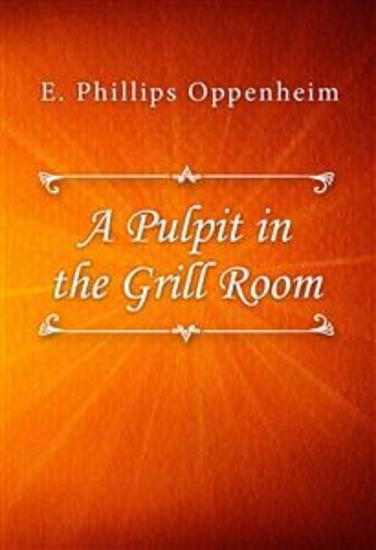
A Pulpit in the Grill Room - cover

A Pulpit in the Grill Room

E. Phillips Oppenheim

Verlag: Classica Libris

  • 0
  • 0
  • 0

Beschreibung

Ten short stories set in the grill room of the Milan Hotel in London.The first nine stories in this collection were “syndicated,” and published during the 1930s in British, American, Australian and other magazines. The tenth story was probably written specifically to complete this book collection, and was not published in a magazine until as late as 1967. A sequel, “The Milan Grill Room,” was published in 1940.The two books star Louis, the disabled maître d’hôtel, and Charles Lyson, ex-intelligence agent and now freelance journalist.Collection of stories: “The Mayor of Ballydaghan,” “Tragedy Dined With Lord Blunt,” “A Rough-House at Elstree,” “The Third Shot,” “The Hour of Reckoning,” “Murder at the Milan,” “Julie Joins the Force,” “The Three Strangers,” “Bunglers at the Game” and “The Flower of Death.”
Verfügbar seit: 30.09.2022.

Weitere Bücher, die Sie mögen werden

  • The Dreaming - cover

    The Dreaming

    Andre Bagoo

    • 0
    • 0
    • 0
    These stories have the virtue of taking the everyday lives of gay Trinidadian men utterly for granted in their searches for adventure, pleasure, self-realisation, loving contact and sex. Written with a sharpness of perception and in a variety of engaging personal voices, these narratives find room for humour, tragic haircuts, and a connection between tattoos and terrible poetry. But they also acknowledge very real fears in a society where there is still prejudice, discrimination and homophobic violence. The narrator of several of these pieces is a writer who wants to focus on the pleasures and inner dramas of these lives as the truth about gay experience. But there are also the stories of brutal murders reported with coy innuendo in the press. If he is tempted to see his lovers as characters in a witty fiction of manners, is this the novel that can be written in Trinidad? And since this is Trinidad, could the conflicted, self-hating Dorian really be a serial killer? But then when one of Bagoo's writer narrators unwittingly alarms his writing buddies by the freedom of his gothic imagination, who knows what might be true. Not for nothing does the author include the singer Kate Bush with her Wuthering Heights in his acknowledgements. Bagoo's stories offer a witty and incisive portrait of contemporary Trinidad in all its intersections of race, class and gender politics. Not least, they have a strong sense of place – Bagoo's gay Woodbrook offers a fine sequel to V.S. Naipaul's Woodbrook in his classic Miguel Street.
    Zum Buch
  • The Will and the Way Stories - cover

    The Will and the Way Stories

    Jessie Benton Frémont

    • 0
    • 0
    • 0
    Simply put, this is a book of 9 short vignettes each of which describes a different scenario which demonstrates the age old adage: 'where there's a will, there's a way'. (Summary by Roger Melin)
    Zum Buch
  • A Chameleon - cover

    A Chameleon

    Anton Chekhov

    • 0
    • 0
    • 0
    "A Chameleon" is a short sketch about the occurrence at the town square, where the main characters were a craftsman Hryukin, policeman Otchumyelov and stray puppy, surprisingly turned to be a property of the general's brother. Hearing about the bite suddenly turns into a scene of Otchumelov's attempts to save face in front of the curious crowd and maneuver between his ambitions and subservience. It is obvious that the story contains a satirical generalization. Psychology of this early story is not expressed verbally, not through the inner speech of the characters and not through the speech of the author-narrator, but through the external behavior - gestures, facial expressions, body movements, actions.A SmartTouch Media production.
    Zum Buch
  • Mr Midshipman Easy - cover

    Mr Midshipman Easy

    Frederick Marryat

    • 0
    • 0
    • 0
    At fourteen the unworldly, idealistic Jack Easy leaves the luxury of his father's estate in England and sails into a world of action and adventure aboard the sloop of war HMS Harpy. At first Jack finds it hard to stomach the discipline of naval life and, with his mischievous sense of humor, is always getting himself into scrapes. But soon he is bravely taming a band of mutinous seamen, outwitting a wily and murderous Sicilian nobleman, and breathing the smell of gunpowder and raw steel as the Harpy chases Spanish ships on the Mediterranean. 
    This neglected 1836 classic is both a rousing adventure story and a profound coming-of-age tale written with great skill and humor.
    Zum Buch
  • Our Strangers - stories - cover

    Our Strangers - stories

    Lydia Davis

    • 0
    • 0
    • 0
    From one of the most accomplished writers of our time comes another brilliant collection of short fiction. Artful, deft, and inventive; Lydia Davis’ newest collection of stories delves into topics ranging from marriage to tiny insects. These stories are a celebration of language and careful observation that once again confirms Davis’ sincere love and mastery of the form. 
    Only available at independent bookstores and libraries, by request of the author.
    Zum Buch
  • Volodya - From their pens to your ears genius in every story - cover

    Volodya - From their pens to...

    Anton Chekhov

    • 0
    • 0
    • 0
    Anton Pavlovich Chekhov was born on 29th January 1860 in Taganrog, on the south coast of Russia.  
    His family life was difficult; his father was strict and over-bearing but his mother was a passionate story-teller, a subject Chekhov warmed to. As he later said; ‘our talents we got from our father, but our soul from our mother’.  
    At school Chekhov was distinctly average. At 16 his father mis-managed his finances and was declared bankrupt. His family fled to Moscow. Chekhov remained and eked out a living by various means, including writing and selling short sketches to newspapers, to finish his schooling. That completed and with a scholarship to Moscow University obtained he rejoined his family. 
    He was able to help support them by selling satirical sketches and vignettes of Russian lifestyles and gradually obtained further commissions. In 1884, he qualified as a physician and, although it earned him little, he often treated the poor for free, he was fond of saying ‘Medicine is my lawful wife, and literature is my mistress.’ 
    His own health was now an issue as he began to cough up blood, a symptom of tuberculosis.  Despite this his writing success enabled him to move the family into more comfortable accommodation.  
    Chekhov wrote over 500 short stories which included many, many classics including ‘The Kiss’ and ‘The Lady with a Dog’.  His collection ‘At Dusk’ won him the coveted Pushkin Prize when was only 26.  
    He was also a major playwright beginning with the huge success of ‘Ivanov’ in 1887.   
    In 1892 Chekhov bought a country estate north of Moscow. Here his medical skills and money helped the peasants tackle outbreaks of cholera and bouts of famine. He also built three schools, a fire station and a clinic.  It left him with less time for writing but the interactions with real people gained him detailed knowledge about the peasantry and their living conditions for his stories.  
    His most famous work, ‘The Seagull’ was received disastrously at its premiere in St Petersburg. It was later restaged in Moscow to highlight its psychological aspects and was a huge success. It led to ‘Uncle Vanya’, ‘The Three Sisters’ and ‘The Cherry Orchard’.  
    Chekhov suffered a major lung hemorrhage in 1897 while visiting Moscow. A formal diagnosis confirmed tuberculosis and the doctors ordered changes to his lifestyle.  
    Despite a dread of weddings the elusive literary bachelor quietly married the actress Olga Knipper, whom he had met at rehearsals for ‘The Seagull’, on 25th May 1901. 
    By May 1904 with his tuberculosis worsening and death imminent he set off for the German town of Badenweiler writing cheerful, witty letters to his family and assuring them his health was improving.  
    On 15th July 1904 Anton Chekhov died at Badenweiler.  He was 44.
    Zum Buch