¡Acompáñanos a viajar por el mundo de los libros!
Añadir este libro a la estantería
Grey
Escribe un nuevo comentario Default profile 50px
Grey
Suscríbete para leer el libro completo o lee las primeras páginas gratis.
All characters reduced
Wanderings in London Piccadilly Mayfair and Pall Mall - cover

Wanderings in London Piccadilly Mayfair and Pall Mall

E. Beresford Chancellor

Editorial: Librorium Editions

  • 0
  • 0
  • 0

Sinopsis

Dr. Johnson in one of his rhetorical flights said that Charing Cross was practically the centre of the universe. “I think,” he observed to Boswell, on a celebrated occasion, “the full tide of human existence is at Charing Cross.” Theodore Hook, on the other hand, considered that that small area in St. James’s, bounded by Piccadilly and Pall Mall, St. James’s Street and Waterloo Place, was the acme of fashion, and contained within itself all that was best worth cultivating in the Metropolis.
Like all generalizations, neither of these dicta will bear the test of logical analysis. Hook’s favourite quarter has undergone many a change, and its present-day equivalent is more likely to be found in that larger area known to all the world as Mayfair. Similarly, although much of the tide of human existence still flows past the spot where Queen Eleanor’s body rested for the last time, on its way to the Abbey, that tide flows as fully and with as much noisy vehemence past half a hundred other crowded spots in London. It is probable, however, that at no one point does it surge and rage (to carry on the metaphor), with greater force than at the spot where Piccadilly and Bond Street join. At this spot stands “Stewart’s”—famed all the world over. I say “Stewart’s,” as I should say in Venice, “Florian’s,” or in New York, “Delmonico’s”; for there are certain famous establishments in all great cities which require no more specific designation.
Disponible desde: 15/10/2023.

Otros libros que te pueden interesar

  • Tech Detox Blueprint: Embracing Digital Minimalism for a Fuller Life - Reclaim Your Time and Attention in the Digital Age - cover

    Tech Detox Blueprint: Embracing...

    Sophia Reed

    • 0
    • 0
    • 0
    In a world dominated by screens and notifications, the "Tech Detox Blueprint: Embracing Digital Minimalism for a Fuller Life - Reclaim Your Time and Attention in the Digital Age" emerges as a beacon of hope for those seeking to break free from the shackles of digital overwhelm. This insightful book is your guide to embracing digital minimalism, empowering you to reclaim precious moments and focus on what truly matters. 
    Discover the secrets to a more fulfilling life as you delve into the profound principles of digital minimalism. The book provides a step-by- step blueprint, carefully curated to help you declutter your digital existence, re-establish meaningful connections, and rediscover the joy of living in the present moment. With real-life anecdotes and practical strategies, you'll find yourself inspired to make positive changes that resonate with your unique lifestyle. 
    Imagine a life where your time is yours to control, free from the incessant demands of technology. The "Tech Detox Blueprint" fuels your desire for a more intentional and purposeful existence. By prioritizing genuine experiences over digital noise, you'll find yourself with increased productivity, improved relationships, and a profound sense of inner peace. 
    Seize the opportunity to transform your life today! Dive into the "Tech Detox Blueprint" and embark on a journey towards digital liberation. With each chapter, you'll gain valuable insights and actionable tips that empower you to reclaim your time and attention. Embrace a fuller life by embracing digital minimalism - it's time to break free from the digital chaos and savor the richness of the analog world. Your journey to a more meaningful, balanced life begins here.
    Ver libro
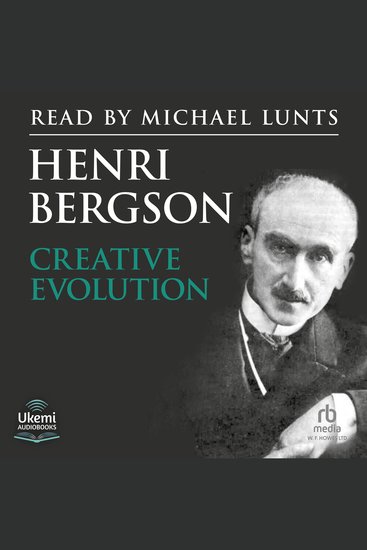
  • Creative Evolution - cover

    Creative Evolution

    Henri Bergson

    • 0
    • 0
    • 0
    Henri Bergson’s highly influential book, ‘Creative Evolution’ (‘Evolution Creatrice’, 1907) established a theory of evolution - called ‘Creative Evolution Theory’ - which gained a considerable following in the first half of the 20th Century. It also helped the author to win the Nobel Prize in 1927 for his work investigating the origins of biological information and divergence in the evolutionary process.  
     
    In this work, Bergson seeks an alternative explanation as to how new forms of life emerge compared to those prevailing at the time. This included both the ‘mechanistic’ or deterministic explanations of biological science on the one hand, and on the other the ‘finalist’ or strictly teleological explanation of those who believed in the hand of a ‘Creator’ or God, coordinating life in a divine plan. 
     
    Creative Evolution proposes a third explanation in what Bergson calls élan vital’ or ‘vital impetus’, a force that infuses all matter and drives it forward into an ever-changing and infinite variety of living forms. This appears as a vital impetus that can also be related to humanity’s own creative life force. Bergson’s book builds on his ‘Theory of Time’ as set forth in works such as ‘Matter and Memory’ and ‘Time and Free Will’.  In these works, and in the present volume, Bergson sees continuous ‘duration’ as real time, as opposed to the way in which time is divided up into measured units by the ‘organising’ mind of science. 
     
    Life, as we really experience it, is subject to constant change and our tendency to explain evolutionary change by looking only at ‘ends’ achieved rather than the processes by which they emerge, divorces us from the life force itself.  
     
    Instead, Bergson feels we need to reengage with our instincts as well as with our intelligence in order to understand the evolutionary process, as both co-exist to some extent within us, all forms of life having a common origin in that instinctual, innate knowledge of simpler life forms. Though these may be unconscious or semi-conscious, they are, in Bergson’s view, much more in touch with the ever-changing nature of real time than the analytical and rational knowledge of our species 
     
    As he writes:  “Our thought, in its purely logical form, is incapable of presenting the true nature of life, the full meaning of the evolutionary movement. Created by life, in definite circumstances, to act on definite things, how can it embrace life, of which it is only an emanation or an aspect?”  
     
    It is to attempt an answer to this question that ‘Creative Evolution’ directs its attention.
    Ver libro
  • Technology and Smart Cities - Innovation in the Urban Landscape (3 in 1) - cover

    Technology and Smart Cities -...

    Lyric Vale

    • 0
    • 0
    • 0
    At the intersection of technological innovation and urban human experience lies a revolutionary transformation of how we conceive, design, and inhabit our living spaces. Smart Cities represent more than a technological trend—they are a fundamental reimagining of urban environments where digital intelligence, interconnected systems, and human-centric design converge to create more responsive, efficient, and adaptive urban landscapes. This comprehensive exploration delves into the complex world of technological integration in urban systems, examining how digital networks, advanced sensors, artificial intelligence, and collaborative platforms are reshaping the very fabric of city life. 
    The narrative of smart cities is a dynamic journey of technological potential and human adaptation, where urban networks become living, breathing ecosystems of information and interaction. By exploring the intricate relationships between technology, infrastructure, social dynamics, and urban design, this book unveils the profound ways in which digital innovations are transforming traditional urban paradigms. Readers will discover how city networks are evolving from static infrastructures to intelligent, responsive systems that can anticipate needs, optimize resources, enhance sustainability, and create more inclusive, connected urban experiences. From data-driven urban management to the Internet of Things, from intelligent transportation systems to participatory digital platforms, this exploration offers a visionary perspective on how technology is not just changing cities, but fundamentally reimagining the potential of human collective living.
    Ver libro
  • Neuropsychology - cover

    Neuropsychology

    Miguel Vaquero

    • 0
    • 0
    • 0
    This book contains two topics, which are the following:1 - Memory Improvement: The ability for the brain to encode, store, and recall information is known as memory. Experience serves as a roadmap for future action.Memory includes both consciously recalled facts and experienced details as well as deeply embedded knowledge that pops up without thought or even awareness. It serves as both a temporary information storage space and a more lasting record of what has been learned.2 - The study of the anatomy and operation of the nervous system and the brain is known as neuroscience. To map the brain mechanistically, neuroscientists draw on cellular and molecular biology, anatomy and physiology, human behavior and cognition, and other fields.Each neuron, or brain cell, in an adult human has an estimated 100 billion connections to other neurons. The mapping of all the cell-to-cell communication networks—the brain circuits that process all ideas, feelings, and behaviors—remains one of the major difficulties of contemporary neuroscience. The resulting image that gradually forms is referred described as "the connectome." All learning is based on the brain's capacity to build new neural circuits and connections, or neuroplasticity.
    Ver libro
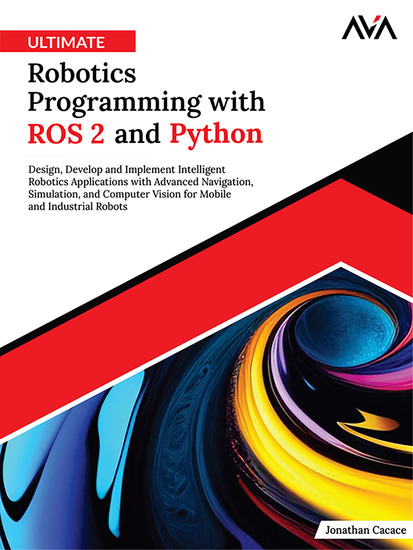
  • Ultimate Robotics Programming with ROS 2 and Python - Design Develop and Implement Intelligent Robotics Applications with Advanced Navigation Simulation and Computer Vision for Mobile and Industrial Robots - cover

    Ultimate Robotics Programming...

    Jonathan Cacace

    • 0
    • 0
    • 0
    Learn Robotics and ROS 2 with Practical Examples
    Book Description
    Robot Operating System (ROS) and Python are essential tools for developing advanced robotics applications, offering reliability and scalability for both research and industrial solutions. Ultimate Robotics Programming with ROS 2 and Python introduces readers to ROS 2 without requiring prior experience in robotics. It blends theoretical explanations with practical exercises, empowering readers to solve specific robotics problems while understanding the reasoning behind various approaches.
    The book covers a broad spectrum of robotics topics, including mobile robots, industrial manipulators, and aerial robots. These systems are simulated using the modern Gazebo simulator and programmed with ROS 2’s out-of-the-box tools and custom solutions using the ROS 2 API. The book also delves into computer vision, generative AI, and machine learning, providing hands-on examples of real-world applications.
    Table of Contents
    1. Introduction to Robot Operating System
    2. Hands-on ROS 2 Programming Using Python
    3. Supplementary Tools for ROS
    4. Robot Visualization and Simulation
    5. Writing Tests Using Pytest for ROS 2 Nodes
    6. Controlling an Inverted Pendulum with a PID Controller
    7. Laser-based Obstacle Avoidance with a Wheeled Mobile Robot
    8. ROS 2 Behaviour Trees Using Python
    9. Surveillance System Using Behaviour Trees
    10. Robot Navigation Using ROS 2 Navigation Stack (Nav2)
    11. Robot Arm Control Using MoveIt
    12. Programming Aerial Robots Using ROS
    13. Computer Vision Using ROS
    14. Object Detection Using ROS
    15. Using Large Language Models with ROS
    16. Deep Reinforcement Learning Using ROS 2       
    
    Index
    Ver libro
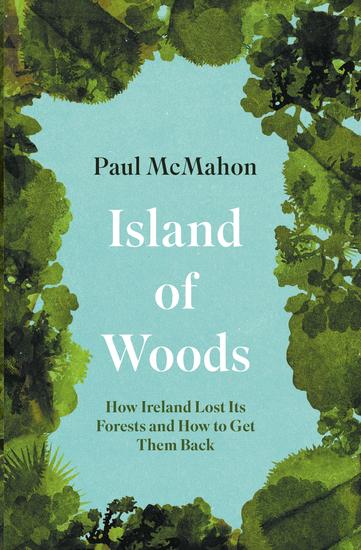
  • Island of Woods - How Ireland Lost its Forests and How to Get them Back - cover

    Island of Woods - How Ireland...

    Paul McMahon

    • 0
    • 0
    • 0
    Forestry in Ireland has never been so contentious. Over the last century the area of Irish woodland has increased tenfold, mostly through the planting of imported conifer species; government policy is to plant more trees to supply industry and to tackle climate change, both urgent priorities. But there has been a backlash from farmers, local communities, environmentalists and EU regulators. The rate of planting has plummeted. And up to one-third of new plantations in Ireland are failed forests that should never have been planted in the first place. How did we end up in this peculiar situation?
    Island of Woods traces the history of Irish forests over the last 10,000 years. It explains why Ireland lost so much of its forest cover, before a burst of tree-planting over the last few decades. It examines the state of Irish forestry today and sketches a way forward for our woods that balances commercial, environmental and social goals – a vision of a different type of forestry that could transform the Irish landscape and re-establish a genuine tree culture in the country.
    This engaging examination of Irish woodlands relates historical events to present-day concerns and controversies, drawing out crucial themes that continue to shape the Irish landscape.
    Ver libro