Join us on a literary world trip!
Add this book to bookshelf
Grey
Write a new comment Default profile 50px
Grey
Subscribe to read the full book or read the first pages for free!
All characters reduced
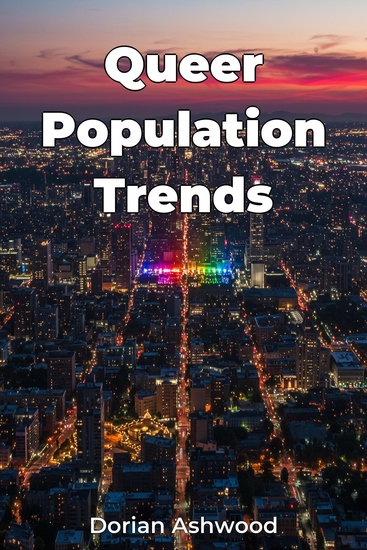
Queer Population Trends - cover

Queer Population Trends

Dorian Ashwood

Translator A Ai

Publisher: Publifye

  • 0
  • 0
  • 0

Summary

Queer Population Trends examines the evolving demographics of LGBTQ communities globally, revealing how social norms and political landscapes influence these shifts. This book navigates through key themes such as age distribution, identity formation, and urban migration. It highlights how legal reforms and social attitudes impact self-identification, revealing that LGBTQ demographic trends are profoundly influenced by broader political, economic, and social forces, not merely individual choices. Delving into comparative case studies, the book analyzes legal and social environments affecting LGBTQ acceptance. It presents quantitative data and qualitative research, drawing from global datasets to address the challenges in studying marginalized populations. For example, the concentration of LGBTQ individuals in urban areas is assessed, examining the socio-economic drivers behind these movements. The book progresses by first introducing key concepts, then examining legal landscapes, age distribution patterns, and the intersection of identity with factors like race and socio-economic status. It culminates in policy recommendations, emphasizing the need for inclusive data collection to inform policy and resource allocation, thereby contributing to the future of LGBTQ rights.
Available since: 04/07/2025.
Print length: 73 pages.

Other books that might interest you

  • Akkadian Empire The: A Captivating Guide to the First Ancient Empire of Mesopotamia and How Sargon the Great of Akkad Conquered the Sumerian City-States - cover

    Akkadian Empire The: A...

    Captivating History

    • 0
    • 0
    • 0
    Was the first empire really started by an abandoned orphan who rose to greatness? 
    Was there an empire older and more important than mighty Egypt? There were a few, but the Akkadian Empire, born out of the cradle of civilization, is thought to be the first. And it was a game-changer. Its creation inspired conquerors and other empire-builders throughout history and spawned two world powers. Its epics, legends, and beliefs influence religions and cultures even today—and make for some darn good listening. 
    Known mostly through clay tablets and stelae, the truth about the Akkadian Empire has intrigued and at times eluded scholars and historians. Victory reliefs made grandiose claims, and propaganda was rampant. Legendary poems countered cautionary tales about arrogance and oppression. We will discuss the men who ruled the empire and the legends that define what we know about them. 
    Some of the treasures you’ll discover about the Akkadian Empire includes:Why the Sumerians were an important part of the empireThe grand wealth and cruelty that accompanied Queen Puabi to her graveHow the first empire-builder the world has ever known rose up from mysterious and legendary originsWhat made Sargon so great?How an empire made up of city-states wanting independence was constantly on the verge of breaking apartThe epic adventures of Gilgamesh—how he slew a forest monster and the tragic consequences for earning the wrath of the godsHow did Naram-sin achieve god-like status? 
    Scroll up and click the “add to cart” button to learn more about the Akkadians and the first known empire!
    Show book
  • Trained by the Football Team (Straight to Gay BDSM Erotica) - cover

    Trained by the Football Team...

    Archer Vale

    • 0
    • 0
    • 0
    I always thought I was straight…but now I’m not sure. 
    “P-please! I promise to be a good boy!” 
    I kneel before the ripped, suntanned alpha male, begging for his most precious gift. He’s the college quarterback and I’m the water boy. He’s my king and I’m his loyal servant. 
    This all began when the football team invited me into their hidden clubhouse. It began when they put a collar around my neck and fed me their seed. The strange flavor…it made my head spin and caused my muscles to relax. 
    I’ve never been the same since. 
    I think I’m addicted… 
    --- 
    CONTAINS EXPLICIT GAY SEXUAL CONTENT. 
    For exclusive stories, visit www.ArcherVale.com.
    Show book
  • Mastering the Philly Accent - A Guide to the Accent Of Philadelphia for the Stage and Screen - cover

    Mastering the Philly Accent - A...

    Oscar Stanley

    • 0
    • 0
    • 0
    This comprehensive audio guide helps actors and language enthusiasts master the distinctive sounds of Philadelphia speech. Perfect for performers preparing for auditions, dialect coaches, and anyone fascinated by American regional accents.
     
    Discover the unique "wooder" phenomenon, where locals transform "water" into something entirely different. Learn the complex Short-A Split System that gives Philadelphia speech its characteristic melody. The guide breaks down distinctive consonant patterns like L-vocalization and subtle R-dropping that create authentic Philly speech rhythm.
     
    Explore how nasal resonance uniquely shapes vowel sounds and understand unexpected stress patterns in multi-syllabic words. Follow along with practice phrases and exercises developed by a dialect expert to internalize these speech patterns naturally.
     
    The course includes contemporary and traditional pronunciations, showing how the accent evolves across generations while maintaining its core character. Build an authentic vocabulary with regional expressions like "jawn," "youse," and "down the shore."
     
    Whether you're studying dialect for acting roles, preparing for an upcoming Philadelphia-based production, or simply interested in American regional speech patterns, this audio resource provides everything needed to convincingly reproduce this distinctive urban dialect.
     
    Keywords: Philadelphia accent, Philly dialect training, acting preparation, regional American speech, dialect coaching, wooder pronunciation, short-a split, L-vocalization
    Show book
  • Who Owns The Moon? - In Defence of Humanity's Common Interests in Space - cover

    Who Owns The Moon? - In Defence...

    A. C. Grayling

    • 0
    • 0
    • 0
    Silicon for microchips; manganese for batteries; titanium for missiles. 
     
    The moon contains a wealth of natural resources. So, as the Earth’s supplies have begun to dwindle, it is no surprise that the world’s superpowers and wealthiest corporations have turned their eyes to the stars. As this new Space Race begins, A.C. Grayling asks: who, if anyone, owns the moon? Or Mars? Or other bodies in near space? And what do those superpowers and corporations owe to Planet Earth and its inhabitants as a whole? 
     
    From feudal common land, through the rules of the sea, to the vast, nationless expanse of Antarctica, Grayling explores the history of the places which no one, and therefore everyone, owns. Examining the many ways this so-called terra nullius has fallen victim to ‘the tragedy of the commons’ – the tendency for communal resources to be exploited by a few individuals for personal gain at the expense of everyone else – Who Owns the Moon? puts forward a compelling argument for a bold new global consensus, one which recognises and defends the rights of everyone who lives on this planet.
    Show book
  • The Anti-Greed Gospel - Why the Love of Money Is the Root of Racism and How the Church Can Create a New Way Forward - cover

    The Anti-Greed Gospel - Why the...

    Malcolm Foley

    • 0
    • 0
    • 0
    "A forceful call to recognize the roots of American inequality and a solid starting point for Christians who want to help fix them." —Publishers Weekly 


    Racism is not about hate and ignorance. It's about greed. And it always has been. 


    Black Christian historian Malcolm Foley explores this idea in The Anti-Greed Gospel, showing how the desire for power and money—what some call "racial capitalism"—causes violence and exploitation. 


    Foley reviews the history of racial violence in the United States and connects the killings of modern-day Black Americans to the history of lynching in America. He helps the contemporary church wrestle with the questions racial violence brings up: How can we become communities that show generosity and resist greed? What is the next step in the journey for racial justice? 


    Listeners will walk away with a better understanding of how they can resist greed that exploits others, love their neighbor more completely, and build communities of deep solidarity, anti-violence, and truth telling.
    Show book
  • Decolonization Movements - The Struggle for Independence and Post-Colonial Challenges - cover

    Decolonization Movements - The...

    Arlo Holders

    • 0
    • 0
    • 0
    Decolonization refers to the process through which colonies gained independence from colonial powers, transitioning from subjugation to self-rule. This process unfolded across the globe, but particularly after the end of World War II, when the political, economic, and social landscapes of the world were rapidly changing. Decolonization was not merely a political transition; it also involved profound shifts in cultural, economic, and social structures. It marked the end of European empires, the dismantling of colonial systems, and the establishment of new nation-states. The effects of decolonization were not only seen in the immediate transfer of power but also in the long-lasting impacts on national identity, social cohesion, and global politics. 
    Historically, colonialism began in the 15th century as European powers, driven by the desire for resources, land, and global dominance, began to expand across the world. Colonies were established in Africa, Asia, the Middle East, and the Americas, often resulting in the exploitation and oppression of indigenous populations. Colonialism shaped the economies and cultures of colonized countries, as the colonial powers imposed their own systems of governance, language, and religion. 
    World War II played a significant role in the rise of decolonization movements. The war weakened the colonial powers, both economically and militarily, while at the same time igniting new ideas about self-determination and sovereignty. The brutal realities of war exposed the contradictions of imperialism, and the idea of a free and independent world began to gain ground. Additionally, the United Nations (UN) emerged after the war as an international body that championed the principles of self-determination and human rights, further encouraging movements for independence.
    Show book