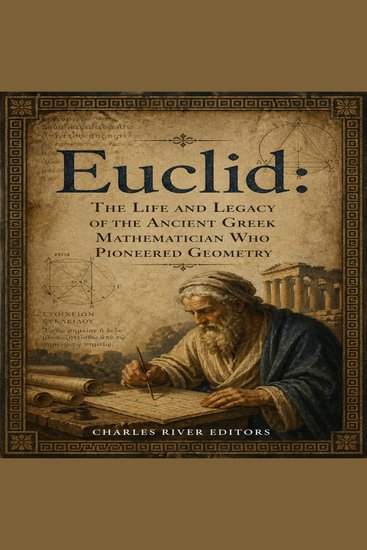
Euclid: The Life and Legacy of...
Charles River Editors
Of the many mathematical advances made by the Greeks, none rival those established by Euclid of Alexandria, who likely remains the most famous ancient mathematician despite the fact little is actually known about his life. He revolutionized geometry, mathematics, and astronomy in Alexandria, Egypt, around 300 BCE, yet left almost no clues about his life story. Historians know he was a trailblazing mathematician and dabbled in astronomy because he wrote many books on these topics, and a 13-book treatise of his has survived, along with four other books. Thus, it’s clear what Euclid learned and knew, but virtually nothing is known about how his life unfolded or what he was like as a person.
	To this day for many students, geometry class was the first time discovering that mathematics is more than calculating numbers. Some may have expected to study shapes, sizes, positions, and the properties of space, but perhaps for the first time, a geometry class required proving why the calculations were true through rigorous, logical arguments using definitions, postulates, and theorems. For countless students, it is excruciating, while others find it fascinating. Either way, the person to thank (or blame) for that is Euclid.
	Often called the “Father of Geometry,” Euclid’s influence is so pervasive that his book, The Elements, was the primary math manual for over 2,000 years. It was not a “textbook” in the modern sense, as it did not have problem sets, word problems, or diagrams for practice, but it was a foundational reference and logical guide that students had to read, memorize, and demonstrate. In both the Western and Islamic worlds, Euclid’s Elements was the standard geometry text for almost every educated person until the 19th century.
Ver livro