Junte-se a nós em uma viagem ao mundo dos livros!
Adicionar este livro à prateleira
Grey
Deixe um novo comentário Default profile 50px
Grey
Assine para ler o livro completo ou leia as primeiras páginas de graça!
All characters reduced
Weapon of Choice - US Army Special Operations Forces in Afghanistan: Awakening the Giant Toppling the Taliban The Fist Campaigns Development of the War - cover
LER

Weapon of Choice - US Army Special Operations Forces in Afghanistan: Awakening the Giant Toppling the Taliban The Fist Campaigns Development of the War

Defense United States Department of, Institute Combat Studies

Editora: e-artnow

  • 0
  • 0
  • 0

Sinopse

"Weapon of Choice" presents a history of the U.S. Army special operations forces in Afghanistan from 11 September 2001 to 15 May 2002, during America's global war on terrorism. The purpose of the book is not to resolve Army special operations doctrinal issues, to clarify or update military definitions, or to be the "definitive" history of the continuing unconventional war in Afghanistan. The purpose is to demonstrate how the war to drive the Taliban from power, help Afghan people, and assist the Afghan Interim Authority (AIA) rebuild the country afterward was successfully accomplished by majors, captains, warrant officers, and sergeants on tactical teams and aircrews at the lowest levels. Contents:  Prelude to Terror Awakening the Giant "Subdue Without Fighting" Developing the SOF Campaign Top Draft Choices Committed to Middle East Exercises Civil Affairs to Islamabad, Pakistan Site Coordination With the Uzbeks at Karshi Kanabad Uncorking the Bottled Airlift Toppling the Taliban in Afghanistan, 19 October-7 December 2001 Jumping Into the Dark Showing American Power "Look, We Have to Get the Special Forces Teams Into Afghanistan!" On Horseback With Dostum A "Bump" and Missiles in the Abyss 500 Afghans Can Die, But Not One American Can Be Injured Al-Qaeda Uprising—Qala-i-Jangi The Karzai Way to Kandahar The Campaign in Transition, 8 December 2001-28 February 2002 Old Glory Flies Again in Kabul Taking Down al-Qaeda at the Mir Wais Hospital Politics, War, and Rapport End of Mission—Aerial Resupply in Afghanistan The New War Entering the Valley D-Day ANACONDA From the Viewpoint of Force Multipliers "Good Morrrrning, Afghannnnistan" Driving the Taliban From Power Transition and Combat Operations
Disponível desde: 14/12/2023.
Comprimento de impressão: 404 páginas.


Outros livros que poderiam interessá-lo

  • Stories from Kathasaritasagara series -1 - From Various sources - cover

    Stories from Kathasaritasagara...

    Anusha HS

    • 0
    • 0
    • 0
    The book Kathasaritsagara has been created by Soma Deva. It consists of 21,500 shlokas. 
     This book Kathasaritsagara has been divided into 18 lambakaas, and those 18 lambakaas are still more divided into 125 Tharanga's. 
     Some lambakaas are very big, while some are very small. 
     If there are 115 Shlokas in the 11th Lambaka, there are around 4925 Shlokas in 12th Lambaka. 
     During ancient times from the mouth of Lord Shiva, this story got birth. Those who listen to this story will experience all sorts of worldly pleasures. They will be blessed by Lord Shiva and at last reach jnana Loka by the blessings of lord shiva.
    Ver livro
  • The Coach’s Toolkit - cover

    The Coach’s Toolkit

    Santiago Machain

    • 0
    • 0
    • 0
    The Coach's Toolkit is the second book in the transformational The Coaching Evolution Series. Designed for aspiring and practicing coaches, this guide bridges the gap between foundational knowledge and powerful application. Within its pages, readers will discover essential coaching frameworks like GROW, SMART goals, and SWOT analysis, and learn how to use them with integrity and flexibility. 
    The book dives deep into career mapping, entrepreneurial planning, personal branding, and financial mindset coaching. It equips readers to work with both job seekers and business clients—guiding them through career transitions, startup scaling, market discovery, networking, and beyond.  
    Whether you're a new coach seeking structure or an experienced coach refining your craft, this book offers actionable insights, rich context, and practical wisdom to elevate your practice and your clients' outcomes.
    Ver livro
  • Mussolini in Myth and Memory - The First Totalitarian Dictator - cover

    Mussolini in Myth and Memory -...

    Paul Corner

    • 0
    • 0
    • 0
    Mussolini has rarely been taken seriously as a totalitarian dictator; Hitler and Stalin have always cast too long a shadow. But what was a negative judgement on the Duce, considered innocuous and ineffective, has begun to work to his advantage. As has occurred with many other European dictators, present-day popular memory of Mussolini is increasingly indulgent; in Italy and elsewhere he is remembered as a strong, decisive leader. Mussolini in Myth and Memory argues against this rehabilitation, documenting the inefficiencies, corruption, and violence of a highly repressive regime and exploding the myths of fascist good government. But this short study does not limit itself to setting the record straight; it seeks also to answer the question of why there is nostalgia for dictatorial rule. Linking past history and present memory, Corner's analysis constructs a picture of the realities of the Italian regime and examines the more general problem of why, in a moment of evident crisis of western democracy, people look for strong leadership and take refuge in the memory of past dictatorships. If, in this book, Fascism is placed in its totalitarian context and Mussolini emerges firmly in the company of his fellow dictators, the study also shows how a memory of the past, formed through reliance on illusion and myth, can affect the politics of the present.
    Ver livro
  • The Legends of the West Point Class of 1846 - cover

    The Legends of the West Point...

    Editors Charles River

    • 0
    • 0
    • 0
    West Point has long been America’s most famous military academy, but in the early 19th century, it was a highly unimpressive school consisting of a few ugly buildings facing a desolate, barren parade ground. Established with just five officers and ten cadets of the Corps of Engineers on March 16, 1802, the Academy was built on a spot just 50 miles north of New York City which had been a key Hudson River military fortress during the Revolutionary War. Cadets attending during the “Point's” first several decades were obliged to maintain their daily regimen knowing the school might shut down at any moment, as the U. S. government frequently questioned why it should provide free education. 
    As it turned out, West Point would become the foremost military academy in the nation, but none of the West Point classes became as famous as the Class of 1846, which boasted more than a dozen future Civil War generals. The Class of 1846 included a shy kid named Thomas Jonathan Jackson who made few friends and struggled with his studies, finishing 17th in his class 15 years before becoming Stonewall. Also in that class was A.P. Hill, who was already in love with the future wife of George McClellan, a young prodigy who finished second in the class of 1846. A popular and mischievous George Pickett would play hooky at the local bar and struggle just to finish last in the class, and the Class of 1846 also churned out critical Union generals like Jesse Reno, Darius Couch, and George Stoneman. 
    Before these men opposed each other on Civil War battlefields, they forged their own friendships and charted their future paths together at West Point and the Mexican-American War. 
    Ver livro
  • America’s Defeat - A Revolutionary War Won by the British - cover

    America’s Defeat - A...

    Marcus Draysun

    • 0
    • 0
    • 0
    The American colonies in the mid-18th century were a thriving part of the British Empire, but tensions had been brewing for decades. What began as minor grievances over trade and governance escalated into a full-scale rebellion. British policies, aimed at tightening control over the colonies, ignited widespread dissatisfaction, planting the seeds of revolution. 
    One of the earliest sources of discontent was the British system of taxation. The Sugar Act of 1764 and the Stamp Act of 1765 imposed direct levies on the colonies, enraging merchants, publishers, and legal professionals. The colonists, who had no direct representation in the British Parliament, saw these taxes as a blatant overreach. Their rallying cry—“No taxation without representation”—became a defining slogan of the growing resistance. The Stamp Act’s repeal in 1766 provided temporary relief, but the British government soon followed with new policies, including the Townshend Acts, which further strained relations. 
    The presence of British troops in colonial cities only exacerbated tensions. Stationed to enforce British laws and maintain order, soldiers were often viewed as an occupying force. Clashes between civilians and the military became frequent, culminating in the infamous Boston Massacre of 1770, where British troops fired into a crowd of unarmed colonists, killing five. This event, heavily publicized by Patriot leaders, fueled anti-British sentiment and strengthened calls for defiance.
    Ver livro
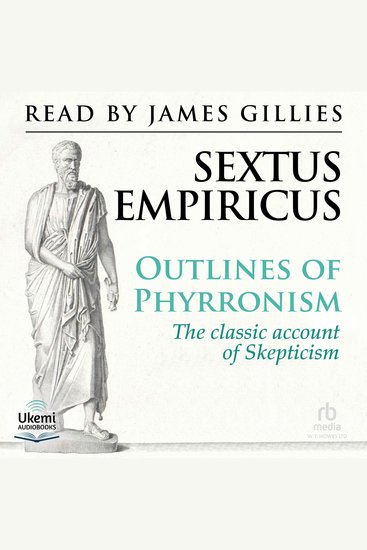
  • Outlines of Pyrrhonism - cover

    Outlines of Pyrrhonism

    Sextus Empiricus

    • 0
    • 0
    • 0
    Throughout history philosophers have sought to define, understand, and delineate concepts important to human well-being. One such concept is knowledge. Many philosophers believed that absolute, certain knowledge, is possible—that the physical world and ideas formulated about it could be given solid foundation unaffected by the varieties of mere opinion. 
     
    Sextus Empiricus stands as an example of the skeptic school of thought whose members believed that knowledge was either unattainable or, if a genuine possibility, the conditions necessary to achieve it were next to impossible to satisfy. In other words, in the absence of complete knowledge, one must make do with the information provided by an imperfect world and conveyed to the mind through sense impressions that can often deceive us. Throughout his life Sextus Empiricus entered into intellectual combat with those who confidently claimed to possess indubitable knowledge. For skeptics, the best one can hope to achieve is a reasonable suspension of judgment—remaining ever mindful that claims to knowledge require careful scrutiny, thoughtful analysis, and critical review if we are to prevent ourselves and others from plunging headlong into mistaken notions.
    Ver livro