Junte-se a nós em uma viagem ao mundo dos livros!
Adicionar este livro à prateleira
Grey
Deixe um novo comentário Default profile 50px
Grey
Assine para ler o livro completo ou leia as primeiras páginas de graça!
All characters reduced
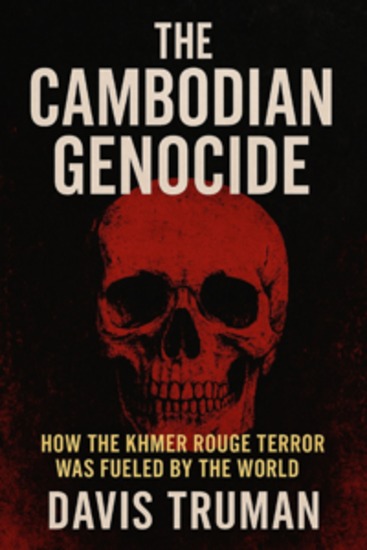
The Cambodian Genocide - How The Khmer Rouge Terror Was Fueled by The World - cover
LER

The Cambodian Genocide - How The Khmer Rouge Terror Was Fueled by The World

Davis Truman

Editora: Davis Truman

  • 0
  • 0
  • 0

Sinopse

A gripping and unflinching examination of one of the darkest chapters in modern history and the global forces that allowed it to unfold.Between 1975 and 1979, Cambodia endured unimaginable horror under the Khmer Rouge regime, where nearly two million lives were lost to systematic brutality, starvation, and mass executions. But this is not just the story of a ruthless dictatorship; it is the story of how international powers, driven by Cold War rivalries and geopolitical interests, turned a blind eye and sometimes actively enabled the rise and reign of terror.Drawing on newly uncovered documents, survivor testimonies, and incisive analysis, this book reveals the tangled web of political alliances, foreign interventions, and diplomatic failures that contributed to the genocide. From secret bombings and covert support to the paralysis of the United Nations, it exposes how global dynamics shaped Cambodia’s fate, allowing one of history’s greatest atrocities to remain hidden for decades.The Cambodian Genocide challenges readers to confront uncomfortable truths about international responsibility, the cost of political indifference, and the enduring scars left on a nation. It is a vital, haunting reminder of how the world’s silence can become complicit in the darkest of crimes — and a call never to forget the lessons of history.
Disponível desde: 28/05/2025.


Outros livros que poderiam interessá-lo

  • Special Men - A LRP's Recollections - cover

    Special Men - A LRP's Recollections

    Dennis Foley

    • 0
    • 0
    • 0
    A recipient of two Purple Hearts gives readers an inside view of US Army special forces through his own trial by fire during the Vietnam War. Days before he was drafted in 1962, Dennis Foley volunteered to join the army in the hopes of someday getting into West Point. He was only eighteen years old. At basic training in Fort Dix, New Jersey, a presentation by two impressive, self-confident special forces sergeants made an indelible impression on him. His career would come full circle. In 1972, wearing a green beret, Foley would be given command of his own A-Team. But between those two pivotal moments, his determination, loyalty, and mental and physical strength would be tested as never before, fighting in the jungles of Vietnam alongside the bravest men he would ever know. In Special Men, Foley describes his experience at the 7th Army NCO Academy in Germany, where he learned more about leadership than at any other school he would later attend. He takes us moment-by-moment on his heart-pounding introduction to combat—a nighttime, amphibious ambush patrol with the South Vietnamese Navy. We see the shock set in upon realizing that conventional training left him unprepared for the guerrilla army he faced in Vietnam. And we share his sadness over fallen comrades and his own relief at surviving his injuries. This is an unvarnished account of horror and heroism and a tribute to the unselfish devotion to duty of the LRPs, Rangers, and Green Berets.
    Ver livro
  • Unsettling Choice - Race Rights and the Partitioning of Public Education - cover

    Unsettling Choice - Race Rights...

    Ujju Aggarwal

    • 0
    • 0
    • 0
    What do universal rights to public goods like education mean when codified as individual, private choices? Is the "problem" of school choice actually not about better choices for all but about the competition and exclusion that choice engenders? Unsettling Choice addresses such questions through a compelling ethnography that illuminates how one path of neoliberal restructuring in the United States emerged in tandem with, and in response to, the Civil Rights movement. 


    Unsettling Choice traces the contestations that surfaced when, in the wake of the 2007–2009 Great Recession, public schools navigated austerity by expanding choice-based programs. Ujju Aggarwal argues that this strategy mobilized mechanisms rooted in market logics to recruit families with economic capital on their side, solidifying a public sphere that increasingly resembled the private. 


    As Unsettling Choice shows, these struggles over public schools were entrapped within neoliberal regimes that exceeded privatization and ensured exclusion even as they were couched in language of equity, diversity, care, and rights. This book tracks an architecture of expansive rights, care, and belonging built among poor and working-class parents at a Head Start center, whose critique of choice helps us understand how we might struggle for justice, and a public that remains to be won.
    Ver livro
  • A Jazz Age Murder in Northwest Indiana - The Tragic Betrayal of Nettie Diamond - cover

    A Jazz Age Murder in Northwest...

    Jane Simon Ammeson

    • 0
    • 0
    • 0
    Gold digging, adultery, and a slaying on Valentine's Day, 1923, in this "juicy . . . page-turner" of a true crime story (Chicago Tribune). 


    It was a Roaring Twenties fatal attraction. Nettie Herskovitz was wealthy and widowed when she met Harry Diamond. The attentive, irresistibly sexy twenty-three-year-old suitor would become Nettie's fifth husband. He was also a bootlegger, pimp, and first-class hustler who thought he'd wed a goldmine. What Harry found instead was a fiercely independent older woman who was nobody's fool for long. 


    Then, on February 14, 1923, Harry tried to secure his inheritance by shooting Nettie four times, once at point blank range to the head. He blamed the crime on their teenage African American chauffeur. Harry might have gotten away with it, if not for one little oversight. Nettie wasn't dead. 


    With its combination of sin, sex, high-society scandal, and even the interference of the Ku Klux Klan, the case against the movie-star handsome Harry Diamond moved beyond tabloid fodder to become the most sensational trial of the era.
    Ver livro
  • Red Cloud’s War: The History and Legacy of the Only 19th Century War Won by Native Americans against the United States - cover

    Red Cloud’s War: The History and...

    Editors Charles River

    • 0
    • 0
    • 0
    In the summer of 1866, Colonel Henry B. Carrington set out from Fort Laramie to establish a series of forts along the Bozeman Trail with the goal of protecting migrants moving along the trail. The Bozeman Trail ran through the Powder River country, which included the traditional hunting grounds of Lakota, Cheyenne, and Arapaho peoples. Carrington had about 1,000 people in his column, of which about 700 were soldiers and 300 were civilians, likely soldiers’ families and migrants. 
    The ongoing hostilities, which included the notorious Fetterman's Massacre, ultimately convinced American officials to head back to the negotiating table with the Native Americans, and as a result, Red Cloud has often been labeled the only Indian chief to win a war against the Americans. After that, however, Red Cloud continued to lead his people to reservations first near the Black Hills and later westward after the Battle of the Little Bighorn. Though he was respected as a war chief, it was his political functions as a spokesman of the Oglala that truly allowed Red Cloud to leave his mark over the last several decades of his life. Whereas Sitting Bull and Crazy Horse suffered premature deaths, Red Cloud outlived the other important leaders of the Sioux until dying in 1909 at 87 years old. Near the end of his life, he reportedly said, “They made us many promises, more than I can remember. But they kept but one -- they promised to take our land...and they took it.” 
    Red Cloud’s War: The History and Legacy of the Only 19th Century War Won by Native Americans against the United States analyzes the seminal moments that brought about the war, the war’s most famous battles, and the aftermath.
    Ver livro
  • A Little Bit of Land - cover

    A Little Bit of Land

    Jessica Gigot

    • 0
    • 0
    • 0
    From midwifing new lambs to harvesting basil, Jessica Gigot invites the reader into her life on a small farm and the uncommon road that led her there. Fascinated by farming and the burgeoning local food movement, she spent her twenties wandering the Pacific Northwest, interning at small farms and doing graduate work in horticulture, always with an eye towards learning as much as she could about how and why people farm. Despite numerous setbacks and the many challenges of farming, she created a family and farm life defined by resilience and a genuine love of the land.   
    In A Little Bit of Land, Gigot explores the intricacies of small-scale agriculture in the Pacific Northwest and the changing role of women in this male-dominated industry. Gigot alternates between chapters describing joys, routines, and challenges of farm life and chapters reflecting on her formative experiences in agriculture, on farms and in classrooms from Ashland to the Skagit Valley. Throughout, she explores questions of sustainability, economics, health, and food systems.
    Ver livro
  • The American Operations in WW2: Po Valley - cover

    The American Operations in WW2:...

    U.S. Army Center of Military...

    • 0
    • 0
    • 0
    World War II was the largest and most violent armed conflict in the history of mankind. Highly relevant today, World War II has much to teach us, not only about the profession of arms, but also about military preparedness, global strategy, and combined operations in the coalition war against fascism. This book follows military operations in Italy from 5 April to 8 May 1945. 
    The Allies had begun their invasion of the Italian mainland in early September 1943 with the promise of a quick drive north, up the "soft underbelly" of Europe and into the German heartland. Yet nineteen months later, after hard fighting up the rugged mountainous spine of the narrow Italian peninsula, such goals still eluded the Anglo-American military leaders of the Mediterranean Theater. To be sure, long before April 1945 Rome had fallen to Allied arms and fascist Italy had been knocked almost completely out of the war. But in the interval France had also been liberated, and the Soviet Union had reclaimed almost all of its territory previously conquered by the once invincible German war machine.
    Italy had in fact become a sideshow, a secondary theater, since the spring of 1944 when the western Allies had shifted their military resources north to support the buildup and execution of Operation OVERLORD, the invasion of Normandy. After that, there had been no turning back on the Anglo-American side, with its main effort directed east through the northern European plains. Thus, by April Germany was besieged on three sides, although the Allied forces in the south, those strung out along the northern Apennines overlooking the Po Valley, were now the farthest away from the tottering Third Reich. British Prime Minister Winston Churchill continued to strongly support an advance from northern Italy into the Balkans and southern Germany. However, the ability of the Italian-based Allied armies to sustain such an effort with minimal support in men and materiel seemed problematic…
    Ver livro