Unisciti a noi in un viaggio nel mondo dei libri!
Aggiungi questo libro allo scaffale
Grey
Scrivi un nuovo commento Default profile 50px
Grey
Iscriviti per leggere l'intero libro o leggi le prime pagine gratuitamente!
All characters reduced
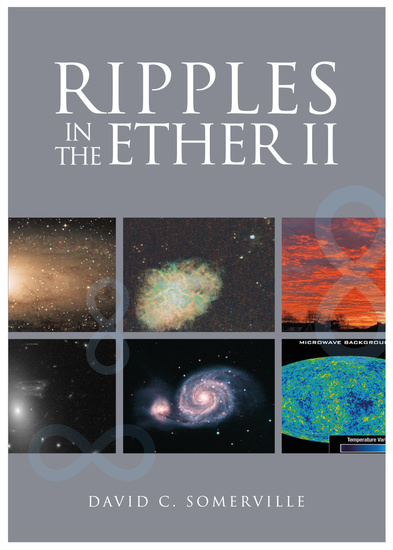
Ripples in the Ether II - cover

Ripples in the Ether II

David Somerville

Casa editrice: Brown Dog Books

  • 0
  • 0
  • 0

Sinossi

When did science fiction become science fact? When did time start from, and all matter form? Ripples in the Ether II explores these questions and discusses the oscillations, which form the basis of all matter. These discussions extend to those frequencies found in the universe to atoms and down through the electromagnetic spectrum from gamma radiation to radio and power transmissions. 
Also, discussions on frequencies to aspects of sound, sight and the human body including those of consciousness are included. These frequencies range from the very detectable low brainwaves to the very high ones discovered in consciousness. 
This is a revised and updated version of Ripples in the Ether. 
‘If you want to discover the secrets of the universe think in terms of energy, frequency and vibration.’ Nikola Tesla (1846–1943)
Disponibile da: 28/12/2022.

Altri libri che potrebbero interessarti

  • Forgotten Forests: Twelve Thousand Years of British and Irish Woodlands - cover

    Forgotten Forests: Twelve...

    Jonathan Mullard

    • 0
    • 0
    • 0
    Ancient trees, some over a thousand years old, are dotted around the British Isles, the last survivors of a lost world. Now, new scientific studies of these trees and of fossilised forests and of our oldest wooden artifacts can help us to understand the many woodlands that have disappeared from our landscapes. 
    Locked in ice for more than twenty thousand years, the lands that now make up Britain and Ireland were some of the last settled by humans. The earliest people, Mesolithic hunter-gatherers like Cheddar Man, arrived around eleven thousand years ago to find dense forests. While they lived lightly, they did introduce fire, which they used to create clearings, and this was the beginning of the reshaping of Britain’s forests. 
    When Neolithic farmers migrated to Britain from Europe some six thousand years ago, it meant a violent end to the hunter-gatherers’ way of life. It also indicated a dramatic change for the ecosystems. Forests were cleared for fields, trees and plants fed to livestock and predators hunted. A wild, forested world became one of agriculture and villages. 
    As humans learned to work bronze, then iron, they also used wood in myriad ways, building homes, then cathedrals, hand tools then furniture and early machines, boats and eventually immense ships. The forests of Britain and Ireland fuelled the burgeoning human civilisation, from the Romans, Anglo Saxons, Vikings and Normans, to the British, Scottish, Welsh and Irish peoples through to the present day. In that time our woodlands have changed beyond recognition, but clues to their story remain. Biologist and Britain’s first senior officer for Areas of Outstanding Natural Beauty Jonathan Mullard retraces the history of the forgotten forests of Britain and Ireland, piecing together historical records going as far back as the written word and archaeological evidence going back far further. The result is a wealth of arcane anecdotes and the latest scientific understanding of our natural history, as well as a fascinating journey through the forests, landscapes and human history of Britain. 
    In his latest non-fiction work, Forgotten Forests, Jonathan Mullard takes us on a journey through time, exploring the habitats that once covered Britain and Ireland. His deep understanding of ecology and passion for nature shine through in this compelling narrative of human impact and ecological transformation. 
    For fans of Robert Macfarlane (Is a River Alive?), Tristan Gooley (How To Read Water), Adam Weymouth (Kings of the Yukon), Jo Woolf (The Great Horizon), and Rough Guides (The Rough Guide to Morocco). 
    HarperCollins 2025
    Mostra libro
  • HowExpert Guide to Microbiology - 101 Tips to Learn about the History Applications Research Universities and Careers in Microbiology - cover

    HowExpert Guide to Microbiology...

    HowExpert, Sehrish Siddique

    • 0
    • 0
    • 0
    If you want to learn about the history, applications, research, universities, and careers in microbiology, then check out HowExpert Guide to Microbiology. 
    HowExpert Guide Microbiology is a compilation of all the major aspects of microbiology for one to get to know microbiology in the best way possible. It includes all minor and major points regarding Microbiology, from a basic introduction to depth and complexity. A very simple yet scientific writing style is adopted for the better understanding of the readers because the main aim of this book is to acknowledge every individual irrespective of the scientific background, to grasp the beauty of microbiology. 
    This book consists of 5 chapters, i.e., Introduction to Microbiology, History of Microbiology, Applications of Microbiology, Research (which is real-life and detailed research under the category food microbiology), Scope and Career in Microbiology. Chapter No 1, “Introduction to Microbiology,” contains most of the weightage of this book as this is the most vital and comprehensive chapter; it lays the base of this book. One can get most of the important and basic knowledge in this chapter. While Chapter No 4, “Research,” is the most complex part of the book and the most interesting one too. By going through it, you’ll feel like a researcher. This is a complete and detailed sample for you to learn about the research. This book is a complete guide for Microbiology. 
    Check out HowExpert Guide to Microbiology to learn about the history, applications, research universities, and careers in microbiology!
    Mostra libro
  • Sirius the Star of the Maltese Temples - cover

    Sirius the Star of the Maltese...

    Lenie Reedijk

    • 0
    • 0
    • 0
    Sirius, the Star of the Maltese Temples invites the reader to look at the megalithic temples of Malta in an entirely new way. The discovery of the temples’ orientation to Sirius explains with mathematical precision the slight shift in the direction of their axes, caused by the movement of the stars called the Precession of the Equinoxes. The resultant astronomical dating of the temples to the Mesolithic, the period immediately after the last Ice Age, is far older than mainstream archaeology maintains and is on a par with other megalithic sites elsewhere, including Göbekli Tepe in Turkey. These findings turn on its head our conception of the accomplishments of ancient people. Instead of being just primitive cave-dwellers, they were primeval astronomers, whose interest in the sky has left us a legacy we never dreamt existed. 
    From the Foreword by Giovanni Bonello: “This is a disturbing book. The author defines its contents as controversial and its conclusions as surprising. I judge it to be far, but far, more than that. It is disruptive of accepted wisdom and unsettles all we believe we knew of the origin of man in Malta, of the sequences of early civilization and the histories of prehistory – not in Malta alone, but throughout the whole of Europe. I started reading it in awe, at first with a deliberate effort at disbelief. By the time I was approaching the climax of the exposition, I ended as mesmerized as I was perplexed.” 
    (Giovanni Bonello is a human rights lawyer and judge who served at the European Court of Human Rights for 12 years)
    Mostra libro
  • Epilepsy: A Guide for Healthcare Providers - cover

    Epilepsy: A Guide for Healthcare...

    Edmonton Epilepsy Association

    • 0
    • 0
    • 0
    Professionals and caregivers play a vital role in the physical and emotional well-being of a person with epilepsy. Often the caregiver is a family member or a person who has a close personal relationship with the individual. Sometimes it is the caregiver who provides the essential link between the individual, health care professionals, and the community at large. ​
    Mostra libro
  • Beastly Britain - An Animal History - cover

    Beastly Britain - An Animal History

    Karen R. Jones

    • 0
    • 0
    • 0
    The remarkable history of Britain and its animals, told through ten iconic species Have you ever wondered why we count sheep to get to sleep? Or where the phrase "red herring" comes from? Across British history, animals have been written about in poetry, painted in oils, and even recorded in law. Loved or feared, familiar or endangered, animals are everywhere to be seen. In this enchanting study, Karen R. Jones takes a journey through the history of ten animals to show the extraordinary story of "beastly" Britain. Jones looks at animals including foxes and hedgehogs, newts and beetles, ghostly hounds, and even the Loch Ness Monster. She reveals the place of animals in British cultural identity and sheds new light on the most iconic moments of British history, from the Black Death to World War II. The story of these isles may be told by human voices, but it is fully brought to life by listening to the squawks, bellows, and howls that make Britain what it is.
    Mostra libro
  • Artificial You - AI and the Future of Your Mind - cover

    Artificial You - AI and the...

    Susan Schneider

    • 0
    • 0
    • 0
    "Entertaining and profound."—Martin Rees, Astronomer Royal
    
    Hailed by the Washington Post as "a sure-footed and witty guide to slippery ethical terrain."
    
    This audiobook narrated by Katherine Fenton take you on a philosophical exploration of AI and the future of the mind
    
    Humans may not be Earth's most intelligent beings for much longer: the world champions of chess, Go, and Jeopardy! are now all AIs. Given the rapid pace of progress in AI, many predict that it could advance to human-level intelligence within the next several decades. From there, it could quickly outpace human intelligence. What do these developments mean for the future of the mind?
    
    In Artificial You, Susan Schneider says that it is inevitable that AI will take intelligence in new directions, but urges that it is up to us to carve out a sensible path forward. As AI technology turns inward, reshaping the brain, as well as outward, potentially creating machine minds, it is crucial to beware. Homo sapiens, as mind designers, will be playing with "tools" they do not understand how to use: the self, the mind, and consciousness. Schneider argues that an insufficient grasp of the nature of these entities could undermine the use of AI and brain enhancement technology, bringing about the demise or suffering of conscious beings. To flourish, we must grasp the philosophical issues lying beneath the algorithms.
    
    At the heart of her exploration is a sober-minded discussion of what AI can truly achieve: Can robots really be conscious? Can we merge with AI, as tech leaders like Elon Musk and Ray Kurzweil suggest? Is the mind just a program? Examining these thorny issues, Schneider proposes ways we can test for machine consciousness, questions whether consciousness is an unavoidable byproduct of sophisticated intelligence, and considers the overall dangers of creating machine minds.
    Mostra libro