¡Acompáñanos a viajar por el mundo de los libros!
Añadir este libro a la estantería
Grey
Escribe un nuevo comentario Default profile 50px
Grey
Suscríbete para leer el libro completo o lee las primeras páginas gratis.
All characters reduced
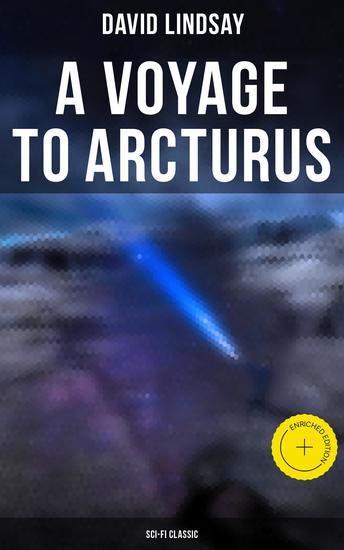
A VOYAGE TO ARCTURUS (Sci-Fi Classic) - Enriched edition A Sci-Fi Classic - cover

A VOYAGE TO ARCTURUS (Sci-Fi Classic) - Enriched edition A Sci-Fi Classic

David Lindsay

Editorial: Musaicum Books

  • 0
  • 0
  • 0

Sinopsis

David Lindsay's "A Voyage to Arcturus" is a groundbreaking science fiction classic that defies traditional genre conventions. The narrative follows protagonist Maskull as he journeys to the enigmatic planet Arcturus, encountering a series of surreal and philosophical experiences along the way. Lindsay's writing style is intricate and thought-provoking, blending elements of fantasy and metaphysical exploration in a way that challenges readers to question the nature of reality and consciousness. The book's themes of spirituality, morality, and existentialism set it apart as a unique and intellectually stimulating work of fiction. David Lindsay, a Scottish author, drew inspiration from his own philosophical beliefs and spiritual experiences when crafting "A Voyage to Arcturus." Trained as a scientist, Lindsay infuses his novel with a sense of wonder and curiosity about the unknown, inviting readers to contemplate their place in the universe. His background in both science and philosophy informs the rich tapestry of ideas present in the book, making it a compelling read for those interested in exploring the boundaries of human knowledge and understanding. I highly recommend "A Voyage to Arcturus" to readers seeking a thought-provoking and intellectually challenging science fiction novel. Lindsay's masterpiece offers a unique and immersive reading experience that will leave you questioning the nature of reality long after you've turned the final page.

In this enriched edition, we have carefully created added value for your reading experience:
- A succinct Introduction situates the work's timeless appeal and themes.
- The Synopsis outlines the central plot, highlighting key developments without spoiling critical twists.
- A detailed Historical Context immerses you in the era's events and influences that shaped the writing.
- A thorough Analysis dissects symbols, motifs, and character arcs to unearth underlying meanings.
- Reflection questions prompt you to engage personally with the work's messages, connecting them to modern life.
- Hand‐picked Memorable Quotes shine a spotlight on moments of literary brilliance.
- Interactive footnotes clarify unusual references, historical allusions, and archaic phrases for an effortless, more informed read.
Disponible desde: 02/11/2018.
Longitud de impresión: 242 páginas.

Otros libros que te pueden interesar

  • The Shunned House - cover

    The Shunned House

    H. P. Lovecraft

    • 0
    • 0
    • 0
    Step inside H. P. Lovecraft’s The Shunned House, a chilling tale of supernatural dread and generational curses. In the heart of New England, a decaying home conceals a legacy of death, madness, and an unspeakable presence lurking beneath its cellar. Blending gothic atmosphere with cosmic horror, Lovecraft crafts a haunting exploration of fear, the unknown, and the malevolent forces that defy human understanding. Perfect for fans of weird fiction, classic horror, and eerie haunted house stories.
    Ver libro
  • What Will Pay? (Unabridged) - cover

    What Will Pay? (Unabridged)

    Booker T. Washington

    • 0
    • 0
    • 0
    Booker Taliaferro Washington (April 5, 1856 - November 14, 1915) was an American educator, author, orator, and adviser to several presidents of the United States. Between 1890 and 1915, Washington was the dominant leader in the African American community and of the contemporary black elite. Washington was from the last generation of black American leaders born into slavery and became the leading voice of the former slaves and their descendants. They were newly oppressed in the South by disenfranchisement and the Jim Crow discriminatory laws enacted in the post-Reconstruction Southern states in the late 19th and early 20th centuries.
    WHAT WILL PAY: I wish to talk with you for a few minutes upon a subject that is much discussed, especially by young people-What things pay in life? There is no question, perhaps, which is asked oftener by a person entering upon a career than this-What will pay? Will this course of action, or that, pay?
    Ver libro
  • A Wicked Woman - From their pens to your ears genius in every story - cover

    A Wicked Woman - From their pens...

    Jack London

    • 0
    • 0
    • 0
    John Griffith Chaney was born on January 12th, 1876 in San Francisco.   
    His father, William Chaney, was living with Flora Wellman when she became pregnant.  Chaney insisted she have an abortion.  Flora's response was to turn a gun on herself.  Although her wounds were not severe the trauma made her temporarily deranged. 
    In late 1876 his mother married John London and the young child was brought to live with them as they moved around the Bay area, eventually settling in Oakland where now, calling himself Jack, he completed grade school. 
    Jack worked hard at several jobs, sometimes 12-18 hours a day, but his dream was university.  He studied hard and borrowed the money to enrol in the summer of 1896 at the University of California in Berkeley. 
    In 1897, at 21, Jack searched out newspaper accounts of his mother's suicide attempt and for the name of his biological father. He wrote to Chaney, then living in Chicago, who claimed he could not be Jack’s father because he was impotent and casually asserted that London's mother had relations with other men.  Jack, devastated by the response, quit Berkeley and went to the Klondike. Other accounts suggest that his dire finances presented Jack with the excuse he needed to leave. 
    In the Klondike Jack began to gather material for his writing but also accumulated many health problems, including scurvy, which together with hip and leg problems he would carry for the rest of his life. 
    During the late 1890's Jack was regularly publishing short stories and by the turn of the century full blown novels. 
    By 1904 Jack had married, fathered two children and was now in the process of divorcing.  A stint as a reporter on the Russo-Japanese war of 1904 was equal amounts trouble and experience. But that experience was always put to good use in a continuing and remarkable output of work. 
    In 1905 he married Charmian Kittredge who at last was a soul and companion who brought him some semblance of peace despite his advancing alcoholism and his incurable wanderlust. 
    Twelve years later Jack had amassed both wealth and a literary reputation through such classics as ‘The Call of the Wild’, ‘White Fang’ and many others. He had a reputation as a social activist and was a tireless friend of the workers.   
    Jack London died suffering from dysentery, late-stage alcoholism and uremia, aged only 40, on November 22nd 1916 at his property in Glen Elen in California.
    Ver libro
  • Quest of Iranon The (Unabridged) - cover

    Quest of Iranon The (Unabridged)

    H. P. Lovecraft

    • 0
    • 0
    • 0
    The story is about a golden-haired youth who wanders into the city of Teloth, telling tales of the great city of Aira, where he was a prince. While Iranon enjoys singing and telling his tales of wonder, few people appreciate it. A city solon even orders Iranon to cease his singing & music, and become apprenticed to a cobbler - or leave the city by sunset. When a disenfranchised boy named Romnod suggests leaving Teloth to go to the famed city of Oonai (which he thinks may be Aira, now under a different name), Iranon takes him up on his offer. Iranon and Romnod spend years on their journey to Oonai. Along the way, Romnod grows up while Iranon remains exactly the same. Eventually they reach Oonai, which Iranon is disappointed (although not surprised) to discover isn't Aira. Iranon is loved by the people in Oonai, however, so he stays there even though he still desires to return to Aira. As the years pass, people appreciate him less and less, and he is eventually upstaged by dancers from the desert. By this point, Romnod has grown old and has become a drunkard. After Romnod's death, Iranon decides to leave Oonai and continue his search for Aira. Eventually Iranon comes across an old shepherd and asks him if he knows of Aira. The shepherd tells him that he has indeed heard of it, for in his youth there was a beggar's boy who had always talked about it. The boy, who presumed himself to be a prince, was laughed at by everyone and ran away. With the truth revealed, that Aira was merely a figment of his imagination, Iranon loses his eternal youth. Now aged significantly, Iranon wanders into the quicksands to his death.
    Ver libro
  • The Haunted Baronet - cover

    The Haunted Baronet

    Joseph Sheridan Le Fanu

    • 0
    • 0
    • 0
    "The lake does not give up its dead easily, and the House of Mardykes has a long memory."
    
    Sir Bale Mardykes is a man of iron will and a cold heart, living in the ancestral home of Mardykes Hall near the secluded village of Golden Friars. He believes he is the master of his own fate, but he is haunted by a centuries-old prophecy of doom. When he cruelly causes the death of his secretary and distant relative, Philip Feltram, Sir Bale believes he has cleared a nuisance from his path. But when Feltram returns—changed, silent, and carrying the chill of the lake—Sir Bale realizes that the dead have a way of reclaiming what is theirs. It is a slow-burn masterpiece of Gothic tension, where the environment itself seems to conspire against the living.
    
    The Environment as Antagonist: Le Fanu utilizes the "Atmospheric Gothic" to its fullest potential here. The swirling mists of the Lake District, the echoes in the mountain passes, and the bottomless depths of the lake serve as metaphors for Sir Bale's mounting paranoia. The house and the land are not just settings; they are active participants in the baronet's downfall.
    
    A Study in Psychological Ruin: Unlike many contemporary ghost stories, the horror in The Haunted Baronet is deeply internal. We watch Sir Bale's skepticism slowly erode as the supernatural elements become undeniable. The figure of the "Returned" Feltram is one of Le Fanu's most effective creations—a ghost that doesn't just haunt, but inhabits the social space of the living.
    
    The Weight of Ancestry: Le Fanu explores the idea that we are never truly free from the actions of our forefathers. Sir Bale is a victim of his own bloodline as much as his own choices. The novella builds to a tragic and inevitable climax that proves that some debts can only be paid in lifeblood.
    
    Beware the calm waters of Golden Friars. Purchase "The Haunted Baronet" today.
    Ver libro
  • Vision of Judgment A (Unabridged) - cover

    Vision of Judgment A (Unabridged)

    H. G. Wells

    • 0
    • 0
    • 0
    "Written in the late 19th century by H. G. Wells and first published in The Butterfly (September 1899), (and collected in The Obliterated Man and Other Stories, (Dec 1925)) A Vision of Judgment is a short story in 9 sections. It portrays a Last Judgment in which God and the archangel Gabriel laugh at sinners and saints alike, embarrassing them until they flee "up the sleeve of God." After every human soul has taken shelter there, all of humanity, "enlightened" and "in new clean bodies," is given a second chance.
    Ver libro