¡Acompáñanos a viajar por el mundo de los libros!
Añadir este libro a la estantería
Grey
Escribe un nuevo comentario Default profile 50px
Grey
Suscríbete para leer el libro completo o lee las primeras páginas gratis.
All characters reduced
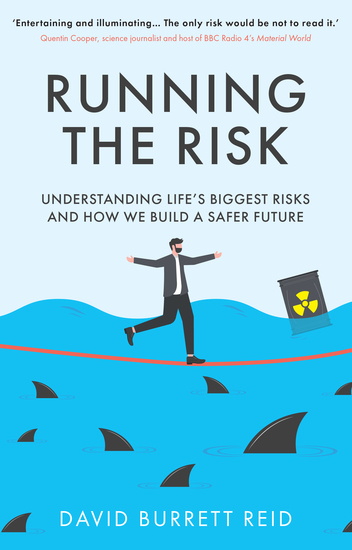
Running the Risk - From Shark Attacks to Nuclear Disaster - understanding life's biggest risks and how we build a safer future - cover

Running the Risk - From Shark Attacks to Nuclear Disaster - understanding life's biggest risks and how we build a safer future

David Burrett Reid

Editorial: Hero

  • 0
  • 0
  • 0

Sinopsis

Key Selling Points: Accessible and entertaining, narrative-driven non-fiction book about the subject of risk. No other mass-market book that covers risk beyond business book.
Disponible desde: 19/05/2025.

Otros libros que te pueden interesar

  • Overcoming Stress-Induced Brain Fog - 10 Simple Ways to Find Focus Improve Memory and Feel Grounded - cover

    Overcoming Stress-Induced Brain...

    PhD Jill Weber

    • 0
    • 0
    • 0
    Do you ever feel spaced out or stuck in a rut, like you just can't think, or you're moving in slow motion? Perhaps you feel detached or disengaged, defeated and hopeless, or just not fully yourself. If you're struggling with a lack of mental clarity, energy, and belief in yourself and your capabilities, you may be experiencing the dreaded brain fog—a very real issue that can result from the exhaustion, overstimulation, and the stress of modern life. 


    All of us struggle to find the get-up-and-go we need sometimes, but when prolonged stress and anxiety begin to affect your ability to focus, concentrate, remember, solve problems, or communicate effectively on a regular basis, these symptoms may point to something more than just a stressful week. It's time to clear away the fog and reclaim your motivation, passion, self-worth, zest, and meaning in life. 


    Based on cutting-edge research, Overcoming Stress-Induced Brain Fog offers quick solutions you can put to work right away, including exercises based in awareness, mindfulness and acceptance, and self-compassion. With these ten easily accessible tools, you'll find your way out of the haze toward clarity, improved memory, and a greater presence to enjoy life.
    Ver libro
  • Being Victorian - How it felt then Why it matters now - cover

    Being Victorian - How it felt...

    Jamie Camplin

    • 0
    • 0
    • 0
    Writers and poets, academics and art critics, mathematicians and experimental scientists, churchmen and politicians, women of strong opinions gather for a summer weekend in the 1870s. Is it real, or is it a fantasy? One thing's sure: their debates – about life's aims, rural and urban living, love and money, civilization and belief, the social framework, the past, the present and the future take us to the heart of the Victorian dream and its reality: the idea that their society exemplified 'Progress'. What did 'Progress' mean? Were things (and which things) getting better? What did 'better' mean? And for whom? The history of the world before the Victorians, from Aberdeen to Africa, showed a particular form of equality for almost everyone: an equality of poverty and no prospects, with kindness often in short supply. Victorians wanted to change that world, thought they were changing it, did change it. They did it in a human way: a melange of muddle, vision, certainty, doubt, too slow for many, too fast for some. Yet their changes were decisive both for creating the modern world, but also for revealing the dilemmas attached to mass living in urban, technological societies, as well as the moral flaws in imposing one civilization's or one person's beliefs on another. Most remarkably of all, the upheaval in making major transitions in every area of life, which produced revolutions and violence across Europe, in the Americas and in Asia, was carried out – at least in Britain itself – almost entirely peacefully. The past will always be a foreign country for those unwilling to engage with its people. Whether viewing the lives of rulers or the ruled, 'Being Victorian' corrects innumerable preconceptions.
    Ver libro
  • The American Dream - A History of the Nation's Ideals - cover

    The American Dream - A History...

    Harry Montgomery

    • 0
    • 0
    • 0
    The roots of the American Dream reach back to the earliest colonial settlements, when European settlers arrived with hopes of building a better life far from the constraints of their homelands. For many, the New World offered something previously unimaginable—land ownership, religious freedom, and the possibility of rising above the station into which they were born. These opportunities, though limited to a select group at the time, laid the foundation for the evolving idea that anyone could succeed through hard work and determination. In this fertile but dangerous land, ambition was a necessity, and the early colonists began to shape a cultural identity around individualism and perseverance. 
    As the colonies grew and developed, tensions with Britain intensified, giving rise to revolutionary ideas that would further fuel the American Dream. The rejection of monarchy and the assertion of natural rights became central to the vision of a new nation. The Revolution itself was not just a fight for independence but also a declaration that ordinary people had the right to govern themselves. The rhetoric of the time emphasized liberty, equality, and the pursuit of happiness—concepts that would become permanently embedded in the national consciousness. The struggle to gain freedom was brutal and uneven, but the ideals expressed during this time continued to inspire generations to believe in the possibility of social mobility and personal fulfillment. 
    One of the most significant documents in American history, the Declaration of Independence, formalized the promise of the American Dream. Its bold claim that "all men are created equal" introduced a national aspiration that transcended the immediate political conflict. Although in practice this equality was far from realized, the statement set a powerful ideal against which future Americans would measure their progress.
    Ver libro
  • ChatGPT For Fiction Writing - How to Make Money from Fiction the AI Way - cover

    ChatGPT For Fiction Writing -...

    Omar Johnson

    • 0
    • 0
    • 0
    Unleash Your Creative Genius with ChatGPT For Fiction Writing: How to Make Money from Fiction the AI Way. Journey into a transformative era where artificial intelligence becomes your co-author, enhancing your storytelling prowess to unprecedented levels. This illuminating guide reveals the masterful ways to employ ChatGPT, enabling you to pen riveting stories that not only captivate readers' hearts but also open lucrative avenues for your craft. 
    Are you an aspiring novelist, eager to etch your mark on the literary world? A forward-thinking entrepreneur, on the hunt for the next breakthrough? Or a seasoned storyteller, ready to elevate your narrative? This book is your guiding star, lighting the path to harnessing AI as a potent ally in your creative journey. 
    With "ChatGPT For Fiction Writing", discover the roadmap to: 
    • Conquer Writer’s Block — Say goodbye to the dreaded blank page 
    • Spawn Infinite Plot Ideas — Unearth twists that keep readers on the edge 
    • Engineer Cliffhangers — Craft endings that leave readers craving more 
    • Sculpt Living, Breathing Characters — Characters that leap off the page 
    • Refine Pacing & Flow — Master the rhythm of compelling storytelling 
    • Pen a Bestseller — Secrets to making your book irresistibly magnetic 
    And that’s just the beginning... 
    Beyond the craft, dive into actionable, step-by-step strategies for marketing your book and monetizing your unique skills in fiction writing — transforming your passion into a rewarding, sustainable income. 
    Bonus: 150+ Tailored Prompts Included 
    Embark with a treasure chest of 150+ meticulously crafted prompts spanning a rich tapestry of genres. 
    Copy, paste into ChatGPT, and ignite the spark of your next great novel.
    Ver libro
  • Beyond the surface - Christopher Columbus and the Kaleidoscope of American Identity - cover

    Beyond the surface - Christopher...

    Davis Truman

    • 0
    • 0
    • 0
    This audiobook is narrated by an AI Voice.   
    "Beyond the Surface: Christopher Columbus and the Kaleidoscope of American Identity" invites readers on an enlightening journey through the intricate layers of history, culture, and identity that have shaped the Americas. In this captivating exploration, the book delves deep into the legacy of Christopher Columbus, unearthing the complex intersections of triumph and tragedy, discovery and displacement. With meticulous research and vivid storytelling, it uncovers the multifaceted facets of Columbus's impact, unveiling the profound effects on indigenous civilizations, European expansion, and the forging of a New World identity. Seamlessly weaving together historical narratives, cultural analyses, and contemporary reflections, the book illuminates the kaleidoscope of influences that have contributed to the diverse tapestry of American identity, challenging readers to confront the nuanced truths that lie beyond conventional narratives. "Beyond the Surface" is a thought-provoking odyssey that compels us to examine the past in order to understand better the present and chart a more inclusive, empathetic future.
    Ver libro
  • Coronavirus Criminals and Pandemic Profiteers - Accountability for Those Who Caused the Crisis - cover

    Coronavirus Criminals and...

    John Nichols

    • 0
    • 0
    • 0
    A furious denunciation of coronavirus criminals 


    The rogues gallery begins with Donald Trump, who deliberately downplayed the coronavirus crisis despite knowing its dangers, as well as his international political allies, above all Boris Johnson. Billionaire politicians like Georgia senator Kelly Loeffler moved stocks at the same time they were telling Americans all was well. Political charlatans like Education Secretary Betsy DeVos undermined public safety in order to advance their agenda. Libertarian "think tanks" like the Ayn Rand Institute decried public expenditures but were first in line to get bailout checks. Pharmaceutical companies gamed the vaccine race, and the most rapacious global corporations like Facebook, Visa, and Pfizer have found the pandemic to be very profitable indeed, vastly enriching the already grotesquely bloated fortunes of trillionaires like Jeff Bezos, Mark Zuckerberg, and Charles Koch. 


    Guilty Men closes with a call for a version of the Pecora Commission, initiated by newly elected Franklin Roosevelt, that took aim at what FDR called "speculation, reckless banking, class antagonism, and profiteering" that stoked the Depression. The commission led to some of the most far-reaching reforms in US history, as well as sensational hearings that led to the fall of the leading bankers and financiers of that era.
    Ver libro