Begleiten Sie uns auf eine literarische Weltreise!
Buch zum Bücherregal hinzufügen
Grey
Einen neuen Kommentar schreiben Default profile 50px
Grey
Jetzt das ganze Buch im Abo oder die ersten Seiten gratis lesen!
All characters reduced
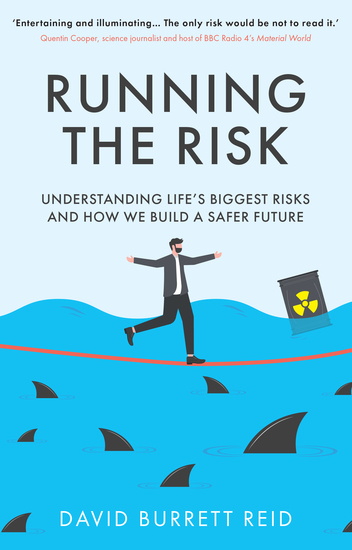
Running the Risk - From Shark Attacks to Nuclear Disaster - understanding life's biggest risks and how we build a safer future - cover

Running the Risk - From Shark Attacks to Nuclear Disaster - understanding life's biggest risks and how we build a safer future

David Burrett Reid

Verlag: Hero

  • 0
  • 0
  • 0

Beschreibung

Key Selling Points: Accessible and entertaining, narrative-driven non-fiction book about the subject of risk. No other mass-market book that covers risk beyond business book.
Verfügbar seit: 19.05.2025.

Weitere Bücher, die Sie mögen werden

  • Global hydrogen trade to meet the 15°C climate goal: Part III – Green hydrogen cost and potential - cover

    Global hydrogen trade to meet...

    Irena International Renewable...

    • 0
    • 0
    • 0
    This report estimates the potential for green hydrogen production as a function of land availability, considering exclusion zones such as protected areas, forests, wetlands, urban centres, slope and water scarcity.
    Zum Buch
  • Cosmos Weekly's Year of Wonders - 30 stories about the science that is changing your world - cover

    Cosmos Weekly's Year of Wonders...

    The Royal Institution of Australia

    • 0
    • 0
    • 0
    Cosmos Weekly is the place for conversations, debates, discussions and insights into the science that changes our lives, where working scientists explain how they came to be where they are, and what hopes and breakthroughs keep them forging on.
    Zum Buch
  • Optics - Principles and Applications of Light and Vision - cover

    Optics - Principles and...

    Mark Hedges

    • 0
    • 0
    • 0
    Optics is the branch of physics that deals with the study of light and its interaction with matter. It encompasses a wide range of phenomena, including reflection, refraction, diffraction, and the formation of images. Light, as an electromagnetic wave, plays a central role in our everyday lives, enabling us to see the world around us and facilitating numerous technological advancements. The study of optics is essential not only for understanding the behavior of light but also for developing applications in fields such as medicine, telecommunications, photography, and astronomy. 
    The nature of light has been a subject of fascination and research for centuries. Early thinkers, such as ancient Greek philosophers, speculated about the properties of light and its role in vision. However, it was not until the work of scientists like Isaac Newton and Thomas Young in the 17th and 18th centuries that light began to be studied in a more rigorous and scientific manner. Newton’s particle theory of light and Young’s double-slit experiment, which demonstrated the wave nature of light, were crucial milestones in the development of optics. These contributions laid the groundwork for the modern understanding of light as an electromagnetic wave, described by Maxwell’s equations. 
    At the heart of optics is the study of how light behaves as it interacts with different materials. This behavior is governed by the fundamental principles of reflection, where light bounces off surfaces, and refraction, where light bends as it passes through different media. These principles are described by laws such as the Law of Reflection and Snell’s Law of Refraction. The interaction of light with materials also leads to phenomena such as dispersion, where different colors of light separate due to their varying wavelengths, and absorption, where light energy is transferred to the material, often converting to heat.
    Zum Buch
  • Vanishing Life on Earth - cover

    Vanishing Life on Earth

    Bimalendu B. Nath

    • 0
    • 0
    • 0
    The book is an abridged story of life that we see now and the life forms that 
    existed in the past. Readers can flip through pages of the planet's 
    history and explore the secrets hidden in the fossils scattered across forgotten landscapes. 
    The species we see today are only a tiny fraction of all those that 
    have ever lived on Earth. Most of the species have vanished throughout the Earth's history. 
    The author intersected at five major extinction episodes and narrated 
    selected stories of the lost world while highlighting life's journey on our plants —from tiny 
    microorganisms to massive dinosaurs, mammoths and mastodons, ultimately leading up to humans. 
    Unfortunately, we're now facing a critical moment when Earth’s biodiversity is at risk of being wiped out entirely, 
    and our planet may stop breathing one day. This prompts readers to reflect on what we have done to bring life's 
    diversity to such a vulnerable state. The author concludes the book with future perspectives on how we all can stop the next mass extinction.
    Zum Buch
  • Be Fruitful and Multiply - How Fertility and Innovation Have Changed Humankind and the Earth - cover

    Be Fruitful and Multiply - How...

    Donald Worster

    • 0
    • 0
    • 0
    A groundbreaking history that explores how human desires have affected our relationship with the natural world, and why this is a cause for hope Donald Worster looks back over 200,000 years of Homo sapiens to show how human nature, especially the drive for food and sex, has responded to environmental conditions throughout history. Examining how this process led from foraging to the agrarian revolution and then to a capitalist way of life, Worster brings us face to face with a third transformation of human society that is beginning to take shape in China: an ecological civilization. This meticulously researched book explores how human desires have driven us to overrun our environments, and how we have adapted by creating new relationships with the earth. Tying the past to the future and humans to the planet, Worster acknowledges that we are at a potentially dangerous tipping point. Yet he offers a surprisingly optimistic vision, full of faith in the strength of our human desires, to help us develop exciting futures in a changing world—as we have done time and again—and achieve a good life for the billions of us trying to survive on a finite planet.
    Zum Buch
  • Planet Earth Is Conscious - And Life Exists in Amazing Places - cover

    Planet Earth Is Conscious - And...

    Martin K. Ettington

    • 0
    • 0
    • 0
    This book explores the concepts of our planet Earth being a conscious entity, and all of the incredible places life has been found, around, on, and inside our planet. 
    I believe that planet Earth (also known as Gaia) is a conscious being in its own right. Many of the ancients also believed the same thing. 
    Even metaphysical philosophies like Theosophy talk about the Gaia consciousness and that there are even higher level beings like the Solar Logos. 
    There is an amazing amount of life on Earth—much of which has only been discovered in recent decades. 
    For example: did you know that life penetrates the Earth’s crust down to at least seven miles beneath the Ocean’s seabed, and possibly much deeper. 
    That life exists in Lake Vostok beneath the Antarctic Ice which hasn’t been in contact with the surface for many thousands of years? 
    There has also been new bacteria found on the International Space Station and in meteorites which have hit the Earth. 
    Life exists on our planet in many unusual and amazing places and you will be amazed at its diversity. 
     
    Zum Buch