Join us on a literary world trip!
Add this book to bookshelf
Grey
Write a new comment Default profile 50px
Grey
Subscribe to read the full book or read the first pages for free!
All characters reduced
On Growth and Form - cover

On Growth and Form

D'Arcy Wentworth Thompson

Publisher: DigiCat

  • 0
  • 0
  • 0

Summary

In "On Growth and Form," D'Arcy Wentworth Thompson investigates the intricate relationship between biological forms and mathematical principles, marrying natural history with a pioneering philosophy of biology. His unique literary style seamlessly intertwines scientific exposition with captivating prose, employing vivid illustrations to elucidate complex theories. The book serves as a profound inquiry into the mechanics of growth and the structural beauty of organisms, positioning itself within the context of early 20th-century biology when the fields of evolution and physical sciences were rapidly evolving, influencing both scholars and artists alike. D'Arcy Wentworth Thompson was a Scottish biologist and mathematician whose multidisciplinary background fueled his passion for understanding the underlying patterns of life. His academic journey traversed the realms of zoology, comparative anatomy, and mathematics, culminating in this seminal work that challenges the reader to reconsider conventional notions of form and function. Thompson's exposure to the burgeoning field of biomorphism and his involvement in environmental stewardship enriched his insights, leading him to explore how natural laws dictate the growth and design of living beings. Recommended for readers interested in the intersection of biology, mathematics, and art, "On Growth and Form" invites contemplation of nature's complexities. Whether you are a student, a scholar, or a curious layperson, Thompson's masterwork promises to deepen your appreciation for the elegance of biological forms and inspire a reconsideration of the interconnectedness of life.
Available since: 09/15/2022.
Print length: 910 pages.
Other books that might interest you

  • Workbook: The Body Keeps the Score - Brain Mind and Body in the Healing of Trauma - cover

    Workbook: The Body Keeps the...

    Liam Daniels, Alice Moore

    • 0
    • 0
    • 0
    Note: This audiobook is included (for free) inside its respective print and e-book versions. 
    To many people, trauma is something that happens to soldiers and refugees, far away and out of sight. But in fact, trauma is the single greatest threat to public health and well-being that America has ever seen. As humans, we are exposed to a horde of trauma, from physical, sexual, and emotional abuse, to neglect, accidents, and the list can go on and on. And while the naked eye can see the immediate effects of that trauma, it is usually the long-term trauma we carry that bogs us down and infects every aspect of our lives, whether we are aware of it or not. 
    Workbook: The Body Keeps the Score not only does it provide all of van der Kolk's teachings about trauma in a clear, comprehensive, and condensed manner—without missing anything important!—but it also allows you to delve deeper into the book's concepts and explore your own personal journey with trauma while prompting you to take action to create a lasting impact. 
     You will get:The latest research on psychiatric theory and practice from the world's leading trauma specialist.Insights into the different methods of treatment, including skills and tools for healing trauma.Comprehensive yet simplified and straightforward chapter-by-chapter summaries, each ending with concise key takeaways.An immersive experience that will bridge the gap between the book's teachings and your own life. 
    …and more! 
    The messages in this book contain information for everyone; for the fight against trauma to be successful, it needs to be a collective effort. Don't miss out on the wisdom and awareness this book offers. Let's all work toward creating a trauma-free generation. 
    Disclaimer: This is an unofficial, third-party workbook for Bessel van der Kolk's The Body Keeps the Score. Please note that it is NOT the original book.
    Show book
  • Six Steps to Managing Alzheimer's Disease and Dementia - A Guide for Families - cover

    Six Steps to Managing...

    MD Andrew E. Budson, PsyD...

    • 0
    • 0
    • 0
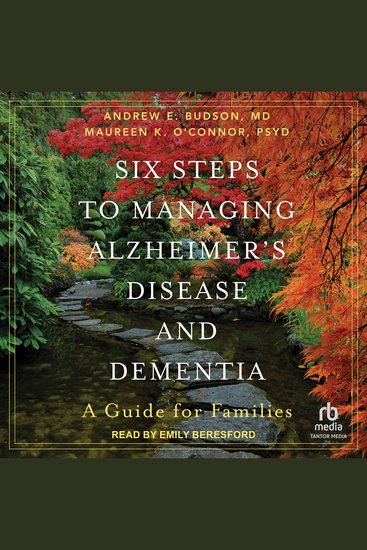
    Caregiving for a loved one with Alzheimer's disease or dementia is hard. It's hard whether you're caring for your spouse, parent, grandparent, sibling, other family member, or friend. And caring for a loved one with dementia can sometimes feel like a long, lonely journey. 


    Six Steps to Managing Alzheimer's Disease and Dementia can help, addressing concerns such as: 


    ● Is the problem Alzheimer's, dementia, or something else? 


    ● How do you approach problems in dementia? How do you manage problems with memory, language, and vision? How do you cope with emotional and behavioral problems? 


    ● What are the best ways to manage troubles with sleep and incontinence? Which medications can help? Which medications can actually make things worse? 


    ● How do you build your care team? Why is it important to care for yourself? How do you sustain your relationship with your loved one? 


    ● How do you plan for the progression of dementia? How do you plan for the end and beyond?
    Show book
  • How To Improve Your Social Media Habits - A Simple Path To Spending Your Time Online The RIGHT Way! - cover

    How To Improve Your Social Media...

    Geordan Richardson

    • 0
    • 0
    • 0
    Are you spending hours a day on social media? 
    Are you frustrated and fed up with the time you waste online? 
    Maybe you would love to learn easy steps you can take to reduce your screen time and use social media the RIGHT way. 
    'How to Improve Your Social Media Habits' is not a book that will tell you to: 
    ‘Avoid social media at all costs!’ 
    For 99% of people, this will not work. 
    Instead, this book will:Highlight the obvious and not-so-obvious negative effects of social media.Outline the positive effects of social media; you can use the platforms for much more than mindless scrolling.Show how small improvements can make a monumental difference in your social media life.Show you two very different sides to social media and force the reader to question; 
    ‘Am I a Stu or a Stephen?' 
    Ready to turn into a savvy sophisticated social media user? 
    If so, scroll to the top of the page now and click the 'BUY NOW' button!
    Show book
  • Exobiology - Life Beyond Earth - cover

    Exobiology - Life Beyond Earth

    Mike Crawford

    • 0
    • 0
    • 0
    The origins of life on Earth remain one of the most profound scientific mysteries. While no definitive answer exists, several compelling theories attempt to explain how life first emerged from non-living matter. Understanding these origins is crucial to the study of exobiology, as it provides insight into how life might arise elsewhere in the universe. 
    One widely accepted hypothesis is abiogenesis, which suggests that life arose from simple organic compounds through natural chemical processes. The famous Miller-Urey experiment in 1953 demonstrated that amino acids, the building blocks of life, could form under conditions similar to those of early Earth. These experiments, combined with discoveries of organic molecules in space, suggest that life’s precursors may have been abundant in the early solar system. 
    The conditions on early Earth were vastly different from today. Around 4 billion years ago, the planet was a harsh, volcanic world with a thick atmosphere composed of methane, ammonia, hydrogen, and water vapor. Lightning, ultraviolet radiation, and hydrothermal vents may have provided the necessary energy to drive complex chemical reactions, leading to the formation of self-replicating molecules like RNA. The RNA world hypothesis proposes that RNA, due to its ability to both store genetic information and catalyze chemical reactions, was a key player in the transition from simple molecules to living cells.
    Show book
  • The Hidden Half - The Unseen Forces That Influence Everything - cover

    The Hidden Half - The Unseen...

    Michael Blastland

    • 0
    • 0
    • 0
    Why does one smoker die of lung cancer but another live to 100? The answer is "The Hidden Half"—those random, unknowable variables that mess up our attempts to comprehend the world. 


    We humans are very clever creatures—but we're idiots about how clever we really are. In this entertaining and ingenious book, Blastland reveals how in our quest to make the world more understandable, we lose sight of how unexplainable it often is. The result—from GDP figures to medicine—is that experts know a lot less than they think. 


    Filled with compelling stories from economics, genetics, business, and science, The Hidden Half is a warning that an explanation which works in one arena may not work in another. Entertaining and provocative, it will change how you view the world.
    Show book
  • Artificial Intelligence - Concepts Evolution and Future Prospects - cover

    Artificial Intelligence -...

    Bright Mills

    • 0
    • 0
    • 0
    Artificial Intelligence (AI) is a transformative field of computer science dedicated to building systems that can perform tasks typically requiring human intelligence. These tasks include learning, reasoning, problem-solving, perception, language understanding, and decision-making. This comprehensive guide explores the foundational principles of AI, its historical evolution, methodologies, real-world applications, ethical challenges, and the future it holds. The document begins by defining AI, its goals, and its place in the broader field of computer science. It discusses the major branches, such as machine learning, natural language processing, computer vision, robotics, and expert systems. Following that, the paper delves into the historical timeline of AI from early philosophical concepts to the rise of neural networks and deep learning in the 21st century. The core methodologies are explored in-depth, including supervised, unsupervised, and reinforcement learning, as well as symbolic AI, heuristic approaches, and hybrid models. It further illustrates how AI is integrated across industries like healthcare, finance, manufacturing, education, transportation, and defense. The guide also addresses the critical ethical and societal questions surrounding AI: data privacy, algorithmic bias, surveillance, job displacement, and the need for regulation and responsible AI development. 
    Finally, it speculates on the future trajectory of AI, including artificial general intelligence (AGI), quantum AI, and human-AI symbiosis. It highlights both the immense opportunities AI offers and the serious challenges it poses. 
    This 10,000-word exposition aims to serve students, researchers, policymakers, and enthusiasts by offering a detailed, accessible, and balanced perspective on one of the most powerful technologies of the 21st century.
    Show book