Junte-se a nós em uma viagem ao mundo dos livros!
Adicionar este livro à prateleira
Grey
Deixe um novo comentário Default profile 50px
Grey
Assine para ler o livro completo ou leia as primeiras páginas de graça!
All characters reduced
De Monarchia - cover
LER

De Monarchia

Dante Alighieri

Editora: CLXBX

  • 0
  • 0
  • 0

Sinopse

De Monarchia is Dante Alighieri's bold and intellectually rigorous treatise on political philosophy, justice, and the rightful ordering of human society. Written in Latin and composed during a time of intense political conflict in medieval Italy, this remarkable work reveals a different side of the celebrated poet—one not only concerned with spiritual vision and lyrical beauty, but also with governance, authority, and the pursuit of earthly peace.

In De Monarchia, Dante presents a compelling argument for a universal temporal ruler—an emperor whose authority derives directly from divine providence and whose purpose is to ensure unity, justice, and harmony among nations. Drawing upon classical philosophy, Roman law, Christian theology, and historical precedent, Dante contends that humanity achieves its fullest potential only when guided by a stable and impartial political order. For him, peace is not merely the absence of conflict, but the necessary condition for intellectual, moral, and spiritual flourishing.

Structured in three books, the treatise systematically develops its thesis. The first book establishes the necessity of a universal monarchy as the most effective means of securing global peace and enabling humankind to fulfill its rational capacities. The second book argues that the Roman Empire rightfully held this authority by divine will and historical legitimacy. The third and most controversial book addresses the relationship between secular and spiritual power, asserting that the authority of the emperor is independent from that of the pope. Dante proposes that the two powers—temporal and spiritual—are distinct yet complementary, each ordained by God to guide humanity toward different but harmonious ends.

At its core, De Monarchia is a passionate defense of balance: between church and state, faith and reason, earthly responsibility and eternal destiny. Dante envisions a world in which political leadership fosters justice and freedom, allowing individuals to cultivate virtue and pursue higher truths without corruption or division. His arguments reflect both the turbulence of his era and his personal experience of exile, offering insight into the political realities that shaped his life and thought.

Philosophically ambitious and historically significant, De Monarchia stands as one of the most important political works of the medieval period. It reveals Dante as a thinker deeply engaged with the pressing issues of his time—authority, legitimacy, law, and moral order—while anticipating debates that would continue for centuries about the separation of powers and the foundations of sovereignty.

Scholarly yet passionate, analytical yet visionary, De Monarchia remains a cornerstone of medieval political theory and a testament to Dante Alighieri's enduring intellectual legacy.
Disponível desde: 01/03/2026.
Comprimento de impressão: 117 páginas.

Outros livros que poderiam interessá-lo

  • The Case for Cancel Culture - How This Democratic Tool Works to Liberate Us All - cover

    The Case for Cancel Culture -...

    Ernest Owens

    • 0
    • 0
    • 0
    This program is read by the author."A necessary discourse about power and control, and who ultimately has a voice versus whose is often stifled."   —Preston D. Mitchum, LGBTQIA attorney, activist, and adjunct professor of law at Georgetown University  The first major case for cancel culture as a fundamental means of democratic expression throughout history, and timely necessity aimed at combating systems of oppression.“___ is canceled.” Chances are, you’ve heard this a lot lately. What might’ve once been a niche digital term has been legitimized in the discourse of presidents, politicians, and lawmakers. But what really is cancel culture? Blacklisting celebrities? Censorship? Until now, this has been the general consensus in the media. But it’s time to raise the bar on our definition— to think of cancel culture less as scandal or suppression, and more as an essential means of democratic expression and accountability. The Case for Cancel Culture does just that. This cultural critique from award-winning journalist Ernest Owens offers a fresh progressive lens in favor of cancel culture as a tool for activism and change. Using examples from politics, pop culture, and his own personal experience, Owens helps readers reflect on and learn the long history of canceling (spoiler: the Boston Tea Party was cancel culture); how the left and right uniquely equip it as part of their political toolkits; how intersections of society wield it for justice; and ultimately how it levels the playing field for the everyday person’s voice to matter. Why should we care? Because in a world where protest and free speech are being challenged by the most powerful institutions, those without power deserve to understand the nuance and importance of this democratic tool available to them. Readers will walk away from this first-of-its-kind exploration not despising cancel culture but embracing it as a form of democratic expression that’s always been leading the charge in liberating us all."An important tool for all times, and for anyone looking to learn how to have the difficult but necessary conversations about race, injustice, inequality, and oppression."  —Dawn Ennis, award-winning journalist, advocate, and university professorA Macmillan Audio production from St. Martin’s Press.
    Ver livro
  • The United Nations - A Very Short Introduction 2nd Edition - cover

    The United Nations - A Very...

    Jussi M. Hanhimäki

    • 0
    • 0
    • 0
    After seven decades of existence has the UN become obsolete? As Jussi Hanhimäki proves in the second edition of this Very Short Introduction, the answer is no. The UN remains an indispensable organization that continues to save lives and improve the world as its founders hoped. Since its original publication in 2008, this edition includes more recent examples of the UN Security Council in action and peacekeeping efforts while exploring its most recent successes and failures.After a brief history of the United Nations and its predecessor, the League of Nations, Hanhimäki examines the UN's successes and failures as a guardian of international peace and security, as a promoter of human rights, as a protector of international law, and as an engineer of socio-economic development. This updated edition highlights what continues to make the UN a complicated organization today, and the ongoing challenges between its ambitions and capabilities. Hanhimäki also provides a clear account of the UN and its various arms and organizations (such as UNESCO and UNICEF), and offers a critical overview of the UN Security Council's involvement in recent crises in Iran, Afghanistan, Iraq, Ukraine, Libya, and Syria, and how likely it is to meet its overall goals in the future.Regardless of its obstacles, the UN is likely to survive for the foreseeable future. That alone makes trying to understand the UN in all its manifold—magnificent and frustrating—complexity a worthy task. With this much-needed updated introduction to the UN, Jussi Hanhimäki engages the current debate over the organization's effectiveness as he provides a clear understanding of how it was originally conceived, how it has come to its present form, and how it must confront new challenges in a rapidly changing world.
    Ver livro
  • Means and Ends - The Revolutionary Practice of Anarchism in Europe and the United States - cover

    Means and Ends - The...

    Zoe Baker

    • 0
    • 0
    • 0
    An expansive and accessible account of anarchism as a theory of practice. 


    Means and Ends is a new overview of the revolutionary strategy of anarchism in Europe and the United States between 1868 and 1939. Zoe Baker clearly and accessibly explains the ideas that historical anarchists developed in order to change the world. This includes their views on direct action, revolution, organization, state socialism, reforms, and trade unions. Throughout, she demonstrates that the reasons anarchists gave for supporting or opposing particular strategies were grounded in a theoretical framework—a theory of practice—which maintained that, as people engage in activity, they simultaneously change the world and themselves. This theoretical framework was the foundation for the anarchist commitment to the unity of means and ends: the means that revolutionaries propose to achieve social change have to involve forms of activity which transform people into individuals who are capable of, and driven to, both overthrow capitalism and the state and build a free society. The consistent heart of anarchism was the idea that anarchist ends can only be achieved through anarchist means. Cutting through misconceptions and historical inaccuracies, Baker draws upon a vast assortment of examples to show how this simple premise underpinned anarchist attempts to put theory into action.
    Ver livro
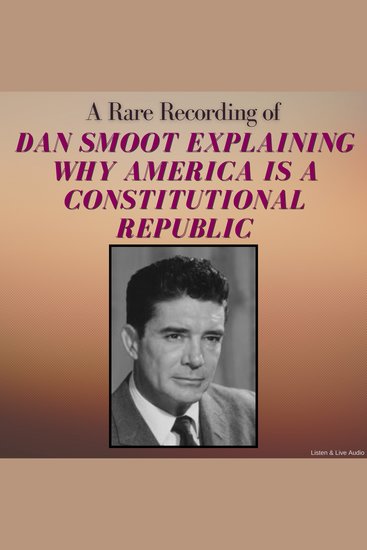
  • A Rare Recording of Dan Smoot Explaining Why America Is A Constitutional Republic - cover

    A Rare Recording of Dan Smoot...

    Dan Smoot

    • 0
    • 0
    • 0
    Dan Smoot (October 5, 1913 - July 24, 2003), born in East Prairie, MO, was an FBI agent turned conservative political commentator. From 1956 to 1971, he published The Dan Smoot Report, which was a weekly newsletter and radio program. Smoot wrote four books, including The Invisible Government (1962), concerning early members of the Council on Foreign Relations. In the following recording, Smoot explains the importance of America as a Constitutional Republic.
    Ver livro
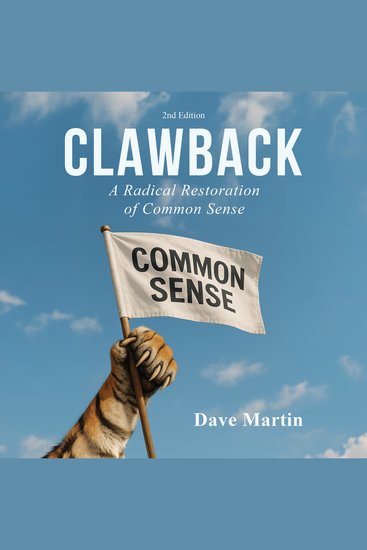
  • CLAWBACK - A Radical Restoration of Common Sense - cover

    CLAWBACK - A Radical Restoration...

    David Martin

    • 0
    • 0
    • 0
    Just a few decades ago, as recently as the Clinton years, we had a vibrant nation that inspired the rest of the world. But then a new religion called Secular Humanism took hold. It saw wrongs that needed to be righted, but went overboard as its revolutionary zeal carried it to excesses that plague our nation today. Clawback proposes a roadmap to get back to the nation we once had when common sense superseded idealistic and impractical zeal. The book presents over two hundred ideas to return us to a time when the pillars of family, friendships, and faith supported a healthy, happy, and powerful nation.
    Ver livro
  • Battleground - 10 Conflicts that Explain the New Middle East - cover

    Battleground - 10 Conflicts that...

    Christopher Phillips

    • 0
    • 0
    • 0
    The essential guide to geopolitics in the modern Middle East 


    The Middle East is in crisis. The shocking events of the war in Gaza have rocked the entire region. More than a decade ago, the Arab Spring had raised hopes of a new beginning but instead ushered in a series of civil wars, coups, and even harsher autocracies. Tensions were exacerbated by the meddling of outsiders, as regional and global powers sought to further their interests. The United States, for so long the dominant actor, had stepped back, leaving a vacuum behind it to be fought over. 


    Christopher Phillips explores geopolitical rivalries in the region, and the major external powers vying for influence: Russia, China, the European Union, and the United States. Moving through ten key flashpoints, from Syria to Palestine, Phillips argues that the United States' overextension after the Cold War, and retreat in the 2010s, has imbalanced the region. Today, the Middle East remains blighted by conflicts of unprecedented violence and a post-American scramble for power—leaving its fate in the balance.
    Ver livro