¡Acompáñanos a viajar por el mundo de los libros!
Añadir este libro a la estantería
Grey
Escribe un nuevo comentario Default profile 50px
Grey
Suscríbete para leer el libro completo o lee las primeras páginas gratis.
All characters reduced
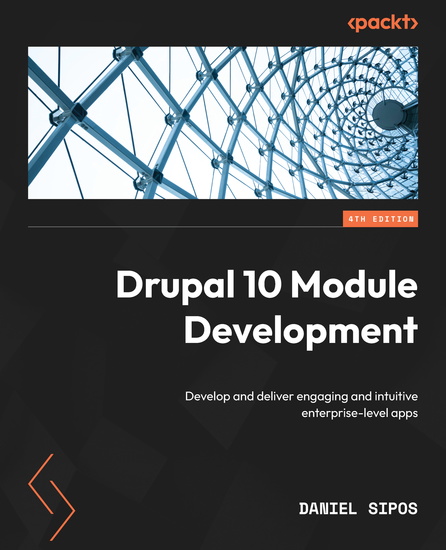
Drupal 10 Module Development - Develop and deliver engaging and intuitive enterprise-level apps - cover

Drupal 10 Module Development - Develop and deliver engaging and intuitive enterprise-level apps

Daniel Sipos

Editorial: Packt Publishing

  • 0
  • 0
  • 0

Sinopsis

Embark on a journey of Drupal module development with the latest edition of this must-have guide written by Daniel Sipos – a Drupal community member! This fourth edition is meticulously revised to cover the latest Drupal 10 enhancements that will help you build custom Drupal modules with an understanding of code deprecations, changing architecture, data modeling, multilingual ecosystem, and so on.

You’ll begin with understanding the core components of Drupal 10 architecture, discovering its subsystems and unlocking the secrets of creating your first Drupal module. Further, you'll delve into Drupal logging and mailing systems, creating theme hooks, and rendering a layout. As you progress, you'll work with different types of data storage, custom entities, field types, and work with Database APIs for lower-level database queries. You'll learn to reap the power of JavaScript and ensure that your code works seamlessly on multilingual sites. You'll also learn to create custom views, automate tests for your functionalities, and write secure code for your Drupal apps.

By the end of this book, you'll have gained confidence in developing complex modules that can solve even the most complex business problems and might even become a valuable contributor to the Drupal community!
Disponible desde: 21/04/2023.
Longitud de impresión: 580 páginas.

Otros libros que te pueden interesar

  • AI-Powered Agriculture - cover

    AI-Powered Agriculture

    Lars

    • 0
    • 0
    • 0
    Agriculture Reimagined: Harnessing the Power of AI for a Greener Future 
     
    In a world where technology touches every facet of life, AI-Powered Agriculture: The Next Green Revolution promises to be a game-changer. Step into a future where artificial intelligence and farming converge to not only secure our food supply but also make agriculture more efficient, sustainable, and resilient than ever before. 
     
    Ever wondered how AI transforms traditional farming? This book unveils the mysteries of AI and machine learning, making technology accessible for agricultural enthusiasts and experts alike. By diving into the evolution of farming technologies and the pivotal role AI plays today, readers will find themselves embarking on a journey that redefines what’s possible in the fields. 
     
    Imagine farms equipped with real-time data collection systems, capable of analyzing soil health, monitoring crop growth, and detecting pests before they wreak havoc. Witness how AI-driven innovations are revolutionizing water management, ensuring every drop counts, and how autonomous machinery is setting new standards for efficiency and precision. 
     
    The economic and environmental benefits are staggering. Discover how AI reduces costs, minimizes food wastage, promotes sustainability, and even helps in combating climate change. Through global case studies, learn about successful implementations across diverse climates and cultures, proving that AI in agriculture is not merely a concept for the wealthy but a powerful tool for small-scale and large-scale farmers alike. 
     
    In addition to practical applications, this book delves into policies, ethical considerations, and the future of AI education in agriculture. With chapters dedicated to funding, investment, and industry partnerships, it provides a comprehensive guide for anyone looking to innovate in this vital sector.
    Ver libro
  • Data Security and Privacy for Beginners - A Beginner's Guide to Safeguarding Your Data and Preserving Privacy in the Digital Age - cover

    Data Security and Privacy for...

    Saimon Carrie

    • 0
    • 0
    • 0
    In today's digital world, the security and privacy of our data are more important than ever. With the rise of cyber threats, data breaches, and privacy concerns, understanding the fundamentals of data security and privacy is essential for everyone, regardless of technical expertise. 
    "Data Security and Privacy for Beginners" is your comprehensive guide to navigating the complex landscape of data protection. Whether you're an individual looking to protect your personal information or an organization seeking to safeguard sensitive data, this beginner-friendly book has you covered. 
    From understanding the basics of data security and privacy to implementing best practices and tools, this book provides clear explanations, practical tips, and actionable strategies to help you protect your data and preserve privacy in the digital age. 
    Inside, you'll learn:The importance of data security and privacy in today's interconnected world.Common cybersecurity threats and privacy risks, and how to mitigate them.Key principles and concepts of data protection, including encryption, access controls, and privacy by design.Best practices for securing data in transit and at rest, and tools and technologies to help you do so.Compliance requirements and regulations governing data security and privacy, and how to ensure compliance.Practical steps you can take to enhance your data security posture and protect your privacy. 
    "Data Security and Privacy for Beginners" will empower you with the knowledge and skills needed to safeguard your data and privacy with confidence. Start protecting what matters most today!
    Ver libro
  • Electro Girl - cover

    Electro Girl

    Lainie Chait

    • 0
    • 0
    • 0
    Lainie Chait was diagnosed with epilepsy in 1991 at the age of 19. At the time of diagnosis, there were three roads to go down - avoidance, acceptance or rebellion.  Avoidance was her first choice. Falling in the shower, brain jerks and muscle twitches when she was 14 was the beginning of something 'not quite right' about her early teenage years. She hid these symptoms from family and friends for three years in the hope that they were just ‘growing pains’.As she started reaching the age of independence (18 in Australia) and started to drink, stay up late and go out partying, these ‘growing pains’ turned into a seizure condition that could no longer be ignored.  Eventually doctors, diagnoses and medicines were brought into the equation.She tried acceptance but at the time it wasn’t the right fit, as the very thought of taming down her young, fun life and replace it with medicine, early nights and mature personal decisions was just too hard to fathom. Rebellion then became her main focus and she achieved this by partying, staying up late and ignoring the triggers. This mindset carried with it an enormous amount of embarrassment and shame.  She constantly felt like a failure after each of the 250+ Grand Mal seizures she endured over 25 years.  But she wasn’t just rebelling against a diagnosis; she was rebelling against a system that has the capacity to make you feel better but at a price that also keeps you in a place of perpetual illness.  She needed to know why she had epilepsy and the only way she was going to find this out was to take herself off all the meds and research it, live it, feel it, document and manage it for herself.She did this much to the horror of her doctors, friends and family.  She went on a journey to get to know her brain and what makes it tick and glitch. The journey was about finding out just how much control she did and didn’t have over her seizures.Electro Girl is Lainie Chait's story of resilience, growth and self advocacy.
    Ver libro
  • Race for Nuclear Weapons during World War II The: The History and Legacy of Both Sides’ Efforts to Build an Atomic Bomb - cover

    Race for Nuclear Weapons during...

    Editors Charles River

    • 0
    • 0
    • 0
    Before the Second World War, military conflicts were fought under orthodox conditions, usually termed “conventional warfare,” but several innovations had significantly changed combat, leading inextricably to the race for a nuclear weapon in the 1930s and 1940s. Conflicts had been fought by armies on horseback with guns of varying sophistication since the 16th century, but mechanized warfare and machine guns changed this calculus and set the stage for future combat by the end of World War I. Other sinister changes entered the fray during this conflict, such as chemical weapons like chlorine and mustard gas. The total warfare brought about by World War I and ensuing wars like the Spanish Civil War made the quest for the most powerful weapons somewhat necessary. 
    The Manhattan Project would ultimately yield the “Little Boy” and “Fat Man” bombs that released more than 100 Terajoules of energy at Hiroshima and Nagasaki, but as it turned out, the Axis were not far behind with their own nuclear weapons program. When the Nazis’ quest for a nuclear weapon began in earnest in 1939, no one really had a handle on how important nuclear weapons would prove to war and geopolitics. The attacks on Hiroshima and Nagasaki in August 1945, along with the Cold War-era tests and their accompanying mushroom clouds, would demonstrate the true power and terror of nuclear weapons, but in the late 1930s these bombs were only vaguely being thought through, particularly after the successful first experiment to split the atom by a German scientist. The nuclear age itself was in its infancy, barely 35 years old, but within a few short years the advent of nuclear war loomed over the world and the prospect of the enemy winning the nuclear race kept Allied leaders awake at night.
    Ver libro
  • The Fall Of Homo Digitalis - Impersonal Intimacy And New Relationships in The Digital Era - cover

    The Fall Of Homo Digitalis -...

    Brian Gibson

    • 0
    • 0
    • 0
    This audiobook is narrated by an AI Voice.  
    With unparalleled insight and a keen understanding of the digital revolution's impact on our lives, this book explores the rise of Homo Digitalis, a new era of human existence where screens, algorithms, and data have reshaped how we interact. 
    From the exhilarating thrill of swiping right to the troubling reality of social media-driven envy, this book delves into the paradox of our time: the paradox of impersonal intimacy. We've become experts at connecting with others across the globe, yet sometimes struggle to communicate with those closest to us. "The Fall of Homo Digitalis" explores how these unprecedented technological advancements have reshaped our understanding of love, friendship, and human connection. 
    Whether you're a digital native, a concerned parent, or anyone curious about the transformative power of technology on our relationships, this book is a must-read for all those seeking to comprehend the ever-shifting dynamics of love, intimacy, and human connection in the digital age. "The Fall of Homo Digitalis" mirrors our digital selves and guides us toward a more connected and authentic future.
    Ver libro
  • War Play - Video Games and the Future of Armed Conflict - cover

    War Play - Video Games and the...

    Corey Mead

    • 0
    • 0
    • 0
    A behind-the-scenes look at how the military uses video game technology to train soldiers, treat veterans, and entice new recruitsHow does the U.S. military train its soldiers for new forms of armed conflict, all within the constraints of diminished defense budgets? Increasingly, the answer is cutting-edge video game technology. Corey Mead shows us training sessions where soldiers undertake multiplayer “missions” that test combat skills, develop unit cohesion, and teach cultural awareness. He immerses himself in 3-D battle simulations so convincing that they leave his heart racing. And he shows how the military, which has shaped American education more than any other force over the last century, fuels the adoption of games as learning tools—and recruitment come-ons. Mead also details how the military uses games to prepare soldiers for their return to the home front and to treat PTSD. Military-funded researchers were closely involved with the computing advances that led to the invention of the Internet. Now, as Mead proves, we are poised at the brink of a similar explosion in game technology. War Play reveals that many of tomorrow’s teaching tools, therapies, and entertainments can be found in today’s military.
    Ver libro