Junte-se a nós em uma viagem ao mundo dos livros!
Adicionar este livro à prateleira
Grey
Deixe um novo comentário Default profile 50px
Grey
Assine para ler o livro completo ou leia as primeiras páginas de graça!
All characters reduced
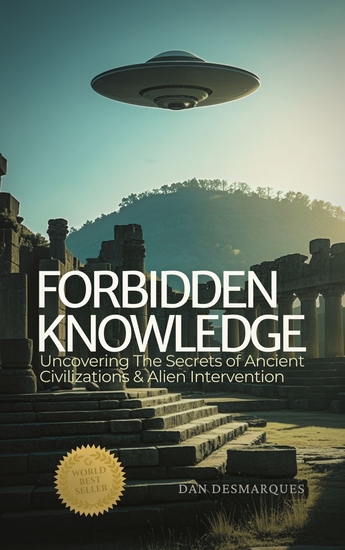
Forbidden Knowledge - Uncovering the Secrets of Ancient Civilizations and Alien Intervention - cover
LER

Forbidden Knowledge - Uncovering the Secrets of Ancient Civilizations and Alien Intervention

Dan Desmarques

Editora: 22 Lions

  • 0
  • 0
  • 0

Sinopse

Have you ever felt that our history is far richer and more complex than what is presented in classrooms and textbooks? Have you ever wondered why certain truths seem to be deliberately obscured, leaving the official narrative feeling incomplete or even fabricated? If so, you are not alone. The hidden truths of our past are waiting to be uncovered, and it's time to reveal the secrets that have been hidden from humanity for millennia.
 
In Forbidden Knowledge, we embark on an eye-opening journey through the mysterious history of our world. This book delves into the secrets of ancient civilizations, the intriguing role of extraterrestrials in our evolution, and the systematic suppression of knowledge by the powerful. This is not just a collection of theories; it is a clarion call for those who yearn to understand the true nature of our existence and reclaim our spiritual sovereignty.
 
Through rigorous research and compelling evidence, we explore the legacies of advanced ancient civilizations such as Atlantis and Lemuria, revealing their profound influence on our modern world. We examine the involvement of extraterrestrial beings, from the genetic engineering of the Anunnaki to the divine wisdom attributed to the Egyptian gods. We also expose the tactics used by the powers that be to suppress this knowledge, including the manipulation of education and the media, and the pervasive use of disinformation.
 
But Forbidden Knowledge is not only about exposing the deceptions of the past; it is also about embracing the truths of the present and envisioning a future that honors our divine potential. By rediscovering the true messages of enlightened figures, we can free ourselves from the constraints of religious dogma and raise our consciousness. This journey encourages us to recognize the interconnectedness of all beings and the vital importance of compassion, empathy, and unity.
 
If you are ready to question the narratives that have been imposed upon us and seek the profound truths that lie beyond the veil of deception, then this book is for you. The path to spiritual liberation is paved with knowledge, understanding, and the courage to defy the status quo. It is a journey that invites us to face the shadows of our past and step into the light of our true potential. If you are ready to discover the truth, you can begin this extraordinary journey today.
Disponível desde: 24/11/2024.
Comprimento de impressão: 160 páginas.

Outros livros que poderiam interessá-lo

  • The Cultural Revolution - China's Radical Change - cover

    The Cultural Revolution -...

    Nova Ashford

    • 0
    • 0
    • 0
    The Cultural Revolution, which took place in China from 1966 to 1976, was one of the most tumultuous and transformative periods in the country’s history. Initiated by Mao Zedong, the founding father of the People’s Republic of China, the movement sought to preserve Chinese communism by removing capitalist, traditional, and cultural elements from Chinese society. At its core, the Cultural Revolution aimed to enforce Maoist ideology, reaffirm his leadership, and transform the cultural, social, and political fabric of China. It was a radical attempt to reshape Chinese society by addressing perceived corruption and ideological impurity within the Communist Party and broader society. 
    Mao’s motivations for launching the Cultural Revolution were multifaceted. After the failure of the Great Leap Forward (1958-1962), which had resulted in widespread famine and economic chaos, Mao’s position within the Communist Party had been weakened. The Cultural Revolution provided Mao with an opportunity to reassert his control over the party and eliminate rivals, many of whom were seen as too moderate or resistant to his vision of a truly communist society. It also reflected Mao’s concern that China was veering away from the revolutionary ideals that had initially driven the Communist Party. 
    The movement was largely propelled by the Red Guards, a youth-based movement that encouraged the younger generation to challenge authority and remove perceived counter-revolutionary influences. Under the banner of Maoism, the Red Guards sought to destroy the "Four Olds"—old customs, old culture, old habits, and old ideas. This led to widespread destruction of cultural heritage, including temples, books, and artworks. Intellectuals, teachers, and perceived enemies of the revolution were subjected to violent persecution, public humiliation, and forced labor, with many being sent to the countryside for "re-education."
    Ver livro
  • Arion's Theme Park Adventure - cover

    Arion's Theme Park Adventure

    A. Thanaraj Kukadia

    • 0
    • 0
    • 0
    Arion is very excited to go to the theme park with his parents. Little does Arion know, there is an adventure in store for him. Arion spreads kindness around the theme park and a magical adventure takes a turn full of surprises! Kindness is magic. It is indeed, a virtue for all of us to live by and practice in all walks of life.
    Ver livro
  • Psychology Of Memory The: How We Remember and Forget - Understanding the Science Behind Memory - cover

    Psychology Of Memory The: How We...

    Draven Frost

    • 0
    • 0
    • 0
    Dive into the fascinating world of human memory with Psychology of Memory, an illuminating audiobook that explores the intricate mechanisms behind how we encode, store, and retrieve information. From the science of forgetting to the secrets of enhancing recall, this audiobook unravels the complexities of memory through a blend of cutting-edge research, real-life examples, and practical applications. 
    Whether you're a student of psychology, a professional seeking to improve cognitive performance, or simply curious about how your mind works, this audiobook offers valuable insights into:The different types of memory (sensory, short-term, and long-term)The role of emotions and stress in memory formationTechniques to boost memory retention and combat forgetfulnessThe impact of aging, trauma, and neurological conditions on memoryThe intersection of memory with identity, decision-making, and creativity
    Ver livro
  • Battle of Kapetron The: The History and Legacy of the First Major Battle Between the Byzantine Empire and Seljuk Turks - cover

    Battle of Kapetron The: The...

    Editors Charles River

    • 0
    • 0
    • 0
    The Byzantine Empire existed for over a thousand years, with a history spanning from the division of the Roman Empire in 395 until the Ottoman conquest of Constantinople in 1453. It was formed from the previous Eastern Roman Empire, and during its long existence, the Byzantine inhabitants were very proud to call themselves Romans.  
    	However, many things changed during the long lifespan of the Byzantine Empire, starting with a Hellenization in the 6th century. The use of the Latin language diminished and Greek took its place, while the typical Roman culture gave way to a more Hellenistic one. The Hellenization of Byzantium was detrimental to the relationship with the Holy Roman Empire, and the Christian world from that point would be split in two. The subsequent strengthening of the Orthodox Church caused many civil wars and conflicts to arise during the centuries, which shattered and reshaped the territory time after time. By the end of the Byzantine Empire’s existence, the old age had weakened both the state and church, making it an easy target for invading forces.  
    	The most notable invaders were the Turkish-speaking Seljuks, led through a series of battles by Kutalmishouglu Suleiman, who supported different usurpers against the Byzantine emperor. The expansion of the Seljuks was so successful that when Suleiman died, he had put all of Bithynia under his control as well as several important harbor towns along the shores on the Asian side of Bosphorus. With that accomplishment, he had managed to separate the Byzantines living in Anatolia from their emperor in Constantinople. This immediately weakened the unity of the Byzantine Empire.  
    	Of all the conflicts that brought this state of affairs into being, few were as instrumental as the Battle of Kapetron, the culmination of one of the first major Seljuk raids into Byzantine territory.
    Ver livro
  • Ratels on the Lomba - The Story of Charlie Squadron - cover

    Ratels on the Lomba - The Story...

    Leopold Scholtz

    • 0
    • 0
    • 0
    “We destroyed a whole enemy brigade (47 Brigade) on the Lomba. History will prove it to be one of the most glorious and successful actions that South African forces ever took part in.” – General Jannie Geldenhuys, as quoted in Cuito Cuanavale 
     
    On 3 October 1987 Charlie Squadron – the iron fist of 61 Mechanised Battalion Group – led the way in a decisive battle on the Lomba River in southern Angola, as part of the South African Defence Force’s Operation Moduler.  
    Although SADF tactical doctrine dictated that the tanks of the Angolan 47 Brigade be countered with tanks, the young conscripts of Charlie Squadron were forced to face their enemy in vastly inferior Ratels, significantly handicapped by the vehicles’ thin armour and low-velocity guns. Not only were they facing a force far superior in terms of weaponry, but they were also hugely outnumbered and had to deal with terrain so dense that their sight was severely impaired and their movement restricted. 
    Through interviews with veterans of the battle and diary entries from the time, Leopold Scholtz recreates the drama of this David vs Goliath battle, taking the reader straight to the heart of the action. A deeply human story, Ratels on the Lomba tells of how individuals react in the face of death, and reveals how the war never left these men, not even when they returned home.
    Ver livro
  • History of the Netherlands - Understanding the Battle of Waterloo and Tulip Mania (2 Titles) - cover

    History of the Netherlands -...

    Kelly Mass

    • 0
    • 0
    • 0
    This book consists of two titles, which are real even in the history of the Netherlands: 
    Battle of Waterloo - The Battle of Waterloo, fought on June 18, 1815, near the village of Waterloo in the United Kingdom of the Netherlands (present-day Belgium), was a decisive conflict that ended the Napoleonic Wars. The battle pitted the French army, led by Napoleon Bonaparte, against two powerful forces from the Seventh Coalition. One of these was a British-led coalition under the command of the Duke of Wellington, which included troops from the United Kingdom, the Netherlands, Hanover, Brunswick, and Nassau. The other force was a larger Prussian army commanded by Field Marshal Gebhard Leberecht von Blücher. Together, these forces effectively crushed Napoleon's ambitions and marked the final chapter in his reign. The battle was also known as the Battle of Mont Saint-Jean (to the French) or La Belle Alliance (to the Prussians). 
    Tulip Mania - Tulip Mania, often considered the first recorded speculative bubble in history, took place during the Dutch Golden Age in the early 17th century. This period saw some tulip bulbs, which had been newly introduced to Europe, achieve extraordinary prices. The peak of the tulip market occurred in 1634, with prices reaching unbelievable levels before plummeting drastically in February 1637. This event is frequently cited as an early example of an asset bubble, where the prices of goods diverged dramatically from their intrinsic value. The tulip mania of the 1630s remains one of the most notable cases of speculative fever in financial history.
    Ver livro