Junte-se a nós em uma viagem ao mundo dos livros!
Adicionar este livro à prateleira
Grey
Deixe um novo comentário Default profile 50px
Grey
Assine para ler o livro completo ou leia as primeiras páginas de graça!
All characters reduced
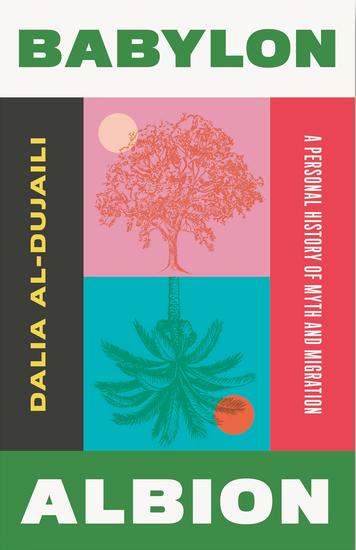
Babylon Albion - A Personal History of Myth and Migration - cover
LER

Babylon Albion - A Personal History of Myth and Migration

Dalia al-Dujaili

Editora: Saqi Books

  • 0
  • 0
  • 0

Sinopse

Whoever said nature is still has not borne witness to the migration of the seasons.


In this lyrical enquiry, Dalia Al-Dujaili considers what it means to belong in your land. She traces the rich heritage of the earth beneath our feet and the wildlife that call it home – from the oak tree and date palm to fairytale creatures, such as dragons, unicorns and the ancient Lamassu. Weaving together Arab and Islamic mythology with the English and Christian pastoral, Al-Dujaili unmasks the communal lush, familiar and, at times, dark places we share.


A love song to Britain, Iraq and the body of earth we hold in common, Babylon, Albion is a compelling re-imagining of what it means to be native.
Disponível desde: 08/05/2025.
Comprimento de impressão: 192 páginas.
Outros livros que poderiam interessá-lo

  • On Dangerous Ground - A Memoir of the Irish Revolution - cover

    On Dangerous Ground - A Memoir...

    Hilary Dully

    • 0
    • 0
    • 0
    On Dangerous Ground is the revolutionary period memoir of Republican Máire Comerford (1893–1982). This striking memoir, one of the last of its era, includes Comerford's original text, written mainly in the 1940s and '50s, and new material unearthed from her extensive archive that also contains a wealth of photographs and memorabilia from the period.
    The memoir begins with Comerford's recollection of Sunday strolls to Avondale, former home of Charles Stewart Parnell, who was a neighbour of her father, the mill owner James Comerford. As a young woman, she experiences a 'political awakening' at the hands of a fierce Unionist woman in a secretarial college in London. Máire Comerford (the only Catholic in the class) begins to engage with Irish history books to counterbalance this brush with religious sectarianism. On her return to County Wexford to live with her mother's people – a move necessitated by the family's change of fortune – she re-enters the genteel world of fox hunting and luncheon parties. The memoir paints an intriguing picture of rural life of the time heralding the arrival of the motorcar, social and economic conditions, the rise of the Gaelic League, debates about Home Rule, and the First World War.
    While the description of her surroundings as a young adult is intriguing and often charming, change is in the air in Ireland and a sharp and wide-ranging political analysis is ever present throughout her writing. Following Comerford's witness account of Dublin during the 1916 Rising, she begins a life of political engagement, joining Cumann na mBan, Sinn Féin and the Gaelic League. In 1919, she moves permanently to Dublin to live with and work for renowned historian and nationalist, Alice Stopford Green. There, she becomes immersed in Republican politics and the War of Independence.
    Comerford's memoir gives voice to the experience of Republican women during revolutionary times, highlighting the immense contribution of women in the struggle for an Irish Republic. She works all over the country, moving arms, carrying dispatches, finding safe houses, researching atrocities and working assiduously for Ireland. She experiences raids, prison vigils, funerals of her comrades and dangers of all kinds, but nothing cuts as deep as the sense of utter betrayal following the signing of the Treaty in 1922. Comerford takes the anti-Treaty side, is imprisoned a number of times and endures a 27-day hunger strike. Following her release, she leaves Ireland on a tour of east coast American cities to raise funds for the Republican cause at the behest of de Valera. She returns to a harsh, poverty-stricken and lonely existence, eking out a living on a hilltop poultry farm in Wexford. But while her memoir ends in bleak times, her overarching vision suggests an unquenchable optimism – and that the fight will go on. An epilogue by the editor chronicles the years between 1927 and her death.
    Ver livro
  • Nadian Sirjanharian - cover

    Nadian Sirjanharian

    Simrat Sumera

    • 0
    • 0
    • 0
    The book *"Nadian Sirjanharian"*, written by Dr. Simrat Kaur Sumera, portrays the lives of approximately 33 renowned women. These women have achieved success in various fields through their hard work and have become a source of inspiration for society.
    Ver livro
  • Galileo Galilei - History Discoveries and Scientific Revolution - cover

    Galileo Galilei - History...

    Kelly Mass

    • 0
    • 0
    • 0
    Galileo di Vincenzo Bonaiuti de' Galilei, known just as Galileo, was an astronomer, physicist, and engineer from Pisa, modern-day Italy, who was regularly described as a polymath. Galileo has been called the "creator of observational astronomy," "father of modern-day physics," "father of the clinical technique," and "father of contemporary science," to name a few titles. 
    Galileo engaged on useful science and innovation, clarifying the characteristics of pendulums and "hydrostatic balances," and also studying speed and speed, gravity and free fall, the concept of relativity, inertia, and projectile movement. He created the thermoscope and some army compasses, and he used the telescope to observe celestial things clinically. Telescopic verification of Venus' stages, observation of Jupiter's 4 biggest satellites, research study of Saturn's rings, and analysis of sunspots are amongst his contributions to observational astronomy. 
    Galileo's big testimony and support of Copernican heliocentrism (the Earth turning daily and circling the sun) drew criticism from the Catholic Church and certain astronomers. In 1615, the Roman Inquisition checked out the subject and realized that heliocentrism was silly, absurd, and profane because it went against the Holy Bible. 
    No doubt Galileo was an intelligent person, who paved the way for many discoveries and inventions. Let’s take a look at his life, his mission, and his accomplishments.
    Ver livro
  • Haughey - cover

    Haughey

    Gary Murphy

    • 0
    • 0
    • 0
    With exclusive access to the Haughey archives, Gary Murphy presents a reassessment of Charles Haughey's life and legacy.
    Saint or sinner? Charles Haughey was, depending on whom you ask, either the great villain of Irish political life or the benevolent and forward-thinking saviour of a benighted nation. He was undoubtedly the most talented and influential politician of his generation, yet the very roots of his success – his charisma, his intelligence, his ruthlessness, his secrecy – have rendered almost impossible any objective evaluation of his life and work.
    That is, until now. Based on unfettered access to Haughey's personal archives, as well as extensive interviews with more than eighty of his peers, rivals, confidants and relatives, Haughey is a rich and nuanced portrait of a man of prodigious gifts, who, for all his flaws and many contradictions, came to define modern Ireland.
    'A superbly balanced exploration of the life and politics of one of the most fascinating figures in 20th century Ireland.' Professor John Horgan
    'An indispensable read for anyone with an interest in modern Irish history.' David McCullagh
    'Offers much new detail –  and not a few surprises –  about the personality and career of a political titan who is still, in equal measure, revered and reviled in 21st century Ireland.' Conor Brady
    Ver livro
  • Reconciling - A Lifelong Struggle to Belong - cover

    Reconciling - A Lifelong...

    Scott Steedman, Larry Grant

    • 0
    • 0
    • 0
    It's taken most of Larry Grant's long life for his extraordinary heritage to be appreciated. He was born in a hop field outside Vancouver in 1936, the son of a Musqueam cultural leader and an immigrant from a village in Guangdong, China. In 1940, when the Indian agent discovered that their mother had married a non-status man, Larry and his two siblings were stripped of their status. With one stroke of the pen, they were disenfranchised—no longer recognized as Indigenous. 
     
    Reconciling is a series of conversations between Larry and writer Scott Steedman as they visit pivotal geographical places together. Larry tells the story of his life, including his thoughts on reconciliation and the path forward for First Nations and Canada. His life echoes the barely known story of Vancouver and spans key events of the last two centuries, including Chinese immigration and the Head Tax, the ravages of residential school and now Indigenous revival and the accompanying change in worldview. 
     
    When Larry talks about reconciliation, he uses the verb reconciling, an ongoing, unfinished process we're all going through. "I have been reconciling my whole life, with my inner self," he explains. "To not belong was forced upon me by the colonial society that surrounded me. But reconciling with myself is part of all that."
    Ver livro
  • The Confession of Saint Patrick - cover

    The Confession of Saint Patrick

    Saint Patrick, Rev James O'Leary

    • 0
    • 0
    • 0
    The Confession of Saint Patrick, originally written in Latin by Ireland's patron saint in the late 5th century CE. Translated by Rev. James O'Leary, D.D. in 1874 and republished in 1880. 
    Narrated by Robin Reads.
    Ver livro