Unisciti a noi in un viaggio nel mondo dei libri!
Aggiungi questo libro allo scaffale
Grey
Scrivi un nuovo commento Default profile 50px
Grey
Iscriviti per leggere l'intero libro o leggi le prime pagine gratuitamente!
All characters reduced
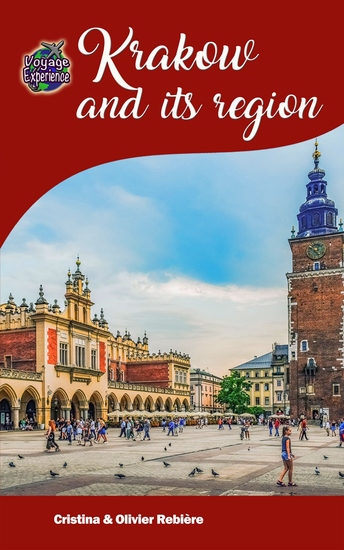
Krakow and its region - cover

Krakow and its region

Cristina Rebiere, Olivier Rebiere

Casa editrice: Cristina & Olivier Rebiere

  • 0
  • 0
  • 0

Sinossi

Krakow and its region
 
Discover a gorgeous city, full of history and culture!
 
Would you like to meet History at every street corner?
 
Welcome to Krakow, in Poland, right in the heart of Central Europe, one of the most beautiful cities of the old continent!
 
Would you like to be amazed by a stunning city, breathtaking landscapes, and enjoy this beauty?Krakow and its region are the right destination for you!We hope that our eGuide Voyage Experience will prove it to you.Read at your own pace and browse through photos, sites or interests.
 
We are Cristina & Olivier Rebière and travel the world since we are students. We have visited more than 60 countries and love finding solutions to travel at affordable prices and maximize our budget to discover hidden treasures during our stay, just like you!
 
Prepare and live your holiday … differently!
 
In fact, in this innovative eGuide, which is a vitaminized supplement to classic tourist guides, we share with you our passion for travel and our crush for Krakow, a gorgeous city that really worth the travel!
 
So, if you do not know where to spend your next holidays or an extended weekend, why not make a visit to Krakow? All its treasures are waiting for you.
 
With this responsive eGuide, use your tablet or smartphone without internet connection and navigate through all the information by choosing from the 3 available methods:
 
By site: Use a « classic » geographic display with high-resolution maps
 
By photo: Choose one of the photos and « jump » in the corresponding section
 
By affinity or interest: Select one of the thematic icons and get a list of the corresponding websites!
Disponibile da: 26/02/2024.
Lunghezza di stampa: 41 pagine.

Altri libri che potrebbero interessarti

  • The Cultural Revolution - China's Radical Change - cover

    The Cultural Revolution -...

    Nova Ashford

    • 0
    • 0
    • 0
    The Cultural Revolution, which took place in China from 1966 to 1976, was one of the most tumultuous and transformative periods in the country’s history. Initiated by Mao Zedong, the founding father of the People’s Republic of China, the movement sought to preserve Chinese communism by removing capitalist, traditional, and cultural elements from Chinese society. At its core, the Cultural Revolution aimed to enforce Maoist ideology, reaffirm his leadership, and transform the cultural, social, and political fabric of China. It was a radical attempt to reshape Chinese society by addressing perceived corruption and ideological impurity within the Communist Party and broader society. 
    Mao’s motivations for launching the Cultural Revolution were multifaceted. After the failure of the Great Leap Forward (1958-1962), which had resulted in widespread famine and economic chaos, Mao’s position within the Communist Party had been weakened. The Cultural Revolution provided Mao with an opportunity to reassert his control over the party and eliminate rivals, many of whom were seen as too moderate or resistant to his vision of a truly communist society. It also reflected Mao’s concern that China was veering away from the revolutionary ideals that had initially driven the Communist Party. 
    The movement was largely propelled by the Red Guards, a youth-based movement that encouraged the younger generation to challenge authority and remove perceived counter-revolutionary influences. Under the banner of Maoism, the Red Guards sought to destroy the "Four Olds"—old customs, old culture, old habits, and old ideas. This led to widespread destruction of cultural heritage, including temples, books, and artworks. Intellectuals, teachers, and perceived enemies of the revolution were subjected to violent persecution, public humiliation, and forced labor, with many being sent to the countryside for "re-education."
    Mostra libro
  • Ghosts of Scotland - Eerie Ghosts Stories Murder Witches and Folklore - cover

    Ghosts of Scotland - Eerie...

    Kelly Mass

    • 0
    • 0
    • 0
    Whether you believe in the supernatural elements or not, it is fascinating to see how the idea of ghosts happened, and how it developed over the ages. Even if they're really there, it can be said that many individuals have been totally wrong about them. And so, it is pretty much up to us to study them and sort out what the most credible, spiritual truths could be, based upon our own beliefs blended with the stories and testaments of others. 
    A ghost is the soul or spirit of a departed individual or animal who can appear to the living in folklore. Ghosts are defined in numerous ways in folklore, varying from an unnoticeable presence to clear or hardly noticeable wispy shapes to reasonable, realistic forms. Mysticism, or a séance in spiritism, is the purposeful effort to get in touch with the spirit of a departed individual. Part, haunt, phantom, poltergeist, shade, specter, ghost, alarm, wraith, devil, and evil spirit are some of the other titles used to define it. 
    The belief in a hereafter, and symptoms of the spirits of the dead, is quite common, extending back to pre-literate civilizations' animism or forefather praise. Funeral events, exorcisms, and some forms of spiritualism and routine magic are all specifically created to put the spirits of the dead to rest. Though legends of ghostly armies and the ghosts of animals instead of people have been told, ghosts are usually depicted as lonesome, human-like essences. They are said to haunt particular spots, products, or people with whom they once had a relationship. According to a Seat Proving ground research from 2009, 18% of Americans declare to have seen a ghost. 
    Let’s talk about this more in this fascinating book.
    Mostra libro
  • Forsaken Realms - A Journey Through Earth's Most Chilling Derelict Locations - cover

    Forsaken Realms - A Journey...

    John Harpoon

    • 0
    • 0
    • 0
    Throughout history, there have been places where human ambition, industry, or even nature’s cruelty has left behind stark reminders of a world once bustling with life, now standing frozen in time. These forsaken realms—whether born of abandonment, catastrophe, or the slow erosion of human civilization—whisper tales of a forgotten past. They are the remnants of once-thriving cities, sprawling industries, and cultures now reduced to ruins, each holding secrets that time has almost claimed. These abandoned places, laden with mystery and heavy with the weight of what they once represented, continue to intrigue and mystify us. 
    Some of these forsaken locations were victims of natural disasters, like the catastrophic eruption of Mount Vesuvius that buried Pompeii under a deadly blanket of ash, preserving the city in eerie stillness. Others, like the ghost towns of the American West, are testimonies to the transient nature of fortune, where entire communities once built on the promise of riches have vanished almost without a trace. The islands and ruins scattered across the globe have become more than just decaying structures; they have morphed into historical monuments, intriguing puzzles, and even pilgrimages for those seeking to uncover their enigmatic stories. 
    These forgotten realms are not only remnants of civilizations but are also haunting mirrors of human nature. They speak to our fragility, to how empires rise and fall, to how entire populations are swallowed by time, war, or the sheer passage of years. What does it mean when a city is abandoned, a place where families once thrived, now empty and silent? What lies behind the decaying walls and the overgrown pathways? The unanswered questions linger in the air, enticing explorers, historians, and wanderers alike.
    Mostra libro
  • The Kingdom of Kush - Nubian Kings and the Black Pharaohs of the Nile - cover

    The Kingdom of Kush - Nubian...

    Rolf Hedger

    • 0
    • 0
    • 0
    The Kingdom of Kush, an ancient African civilization, flourished along the Nile River in what is now modern-day Sudan. This powerful kingdom played a crucial role in the history of northeastern Africa, often interacting with its northern neighbor, Egypt. The land of Kush was known for its rich natural resources, strategic location, and unique cultural identity, which set it apart from other civilizations of the time. 
    Geographically, Kush was centered in the region known as Nubia, a stretch of land between the first and sixth cataracts of the Nile. This location provided fertile lands for agriculture, supported by the annual flooding of the river. Unlike Egypt, which relied heavily on the predictable flooding of the Nile, the Kushites also adapted to drier conditions, developing irrigation techniques to sustain their crops. The region was abundant in valuable resources such as gold, ivory, ebony, and exotic animal skins, making it an important trade hub in the ancient world. These resources attracted merchants from Egypt, the Mediterranean, and even as far as the Middle East, contributing to the kingdom's economic strength. 
    Kushite civilization was heavily influenced by its relationship with Egypt, but it also maintained distinct cultural and political traditions. Early Kushite settlements date back to around 2500 BCE, and by the time of the Egyptian Middle and New Kingdoms, Kush had grown into a formidable power. Egyptian pharaohs often sought control over Nubia due to its wealth, leading to periods of conquest and integration. However, Kush was not merely a passive recipient of Egyptian influence. It developed its own identity, blending Egyptian religious beliefs with native Nubian traditions, which would later be reflected in Kushite art, architecture, and burial practices.
    Mostra libro
  • Tulip Mania - The First Economic Bubble Caused by Speculative Dutch Investors - cover

    Tulip Mania - The First Economic...

    Kelly Mass

    • 0
    • 0
    • 0
    Tulip Mania, often considered the first recorded speculative bubble in history, took place during the Dutch Golden Age in the early 17th century. This period saw some tulip bulbs, which had been newly introduced to Europe, achieve extraordinary prices. The peak of the tulip market occurred in 1634, with prices reaching unbelievable levels before plummeting drastically in February 1637. This event is frequently cited as an early example of an asset bubble, where the prices of goods diverged dramatically from their intrinsic value. The tulip mania of the 1630s remains one of the most notable cases of speculative fever in financial history. 
    Despite the frenzied speculation surrounding tulips, the overall economic impact on the Dutch Republic was limited. While the tulip mania itself was a unique socio-economic event, it did not significantly harm the prosperity of the Dutch economy. In fact, the Dutch Republic was one of the world's leading economic and financial powers during the 17th century, boasting the highest per capita income in the world from around 1600 to 1720. The country’s financial and economic institutions were advanced, and its economy continued to thrive even as the tulip market collapsed. Today, the term "tulip mania" has evolved into a metaphor used to describe any situation in which asset prices become detached from their underlying value, only to be followed by a sharp decline.
    Mostra libro
  • South West Scotland - cover

    South West Scotland

    Tom Atkinson

    • 0
    • 0
    • 0
    The lovely land of hills, moors and beaches is bounded by the Atlantic and the Solway. Steeped in history and legend, still unspoiled, it is a land whose peace and grandeur are at least comparable to the Highlands, and yet it is hardly known. No area of Scotland better repays exploration than this.
    From the Auld Kirk of Alloway where tales of Tam O'Shanter resound, to the legends of St Ninian at one of Scotland's earliest Christian sites, Whithorn, this region is lovingly described by a local author, who will explore with you the splendour of Culzean Castle and delights of Wanlockhead, Scotland's highest village.
    Mostra libro