Rejoignez-nous pour un voyage dans le monde des livres!
Ajouter ce livre à l'électronique
Grey
Ecrivez un nouveau commentaire Default profile 50px
Grey
Abonnez-vous pour lire le livre complet ou lisez les premières pages gratuitement!
All characters reduced
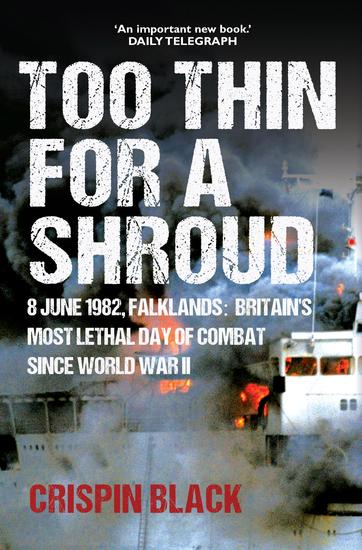
Too Thin for a Shroud - The Last Untold Story of the Falklands War - cover

Too Thin for a Shroud - The Last Untold Story of the Falklands War

Crispin Black

Maison d'édition: Gibson Square

  • 0
  • 0
  • 0

Synopsis

'One of the best in the field.' JON SNOWOn 8 June, 1982, some 600 troops aged 17-22 were packed closely together on the Galahad at Fitzroy, 3 miles from the front line, to liberate Port Stanley on 10 June. They became the thunderbolt target of Argentine airforce attacks resulting in Britain's most devastating military day since 1945 with additional attacks on two Royal Navy ships, including frigate HMS Portsmouth struck by five 500lbs bombs.Written as a tribute to the bravery of the troops as they suddenly came under attack, this memoir is filled with first-hand recollections from officers under attack. The first history of that fateful day, it is also the first Falklands book based on the official June-Sept 1982 Royal Navy Inquiry, recently declassified and made accessible at Kew Archives. Too Thin for a Shroud casts an unmissable, gripping new light on this dramatic part of the land-campaign that has been misunderstood and overlooked for forty years.
Disponible depuis: 16/03/2023.
Longueur d'impression: 224 pages.

D'autres livres qui pourraient vous intéresser

  • Feudalism - The Structure of Medieval Society - cover

    Feudalism - The Structure of...

    Harris Ropes

    • 0
    • 0
    • 0
    Feudalism emerged in Western Europe as a response to the collapse of centralized authority following the fall of the Roman Empire. As Roman institutions crumbled in the 5th century, Europe descended into a period of instability and fragmentation. Without the protection and infrastructure once provided by Rome, people turned to local leaders for safety and organization. These leaders—often wealthy landowners or military figures—became the foundation of a new social and political structure that emphasized land ownership, loyalty, and mutual obligation. 
    The early roots of feudal practices can be traced to the relationships that formed during this chaotic period. In the absence of a strong central government, powerful individuals began offering protection to those around them in exchange for service or labor. Over time, this informal system developed into a structured hierarchy, with clearly defined roles and responsibilities. Lords granted land, known as fiefs, to their vassals, who in return pledged loyalty and military support. This mutual dependency became the backbone of medieval society and formalized the relationships that had organically formed during the earlier periods of uncertainty. 
    Localized power became the defining feature of feudal Europe. With no single empire to unify the continent, authority became decentralized. Kings often ruled in name only, while real control rested in the hands of regional lords and nobles. These lords governed their own territories, enforced laws, and maintained private armies. In turn, they depended on the support of lesser vassals and knights, who managed smaller portions of land and fulfilled military duties. This layered structure ensured that each level of society relied on those above and below, creating a rigid yet stable social order.
    Voir livre
  • Righteous Mind The: Book Summary & Analysis - cover

    Righteous Mind The: Book Summary...

    Briefly Summaries

    • 0
    • 0
    • 0
    This is a concise summary and analysis of The Righteous Mind, by Jonathan Haidt. It is not the original book and is not affiliated with or endorsed by Jonathan Haidt. Ideal for those seeking a quick and insightful overview.
     
    Why do people on different sides of the political spectrum see the world so differently? This insightful book explores the psychological foundations of morality, revealing how our values, intuitions, and group loyalties shape our political beliefs. Drawing from psychology, anthropology, and evolutionary biology, the book argues that moral reasoning is driven more by intuition than by logic, and it challenges readers to understand—and even empathize with—opposing viewpoints. A must-read for anyone seeking to bridge political and ideological divides.
    Voir livre
  • No Country for Old Men by Cormac McCarthy (Book Analysis) - Detailed Summary Analysis and Reading Guide - cover

    No Country for Old Men by Cormac...

    Bright Summaries

    • 0
    • 0
    • 0
    Unlock the more straightforward side of No Country for Old Men with this concise and insightful summary and analysis!This engaging summary presents an analysis of No Country for Old Men by Cormac McCarthy, the story of Llewelyn Moss, a war veteran who stumbles across the aftermath of a drug deal gone wrong and makes off with a briefcase full of money that he finds at the scene of the carnage. However, this leads to a cross-country pursuit with both law enforcement and the psychopathic hitman Anton Chigurh hot on Moss's heels. As his world spirals into chaos, Moss's life turns into a desperate struggle to keep himself and his wife Carla Jean alive. Known for his original and effective writing style, Cormac McCarthy is the multi-award-winning author of several acclaimed novels, including The Road and Blood Meridian.Find out everything you need to know about No Country for Old Men in a fraction of the time!This in-depth and informative reading guide brings you:• A complete plot summary• Character studies• Key themes and symbols• Questions for further reflectionWhy choose BrightSummaries.com?Available in print and digital format, our publications are designed to accompany you on your reading journey. The clear and concise style makes for easy understanding, providing the perfect opportunity to improve your literary knowledge in no time.See the very best of literature in a whole new light with BrightSummaries.com!
    Voir livre
  • Loyalty in Time of Trial - The African American Experience During World War I - cover

    Loyalty in Time of Trial - The...

    Nina Mjagkij

    • 0
    • 0
    • 0
    The little-known history of black soldiers and defense workers in the First World War, and what happened afterward: “Highly recommended.” —Choice   In one of the few book-length treatments of the subject, historian Nina Mjagkij conveys the full range of the African American experience during the “Great War.” Prior to World War I, most African Americans did not challenge the racial status quo. But nearly 370,000 black soldiers served in the military during the war, and some 400,000 black civilians migrated from the rural South to the urban North for defense jobs.    Following the war, emboldened by their military service and their support of the war on the home front, African Americans were determined to fight for equality—but struggled in the face of indifference and hostility in spite of their combat-veteran status. America would soon be forced to confront the impact of segregation and racism—beginning a long, dramatic reckoning that continues over a century later.   “Painstakingly describes the frustration, sometimes anger, and frequent courage demonstrated by southern and northern African Americans in their attempts to include themselves in the national crusade of making the world safe for democracy . . . one of the most comprehensive treatments of the race issue in the early twentieth century that this reader has seen.” —Journal of Southern History
    Voir livre
  • Twelve Days - How the Union Nearly Lost Washington in the First Days of the Civil War - cover

    Twelve Days - How the Union...

    Tony Silber

    • 0
    • 0
    • 0
    In the popular literature of the Civil War, the days immediately after the surrender at Fort Sumter are overshadowed by the battles and changes in American life. 


    Tony Silber's account starts on April 14, 1861, with President Lincoln's call for seventy-five thousand militia troops. Washington, a Southern slaveholding city, was the focal point. The capital was barely defended, by about two thousand local militia troops of dubious training and loyalty. In Charleston, the Confederates had an organized army that was larger and ready to fight. 


    Maryland's eastern sections were reeling in insurrection, and within days Virginia would secede. For half of the twelve days after Fort Sumter, Washington was severed from the North. The United States had a tiny standing army. The federal government's only defense would be state militias. 


    A Confederate success in capturing Washington would have changed the course of the Civil War. Instead, Lincoln emerged as the master of his cabinet, a communications genius, and a strategic giant. Twelve Days alternates between the four main scenes: Washington, insurrectionist Maryland, the advance of Northern troops, and the Confederate planning and military movements.
    Voir livre
  • Saving Ourselves From Suicide - Before and After - How to Ask for Help Recognize Warning Signs and Navigate Grief - cover

    Saving Ourselves From Suicide -...

    LInda Pacha

    • 0
    • 0
    • 0
    HELP, HOPE, AND HEALING - 125 FIVE STAR AMAZON REVIEWS 
    An up-close look at Suicide Prevention and Grief in one best-selling book. Why? They relate more than you realize. Considering how loved ones would grieve might be what keeps someone here. Likewise, grief can become so intense that prevention tools are needed to keep safe those left behind. 
    Pacha, an attorney with a degree and post graduate studies in psychology, public speaks about prevention and grief through her nonprofit, Nick's Network of Hope. She lost her teen son and holds nothing back to help others. 
    SELF-HELP: Reasons to stay; make a safety plan; yell for help and allow it; you're not a burden; people care more than you think; how to reach out when hope is lost; and risk factors and warning signs with real-life examples 
    HOW TO HELP PEOPLE STRUGGLING: Okay to ask if suicidal; listen and ask open-ended questions; don't be a cheerleader if more is needed; believe behavior more than words; and seek professional help 
    GRIEF: Why push on; release guilt and anger; emotions of the first year; second year and beyond; grieving individually and together; new family dynamics; getting back into society; answering difficult questions; parenting surviving kids; keeping your marriage intact; what to avoid; siblings of suicide 
    HOW TO HELP THOSE GRIEVING: Don't avoid; listen but don't try to fix; talk about loved ones; and birthdays and anniversaries 
    STIGMA: Why it exists; ways to reduce it, complexities of mental health; misconceptions of suicide; and how mental health stigma morphs and attaches to survivors 
    HOW TO REDUCE PRESSURE: What is the pressure and ways to reduce it; and recommendations for parents and schools 
    A BETTER TOMORROW: Ways for kinder world; how to reduce bullying and teach kids to live with more compassion
    Voir livre