¡Acompáñanos a viajar por el mundo de los libros!
Añadir este libro a la estantería
Grey
Escribe un nuevo comentario Default profile 50px
Grey
Suscríbete para leer el libro completo o lee las primeras páginas gratis.
All characters reduced
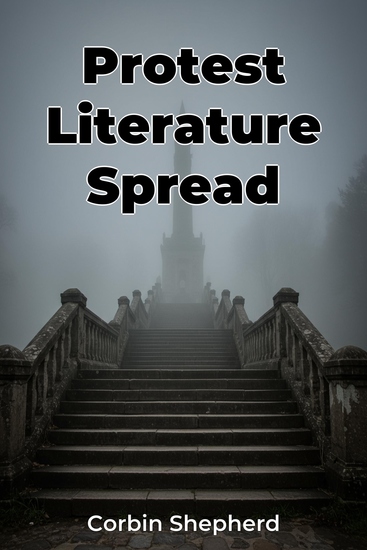
Protest Literature Spread - cover

Protest Literature Spread

Corbin Shepherd

Traductor A AI

Editorial: Publifye

  • 0
  • 0
  • 0

Sinopsis

Protest Literature Spread explores how literary works have acted as catalysts for social and political movements worldwide. The book argues that these works do more than reflect discontent; they actively shape historical outcomes. By transforming individual grievances into shared struggles, literature fosters solidarity and inspires action, even circumventing censorship to spread revolutionary ideas.

 
The book uniquely examines global movements, extending beyond a Eurocentric view to include Africa, Asia, and Latin America, offering a comprehensive understanding of literary activism.

 
The book begins by defining protest literature and its characteristics, then progresses through chapters exploring its role in civil rights, anti-colonial struggles, and gender equality movements. One chapter will highlight the ingenuity writers use to avoid censorship.

 
By analyzing influential texts and historical contexts, the book demonstrates how literature amplifies marginalized voices and challenges oppressive ideologies. It connects to sociology and communication studies to illuminate the dynamics of social movements, message spread, and how historical precedents influence modern political strategies.

 
The book culminates by examining the legacy of protest literature and its continued relevance in the 21st century.
Disponible desde: 06/05/2025.
Longitud de impresión: 62 páginas.


Otros libros que te pueden interesar

  • Israel - What Went Wrong? - cover

    Israel - What Went Wrong?

    Omer Bartov

    • 0
    • 0
    • 0
    A leading Israeli American scholar of the Holocaust explores and explains his native country's intensifying turn toward violence and exclusion.The distinguished historian Omer Bartov was born on a kibbutz, grew up in Tel Aviv, and served in the Israel Defense Forces during the Yom Kippur War. He went on to become a leading scholar of the German army and the Holocaust, before turning his attention to his native country.In Israel: What Went Wrong?, Bartov sketches the tragic transformation of Zionism, a movement that sought to emancipate European Jewry from oppression, into a state ideology of ethno-nationalism. How is it possible, he asks, that a state founded in the immediate aftermath of the Holocaust, an event that gave legitimacy to a national home for the Jews, stands credibly accused of perpetrating large-scale war crimes? How do we come to terms with the fact that Israel’s war of destruction is being conducted with the support, laced with denial and indifference, of so many of its Jewish citizens?Tracing the roots of the violent events currently unfolding in Israel and the occupied territories, Bartov tracks his country's moral tribulations and considers the origins of Zionism, the intertwining of Israel’s independence with Palestinian displacement, the politics of the Holocaust, controversies over the term "genocide," and the uncertain future. The result is a searing and urgent critique that addresses today’s debates over Zionism and the future of Israel with rigor and depth.
    Ver libro
  • William Butler Yeats: 16 Poems and Analyses - with an Original Piano Underscore Adapted for each Poem - cover

    William Butler Yeats: 16 Poems...

    Anónimo

    • 0
    • 0
    • 0
    This audiobook is narrated by an AI Voice.   
    "William Butler Yeats: 16 Poems and Analyses" invites listeners into the luminous, mysterious world of one of Ireland’s greatest poets, presented with a fresh sense of intimacy and emotional depth. This audiobook brings together sixteen of Yeats’s most compelling works, each paired with a thoughtful, accessible analysis that illuminates the poem’s themes, symbols, and craft without sacrificing its magic. Whether Yeats is exploring the longing of youth, the ache of unfulfilled desire, or the turning of history’s wheel, his voice resonates with a timeless beauty that continues to move readers more than a century later. 
    Each poem is accompanied by an original piano underscore, composed and adapted by A. M. Bly to reflect the unique emotional atmosphere of Yeats’s verse. These musical settings do not overpower the poetry; instead, they enhance its rhythms and imagery, offering listeners a deeper, more immersive experience. From gentle, wistful harmonies to bold, dramatic motifs, the music enriches the language and invites the listener to feel each poem as Yeats might have intended: alive, mysterious, and resonant with inner music. 
    Narrated by the expressive and natural-sounding AI voice Willow, this collection balances clarity with warmth, guiding listeners through Yeats’s shifting landscapes of myth, memory, love, and dream. Willow’s narration brings a steadiness and emotional sensitivity to each piece, helping the nuances of the poetry—and the insights that follow—to unfold with ease. 
    Ideal for longtime admirers of Yeats and newcomers alike, this audiobook offers not only a rich appreciation of the poems themselves but also a set of interpretations that deepen understanding and spark reflection. William Butler Yeats: 16 Poems and Analyses is an evocative blend of literature, insight, and music—an invitation to revisit, re-hear, and rediscover a master poet’s enduring work.
    Ver libro
  • Subconscious Mind - Rewiring Your Mind for Positive Change and Mental Clarity - cover

    Subconscious Mind - Rewiring...

    Coral Nunez

    • 0
    • 0
    • 0
    The subconscious mind is a powerful and often misunderstood component of our overall mental framework. It operates beneath the surface of our conscious awareness, influencing our emotions, behaviors, and perceptions in ways we rarely notice. This hidden realm of thought is not merely a repository of forgotten memories or repressed emotions, but rather a dynamic and active process that continuously shapes our daily experiences. From habits formed during childhood to deeply ingrained belief systems, the subconscious mind acts as an archive that stores our past experiences and serves as the engine behind our reactions and decision-making. Understanding its workings can unlock profound insights into why we behave the way we do, providing the keys to personal growth and transformation. 
    In exploring the subconscious mind, it is essential to consider both historical and modern scientific perspectives. Ancient philosophies and spiritual traditions have long acknowledged the power of the inner self, emphasizing techniques such as meditation, dream analysis, and ritual practices to access deeper layers of consciousness. In contrast, modern neuroscience and psychology have begun to uncover the biological underpinnings of subconscious processes, such as neural plasticity and the complex interplay between various brain regions. These scientific advancements have validated many traditional practices, demonstrating that our subconscious is not a mysterious, mystical force, but a tangible and influential part of our neurobiology. The integration of these views has fostered a comprehensive understanding of mental processes, blending empirical evidence with time-tested wisdom.
    Ver libro
  • The Dark Ages Collection - cover

    The Dark Ages Collection

    David Hume, J. B. Bury, Edward...

    • 0
    • 0
    • 0
    What really happened after the fall of Rome?
    
    The Dark Ages Collection brings together classic historical writings that explore one of the most mysterious and transformative periods in human history. Spanning the collapse of the Roman Empire to the rise of medieval Europe, this collection examines how societies survived, adapted, and rebuilt in an age of upheaval and change.
    
    Through chronicles, scholarly essays, and historical narratives by respected authors, these works illuminate the political, cultural, and religious forces that shaped the early Middle Ages. Far from a time of simple decline, the Dark Ages emerge here as a complex era of transition, innovation, and enduring influence.
    
    This anthology offers readers a deeper understanding of how modern Europe was forged from chaos, tradition, and resilience.
    
    Inside this eBook, you'll explore:
    
    Classic texts on the fall of Rome and early medieval history
    
    Political, religious, and cultural transformation in Europe
    
    The foundations of medieval society and governance
    
    A valuable collection for historical study and reference
    
    Long studied by historians and scholars, the works in this collection remain essential for anyone seeking to understand the roots of Western civilization.
    
    Step into the centuries that reshaped the world. Buy now and explore The Dark Ages Collection.
    Ver libro
  • What Causes Lighter and Darker Skin - cover

    What Causes Lighter and Darker Skin

    Andrew Kirby

    • 0
    • 0
    • 0
    Embark on a captivating journey into the origins of human skin color with this thought-provoking audiobook. Through in-depth genetic studies and poignant narratives, it challenges conventional notions, revealing the intricate interplay of genetics, environment, and societal influences. From the diverse ethnic groups worldwide to the persecution of Albinos in Sub-Saharan Africa, it offers a compelling exploration of identity and diversity. Delve into the complexities of mate selection, genetic inheritance, and cultural preferences, prompting reflection on the fluidity of human traits and the rich tapestry of our shared genetic heritage. This audiobook transcends borders and stereotypes, inviting listeners to reconsider their understanding of race and ethnicity, and to appreciate the complexity and beauty of human evolution.
    Ver libro
  • Tanks of the Eastern Front - Armored Warfare in the Battle Between Germany and the Soviet Union - cover

    Tanks of the Eastern Front -...

    Sage Winters

    • 0
    • 0
    • 0
    The Eastern Front of World War II was a vast and brutal theater of combat that spanned thousands of miles, from the icy steppes of northern Russia to the warm plains of the Ukraine. It was here that some of the largest and most decisive battles of the war took place, involving millions of soldiers, tanks, and aircraft. The conflict between Nazi Germany and the Soviet Union began in 1941 with the German invasion under Operation Barbarossa, and it would continue until the final Soviet assault on Berlin in 1945. This epic struggle not only shaped the outcome of the war but also fundamentally altered the future of Europe and the global balance of power. 
      
    The war on the Eastern Front was marked by its sheer scale and the intensity of its combat. The German Army, bolstered by its formidable armored forces, initially swept across Soviet territory with alarming speed, encircling entire Soviet armies and capturing vast stretches of land. However, the Soviet Union, under the leadership of Joseph Stalin, mobilized its resources and manpower to repel the invasion. The conflict would evolve into a war of attrition, with both sides suffering staggering casualties in their attempt to either conquer or defend the heartland of Eastern Europe. 
      
    The role of tanks on the Eastern Front cannot be overstated. Both the Germans and Soviets relied heavily on armored vehicles, with each side developing and refining its tank forces throughout the war. German tanks, such as the Panzer III, IV, and the iconic Tiger, were initially superior in design and firepower. However, the Soviet Union, despite early setbacks, quickly adapted and mass-produced the T-34, which would become one of the most effective and influential tanks of the war. The T-34’s combination of mobility, armor, and firepower helped shift the balance of armored warfare in favor of the Soviets.
    Ver libro