Join us on a literary world trip!
Add this book to bookshelf
Grey
Write a new comment Default profile 50px
Grey
Subscribe to read the full book or read the first pages for free!
All characters reduced
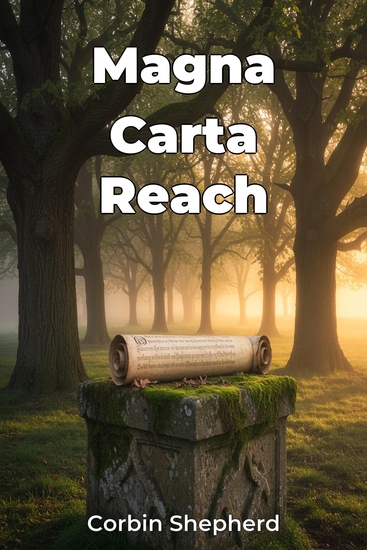
Magna Carta Reach - cover

Magna Carta Reach

Corbin Shepherd

Translator A AI

Publisher: Publifye

  • 0
  • 0
  • 0

Summary

Magna Carta Reach explores the lasting influence of a pivotal document born from medieval conflict. It examines how the Magna Carta's core tenets, such as the rule of law and due process, extend far beyond their 13th-century origins, shaping modern governance and civil liberties. Initially intended to address grievances against King John, the Magna Carta laid the foundation for constitutionalism and human rights. One intriguing aspect is how a document created in a specific historical context continues to be relevant in contemporary debates about government power. The book progresses by dissecting the original text, tracing its evolution through centuries of reinterpretation, and investigating its global reach. It highlights Magna Carta's impact on legal systems worldwide, including the United States and Canada. The book employs a balanced and analytical approach, drawing from primary sources, legal treatises, and historical chronicles to offer a nuanced account of Magna Carta's legacy. Its value lies in providing an up-to-date analysis of Magna Carta's enduring influence on political science and legal history for students and general readers alike.
Available since: 05/05/2025.
Print length: 56 pages.

Other books that might interest you

  • Outsmart Anxiety - A Practical Guide to Understanding and Empowering Your Mind - cover

    Outsmart Anxiety - A Practical...

    Lily Felton

    • 0
    • 0
    • 0
    Outsmart Anxiety: A Practical Guide to Understanding and Empowering Your Mind offers listeners a comprehensive and compassionate exploration of anxiety, providing the tools to navigate their own experience with confidence and clarity. 
     
    With Felton's friendly and relatable voice, complex concepts are broken down into clear, practical insights that explain what anxiety is and why it arises. Through real-life examples, personal stories, actionable tips, and evidence-based strategies, this book blends professional expertise with genuine experience to create an accessible and empowering guide. 
     
    Ideal for teenagers, young adults, parents, teachers, and mental health professionals, Outsmart Anxiety serves as an essential toolkit to deepen understanding of anxiety and develop self-awareness—whether for oneself or in supporting others.
    Show book
  • How to stop overthinking - Improve Emotional Health through Practicing Mindfulness Meditation and Unwinding Anxiety - cover

    How to stop overthinking -...

    Aria Ponder

    • 0
    • 0
    • 0
     Embark on a transformative journey towards mental liberation with “How to Stop Overthinking”! 
    Driven by psychology and neuroscience, this guide is your roadmap to clarity. So, get ready to: 
    ●    Unravel the complexities of overanalysis, anxiety, and self-doubt as you discover the keys to emotional well-being.  
    ●    Gain deep insights into overthinking’s cognitive science, distinguishing productive thinking from its hindering counterpart.  
    ●    Dive into mindfulness exercises—breath awareness, body scan meditation—to break free from the cycle of relentless thoughts and enhance emotional regulation.  
    ●    Master thought management techniques, rewrite unhelpful thinking patterns, and cultivate positivity for improved decision-making. 
    ●    Establish healthy lifestyle habits, from sleep routines to nutrition, and learn to set boundaries that restore balance.  
    ●    Embrace resilience, embrace self-compassion, and transform your relationship with technology. 
    And more! 
    With “How to Stop Overthinking”, you can empower yourself with practical strategies, reclaim serenity, and navigate life’s complexities with confidence.  
    Ready to live a life free from the chains of overthinking? Then dive into “How to Stop Overthinking” today and experience the liberating power of a clear mind! 
     
    Show book
  • Living in Language - International reflections for the practising poet - cover

    Living in Language -...

    Erica Hesketh

    • 0
    • 0
    • 0
    Living in Language brings together reflections on the craft and purpose of poetry, by 21 leading poets from around the world. The lyric essays, fragments, letters and new poems in this groundbreaking anthology shed light on topics as diverse and vital as writing the body, writing in exile, writing as witness, writing as a shamanic act, grappling with traditional forms, discovering your own voice, and even translation and self-translation. This is an essential resource for anyone looking to broaden their horizons and engage with the cutting edge of poetry as it is practised, around the world, in the 21st century.
    Show book
  • Attention Implies That There is No Centre - Brockwood Park and Gstaad 1975 - Dialogue 5 - cover

    Attention Implies That There is...

    Jiddu Krishnamurti

    • 0
    • 0
    • 0
    Attention implies that there is no centre - 22 June 1975 
    • Consciousness, because it is in constant movement, has never found an energy 
    which is not contradictory, which is not produced by desire and thought. 
    • Can thought ever see its own movement and the futility of its own movement? • Attention implies that there is no centre. 
    • Is there a perception, a seeing outside the space which is part of consciousness? • Therearetwohumanbeings,onegetsconditionedandtheotherdoesn’t.Why? 
    How has it happened the other doesn’t get conditioned? 
    • How does this perception which is beyond attention, beyond awareness, 
    beyond concentration come about? 
    • Thought is rather superficial, it’s merely a very small part of the operation of the 
    brain. 
    • Can consciousness be completely empty of its content? • Order and disorder
    Show book
  • My Blue Book of Grammar for Class 7 - cover

    My Blue Book of Grammar for Class 7

    Meigha Rawat

    • 0
    • 0
    • 0
    A Grammar Series That Uses the Functional Approach 
    
    KEY FEATURES 
    - Functional approach to grammar teaching, using exemplars to illustrate the usage before defining the structure and rules 
    - Vocabulary taught through language-in-use to build the learners’ vocabulary through use rather than memorisation of rules 
    - Contemporary topics to inculcate 21-century skills amongst learners 
    - Use of literature to help learners understand how grammar is used in text 
    - A comprehension section comprising texts from different genres so that learners may relate grammar to different types of works produced in English 
    - Phonics in Grades 1 and 2 to teach the very basis of language 
    - Uniquely stylised illustrations 
    - Activities such as puzzles, crosswords, word grids and games to aid the facilitator in using the concept of ‘flipped classroom’ 
    - Periodic tests to help the learners self-assess the acquisition of concepts 
    - Digital component to cater to a technology-driven classroom 
    
    DESCRIPTION: 
    My Blue Book of Grammar is a course that has been conceptualized and designed keeping in mind the increasingly dynamic role of the English language in today’s world. Especially in our country, where English serves as the lingua franca, a grammar course has to offer not only an exposition of the pedagogy but also the exhibition of the utility of that pedagogy. The aim of a grammar series should be to encourage the development of competency amongst learners, even though their proficiency levels may vary. While the level of exposure to English of all learners may be different, a grammar series should aid in the development of a certain level of confidence amongst the learners, with the end result being that they are able to converse without hesitation in English. 
    
    WHAT WILL YOU LEARN 
    - Understand grammar concepts 
    - Learn how to use different vocabulary concepts taught through language-in-use 
    - Learn 21-century skills 
    - Develop deeper understanding of and appreciation for literature 
    - Have clearer pronunciation through a better understanding of phonics 
    
    WHO THIS BOOK IS FOR: 
    School students of Grades 7 
    
    TABLE OF CONTENTS 
    GRAMMAR 
    1. Compound–Complex Sentences 
    2. Ellipsis 
    3. Compound Subject 
    4. Reported Speech 
    5. Compound Predicate 
    6. Coordinating Adjectives 
    7. Sentences, Fragments and Run-ons 
    8. Comparative and Superlative Adverbs 
    9. Pronoun–Antecedent Agreement 
    10. Active and Passive Voice 
    11. Commas: With Introductory Phrases; When Addressing a Person; 
    in Dates; and in Addresses 
    12. Comma Splices 
    13. Singular and Plural Possessive Nouns 
    14. Linking Verbs 
    15. Transitive and Intransitive Verbs – Revision 
    Test Paper 1 
    VOCABULARY 
    16. Difference Between Who and Whom 
    17. Formal and Informal Language 
    18. Compound Subject with I and Me 
    19. Can and Could 
    20. Redundancy 
    21. Prefixes: inter–, trans–, super– 
    22. Suffixes: –ent, –ant, –ous 
    23. Latin and Greek Roots 
    24. Good vs Well 
    25. Using Clues from the Context to Find the Meaning of the Word 
    26. How versus What in Exclamations 
    27. Positive and Negative Connotations 
    28. Suggestions and Requests 
    Test Paper 2 
    WRITING 
    29. Writing a Notice 
    30. Narrative Poem 
    31. Dialogue Writing 
    32. Writing a Summary 
    33. Survey Findings 
    Test Paper 3 
    COMPREHENSION 
    34. I Have a Dream 
    35. Ain’t I a Woman? 
    36. We Are the World 
    37. Thang-Ta: The Martial Art Dance of Manipur 
    Orange Global Olympiad – English Sample Paper
    Show book
  • Black Soldiers in the World Wars: The History of the Most Decorated African American Units in Both Conflicts - cover

    Black Soldiers in the World...

    Charles River Editors

    • 0
    • 0
    • 0
    The United States has no shortage of famous military units, from the Civil War’s Iron Brigade to the 101st Airborne, but one would be hard pressed to find one that had to go through as many hardships off the field as the Tuskegee Airmen, a group of African American fighter pilots who overcame Jim Crow at home and official segregation in the military to serve their country in the final years of World War II. In fact, it required a concerted effort by groups such as the National Association for the Advancement of Colored People (NAACP) and the extreme circumstances brought about by World War II that the military eventually decided to establish the “Tuskegee Experiment.” In time, the Tuskegee Airmen would be romanticized and mythologized to the extent that it was erroneously claimed that some escort squadrons didn’t lose a bomber to the enemy, which led Tuskegee airman Grant Williams to note in jest, “Back then, nobody realized the significance of what we were doing. Now, they seem to think we could walk on water."  
    Between 1942 and 1949, nearly 20,000 black men trained at Montford Point. They endured tar-paper barracks that baked in summer heat and leaked in coastal storms, learned to drill to the cadence of instructors who sometimes doubted their right to wear the uniform, and mastered skills that would carry them to the beaches and supply trails of Saipan, Iwo Jima, and Okinawa. Their story illuminated the paradox of wartime America, a republic that preached freedom abroad while policing hierarchies at home. 
    One of the most overlooked African American combat units is the Harlem Hellfighters, also known as the 369th Infantry Regiment of the U.S. Army. Initially raised as the 15th New York (Colored) National Guard and later federalized for World War I, the regiment was "loaned" to the French Army, where it compiled an extraordinary combat record, with a remarkable 191 days on the line and suffering about 1,400 casualties.
    Show book