¡Acompáñanos a viajar por el mundo de los libros!
Añadir este libro a la estantería
Grey
Escribe un nuevo comentario Default profile 50px
Grey
Suscríbete para leer el libro completo o lee las primeras páginas gratis.
All characters reduced
Census Inclusion Effects - cover

Census Inclusion Effects

Corbin Shepherd

Traductor A AI

Editorial: Publifye

  • 0
  • 0
  • 0

Sinopsis

Census Inclusion Effects explores the implications of incorporating sexual orientation and gender identity (SOGI) questions into national census forms. Focusing on the United States, the United Kingdom, and Canada, the book delves into both the statistical and socio-political ramifications of collecting SOGI data. A key insight is that while such data is invaluable for addressing inequalities affecting marginalized communities and allocating resources effectively, it also raises significant concerns about data privacy and the potential for misuse.

 
The book examines the historical context of census taking and the evolution of demographic data collection. It highlights debates surrounding SOGI data collection, weighing the benefits of informed social policy against the risks to individual privacy. For example, while Canada includes SOGI questions, generating data for policy, the US has seen limited inclusion in specific surveys. By comparing these approaches, the book identifies best practices for responsible and effective SOGI data collection.

 
Structured to provide a comprehensive understanding, the book first introduces a theoretical framework, then analyzes methodologies, and finally offers policy recommendations. Drawing from government reports, statistical datasets, and interviews, it uniquely combines quantitative analysis with qualitative insights, making it a valuable resource for policymakers, researchers, and LGBTQ+ advocates alike.
Disponible desde: 07/04/2025.
Longitud de impresión: 92 páginas.


Otros libros que te pueden interesar

  • The Prince - Machiavelli’s Masterpiece on Power Control and Human Nature (UK Accent) - cover

    The Prince - Machiavelli’s...

    Nicolo Machiavelli, Classics by TFM

    • 0
    • 0
    • 0
    Written in 1513, Niccolò Machiavelli’s The Prince remains one of the most influential works on political philosophy, leadership, and power. This groundbreaking classic reveals timeless lessons on how rulers gain, hold, and use authority — insights that continue to shape discussions on strategy, governance, and human nature to this day. 
    Often seen as the ultimate guide to realpolitik, The Prince strips away illusions of morality in politics and instead focuses on practical wisdom, calculated risk, adaptability, and influence. From the nature of fortune and fate to the importance of strong leadership and decisive action, Machiavelli’s work is as strikingly relevant for today’s world of business, politics, and leadership as it was in Renaissance Italy. 
    Perfect for listeners interested in philosophy, stoicim, strategy, self-help, and history, this audiobook delivers powerful insights into the art of leadership, resilience, and decision-making. 
    This audiobook is for yu if you enjoy listen to podcast such as the the daily stoic, the daily dad, practical stoicism, stoic lessons and audiobooks such as the art of war, 48 laws of power, letters from seneca, from ryan holiday, tim ferris, robert greene and more about stoic philosophy.
    Ver libro
  • Learn Swahili: The Master Guide to Kenyan Holidays for Beginners - Discover Kenyan Culture Festivals & Traditions with 25 Easy Audio Lessons - cover

    Learn Swahili: The Master Guide...

    SwahiliPod101.com

    • 0
    • 0
    • 0
    How does Kenya celebrate Madaraka Day? What happens on Heroes' Day? Learn Swahili: The Master Guide to Kenyan Holidays for Beginners answers questions like these while you pick up the Swahili words and phrases that go with every celebration. 
     
    This beginner-friendly audiobook from Innovative Language, the creators of SwahiliPod101, walks you through the Kenyan calendar in clear English. For each holiday, you learn when it's celebrated, why, where, and by whom, plus the key Swahili vocabulary to talk about it. It's an easy way to understand Kenyan culture and build your Swahili at the same time. 
     
    Holidays and traditions include Madaraka Day, Heroes' Day, Independence Day, Eid al-Fitr, Diwali, the Maasai cultural festival, and the Lamu Cultural Festival. 
     
    What's inside: 
    • 25 audio lessons, about 2 hours in total 
    • Every lesson presented in English, with key Swahili words and phrases 
    • PDF lesson notes so you can read along 
    • Fresh talking points for conversations with Swahili speakers 
     
    Who it's for: 
    • Beginner learners of Swahili, and learners of all levels 
    • Travelers planning a trip to Kenya 
    • Heritage learners and families connecting with Kenyan traditions 
    • Anyone curious about Kenyan culture, festivals and customs 
     
    By the end, you'll understand the most important Kenyan holidays, know the Swahili words to talk about them, and be ready to chat with native speakers about the next celebration.
    Ver libro
  • Carlist Wars and the Spanish Civil War The: The History of the Conflicts that Divided Spain in the Last 200 Years - cover

    Carlist Wars and the Spanish...

    Editors Charles River

    • 0
    • 0
    • 0
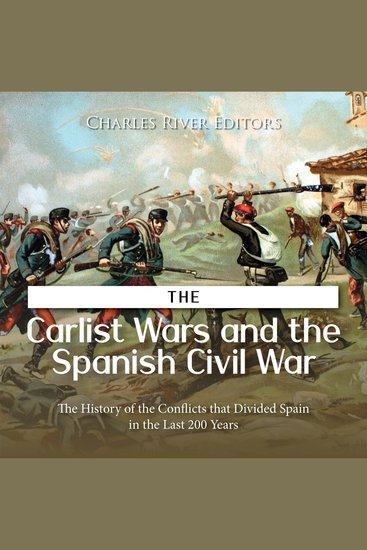
    Thinking of Spain as a modern nation state today distorts the complicated reality that the Iberian Peninsula faced in the past. Spain was a nation in progress, consisting of regions united under the Spanish crown, but with strong regional identities based on different historical and cultural experiences. The largest entities were the kingdoms of León and Castile, but Spain also included the kingdoms of Navarre, Andalusia, Granada, Jaén, Aragon, and Valencia. There were also the principalities of Asturias and Catalonia, the lordship of Vizcaya, and both Guipúzcoa and Alava were “exempted provinces.” Navarre, Aragon, and Catalonia had separate Cortes, which were versions of parliaments (Parker 18-19). This complex system of entities granted privilege to local power structures over the concept of a unified nation and made administration difficult, because there were few standards that applied to all of Spain. Many of the regions had special laws that respected and allowed traditional institutions, administrative patterns, and cultural patterns. These local and regional rights were called fueros and were fiercely defended against centralization. 
    	The Spanish Civil War has exerted a powerful impact on the historical imagination. Without question, the conflict was a key moment in the 20th century, a precursor to World War II, and an encapsulation of the rise of extremist movements in the 1930s, but it was also a complex narrative in and of itself, even as it offered a truly international theatre of war. It marked one of the seminal moments, along with the 1929 Wall Street Crash, between the two apocalyptic wars of the early 20th century, and since it occurred between 1936 and 1939, Spain proved to be a testing ground of tactics, weaponry, and ideology ahead of World War II. 
    Ver libro
  • Antelope The: The History of the Spanish Slave Ship and Its Unprecedented Supreme Court Case - cover

    Antelope The: The History of the...

    Charles River Editors

    • 0
    • 0
    • 0
    By the early 19th century, several European nations had banned slavery, but while the United States had banned the international slave trade, slavery was still legal in the country itself. As a result, there was still a strong financial motive for merchants and slave traders to attempt to bring slaves to the Western hemisphere, and a lot of profits to be gained from successfully sneaking slaves into the American South and the Caribbean by way of locations like Havana, Cuba.  
    	At the same time, the cruelties of the slave trade often led to desperate attempts by slaves or would-be slaves to avoid the horrific fate that they were either experiencing or about to face. In 1831, Nat Turner’s revolt shocked the South and scared plantation owners across the country, while also bringing the issue of slavery to the forefront of the national debate, and the mutiny on the Amistad is still taught in American schools today.  
    	Less than 20 years before the mutiny on the Amistad, another Spanish slave ship was at the center of a dramatic legal case in the United States, this time involving privateers. The Antelope was a slave ship that plied the waters in the Western hemisphere after the international slave trade had been banned, making it a potential prize not just for crews looking to trade illicit human cargo, but also for those who hunted slave ships themselves. The name of the ship that captured the Antelope changed at least four times in less than two years, (as well as the flag under which it flew), and the Antelope’s name also changed after pirates captured it. Hundreds of Africans destined for a lifetime of slavery were on the ship when it was captured. They had been taken from their families and villages in Africa, then marched overland by cannibalistic warlords. After being sold on the beach, they were forced into the hold of a ship and endured rough seas, pirates, and shipwreck. Dozens died on the voyage, and when their ship was captured, nobody knew what to do with them. 
    Ver libro
  • Manifesto of the Communist Party - cover

    Manifesto of the Communist Party

    Karl Marx

    • 0
    • 0
    • 0
    One of the most influential political texts in modern history, Manifesto of the Communist Party examines the forces shaping society, economics, and political change.
    
    Originally published in 1848, Manifesto of the Communist Party by Karl Marx and Friedrich Engels presents a concise and influential critique of nineteenth-century capitalist society and the social structures surrounding it. Written during a period of rapid industrialization and political upheaval, the work examines the development of modern classes, economic relationships, and conflicts between social groups.
    
    The manifesto famously explores the historical development of class struggle, examining the relationship between the bourgeoisie and the working class. Marx and Engels argue that economic structures and material conditions play a central role in shaping political institutions, social relationships, and historical change.
    
    Divided into several sections, the work discusses the relationship between communists and the working class, critiques contemporary socialist and political movements, and presents the authors' vision of social transformation. Its direct style and condensed arguments have made it an enduring subject of political, economic, historical, and philosophical study.
    
    Beyond its political arguments, the manifesto provides valuable insight into the intellectual and social conditions of nineteenth-century Europe. It has influenced political movements, academic debates, revolutionary history, economics, sociology, and discussions about capitalism and inequality around the world.
    
    For students, researchers, and readers interested in political philosophy, economic history, socialism, Marxism, capitalism, class theory, and modern political thought, Manifesto of the Communist Party remains an essential historical document.
    
    Explore one of the defining political texts of the modern era. Read Manifesto of the Communist Party today and examine Marx and Engels' influential ideas about class, capitalism, labor, society, and historical change.
    Ver libro
  • Freedom For All - cover

    Freedom For All

    Neville Goddard

    • 0
    • 0
    • 0
    Freedom For All by Neville Goddard is a profound exploration of the principles of spiritual freedom and the power of human imagination. In this concise yet impactful work, Goddard delves into the idea that true freedom is achieved through the conscious control of one's thoughts and beliefs, which in turn shape one's reality.Central to Goddard's teachings is the concept that the imagination is a divine tool that can transform circumstances and bring about personal liberation. He posits that every individual has the innate ability to create their desired life through focused imagination and faith. By aligning one's inner beliefs with the feeling of the wish fulfilled, Goddard asserts that external conditions will inevitably conform to these inner convictions.The book is structured to guide readers through the key steps to attaining spiritual and personal freedom:Understanding the Creative Power of Imagination:Goddard explains how imagination is the driving force behind all creation and how it can be harnessed to bring about desired changes in one's life.The Law of Assumption:This principle is about assuming the feeling of the wish fulfilled. Goddard emphasizes that by living in the state of the wish already realized, one sets the stage for its manifestation in reality.Faith and Belief:Goddard highlights the importance of unwavering faith in the process of manifestation. He teaches that belief in the unseen and persistence in the feeling of the desired state are crucial for achieving freedom.Practical Application:Throughout the book, Goddard provides practical exercises and meditations designed to help readers internalize and apply these principles in their daily lives.Freedom For All is not just a theoretical exposition but a practical guide that empowers readers to take control of their mental and emotional states. By doing so, they can break free from limiting beliefs and circumstances, achieving true freedom and fulfillment.Neville Goddard's teachings in this book continue to inspire and empower individuals seeking to unlock their creative potential and live a life of freedom and abundance. Through clear and accessible language, Goddard offers timeless wisdom on the transformative power of the human mind and spirit.
    Ver libro