¡Acompáñanos a viajar por el mundo de los libros!
Añadir este libro a la estantería
Grey
Escribe un nuevo comentario Default profile 50px
Grey
Suscríbete para leer el libro completo o lee las primeras páginas gratis.
All characters reduced
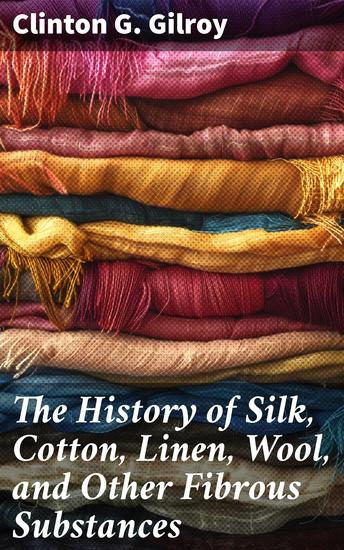
The History of Silk Cotton Linen Wool and Other Fibrous Substances - Including Observations on Spinning Dyeing and Weaving - cover

The History of Silk Cotton Linen Wool and Other Fibrous Substances - Including Observations on Spinning Dyeing and Weaving

Clinton G. Gilroy

Editorial: Good Press

  • 0
  • 0
  • 0

Sinopsis

In "The History of Silk, Cotton, Linen, Wool, and Other Fibrous Substances," Clinton G. Gilroy delivers an extensive exploration of the intricate relationships between human civilization and its fundamental textile materials. Through a meticulous examination of historical contexts, Gilroy captures the significance of these fibers in shaping economies, cultures, and trade across different civilizations. The narrative is rich with detailed descriptions, blending historical analysis with ethnographic insights, revealing how each fiber not only served practical purposes but also influenced social and artistic developments throughout the ages. Clinton G. Gilroy, a scholar with deep roots in textile studies and anthropology, embarked on this ambitious work to illuminate the often-overlooked narratives surrounding fibers. Influenced by his background in both environmental history and economic anthropology, Gilroy seeks to connect the past with contemporary issues of sustainability and cultural preservation. His academic journey has instilled in him a profound appreciation for the ways in which textiles reflect human creativity and resilience. This book is a compelling read for scholars, students, and hobbyists alike. Readers will find a wealth of information that not only enriches their understanding of textiles but also evokes a greater appreciation for the intertwined histories of these fibrous substances and human civilization. Gilroy's narrative encourages readers to reflect on the impact of fibers in their own lives, making this work an invaluable addition to any library.
Disponible desde: 20/11/2023.
Longitud de impresión: 475 páginas.

Otros libros que te pueden interesar

  • Break Through the Limits of the Brain - Experience Superconscious Awareness Intuition Vitality Creativity and Fulfilling Divine Joy - cover

    Break Through the Limits of the...

    Joseph Selbie

    • 1
    • 1
    • 0
    A life-changing guide to understanding your brain and how to change it—for good.Break Through the Limits of the Brain explores the neuroscience of sacred, superconscious experience. It offers proven ways to break through the brain’s limits into a life-changing, life-enhancing awareness that is beyond our everyday consciousness; an awareness that is intuitive, creative, energized, joyful, and spirit-filled. Selbie explains how and why the brain’s neural circuits reinforce thoughts, emotions, and behaviors that keep us immersed in limited conscious awareness—and how radical neuroplasticity enables our innate ability to rewire the brain to break through to unlimited superconscious awareness. The book offers many practices: the Hong Sau technique of meditation for deepening concentration, energization exercises for increasing life-force and vitality, methodical introspection techniques for identifying neurally reinforced negative patterns of thought, emotion, and behavior and affirmations for directly rewiring them. These practices will help you bring superconscious awareness into your life that enables, awakens, and supports success, vitality, creativity, health, peace of mind, and lasting, fulfilling happiness.Break Through the Limits of the Brain provides strong scientific support for superconscious awareness; scientific support provided by quantum physics and M-theory for the existence of a subtle, nonlocal reality; a reality in which we exist simultaneously with physical reality; a reality of which we can become aware by breaking through the limits of the brain. The book debunks scientific materialism’s brain-based explanation for consciousness and intelligence—the brain-as-supercomputer model—and explains the view of many prominent and open-minded scientists that an all-pervading intelligent consciousness is not only the source of our own consciousness but also the foundation of reality—an age-old sacred belief shared by saints, sages, mystics, and those who’ve had near-death experiences.Meditation is a central theme of the book—what it is; how to do it; why it works; its physical, mental, and emotional benefits as measured by neuroscientists; and how it rewires the brain for us to experience superconscious awareness and to achieve whatever we put our mind to.
    Ver libro
  • The Sioux Wars - The History of the Conflicts Between the Sioux and US Army - cover

    The Sioux Wars - The History of...

    Charles River Editors

    • 0
    • 0
    • 0
    From the “Trail of Tears” to Wounded Knee and Little Bighorn, the narrative of American history is incomplete without the inclusion of the Native Americans that lived on the continent before European settlers arrived in the 16th and 17th centuries. Since the first contact between natives and settlers, tribes like the Sioux, Cherokee, and Navajo have both fascinated and perplexed outsiders with their history, language, and culture. 
    	The history of the Sioux is replete with constant reminders of the consequences of both their accommodation of and resistance to American incursions into their territory by pioneering white settlers pushing further westward during the 19th century. Some Sioux leaders and their bands resisted incoming whites, while others tried to accommodate them, but the choice often had little impact on the ultimate outcome. Crazy Horse, who was never defeated in battle by U.S. troops, surrendered to them in 1877, only to be bayoneted to death by soldiers attempting to imprison him. Black Kettle, who flew a large American flag from his lodge to indicate his friendship with the white man, was shot to death by soldiers under George Custer’s command in 1868. Throughout the 19th century, the U.S. government and its officials in the West adopted a policy of dividing the Sioux into two groups: “Treaty Indians” and “Non-treaty Indians.” Often they used these groups against each other or used one group to influence another, but the end was always the same. They were forced off the land where they resided, their populations were decimated by disease, and they were forced onto reservations. 
    	Despite being one of the most erstwhile foes the U.S. government faced during the Indian Wars, the Sioux and their most famous leaders were grudgingly admired and eventually immortalized by the very people they fought. Sitting Bull and Crazy Horse remain household names due to their leadership of the Sioux at the fateful Battle of the Little Bighorn.
    Ver libro
  • Taboo Sex Stories - cover

    Taboo Sex Stories

    Eva Harmon

    • 0
    • 0
    • 0
    Warning: This book is for adults that are looking for something to drive them wild.Are you looking for something to spice up your night? Look no further—this book features seven highly erotic stories that will tickle your fancy while you tickle something else. If you’re into taboo, sexy stories filled with subjects that would make your mother blush, you’re in the right place. Open this book and find something to get your panties soaked today. You’ll find stories that are rough and sensual at the same time, tickling taboo fancies and wetting panties, such as:• Blind Pleasure: A woman exploring a swinger’s club with her husband getting a night that she’ll remember forever after the sexy, sensual experience that she has with more than one man. Who knew so many different hands could feel so good?• Variety is the Spice of Sex: A woman who is bored with her married sex life decides to bring in some reinforcements to relive her days of not being beholden to just one body, spending some sexy, sensual time with both her husband and their neighbor to spice their bedroom life up a bit more than they realized they needed. Variety is the spice of life—and sex!126• Clara’s Experiment: A woman exploring her interest in being submissive learning what it really means to be bound and used like a toy for the thrill of someone else, being truly at the mercy of someone else, and discovers that she loves every single moment of it.• Amelia’s Punishment: A young, hot housekeeper makes a mistake that deserves to be punished. After all, what good is it to have housekeepers that can’t do what they’re told when they’re told to do it? Sometimes, you need a firm hand to teach you what needs to be done, and her boss is not afraid to teach that lesson if he has to. In fact, he’s more than willing to and teaches her a lesson she’ll never forget.• Unwrapped Gifts: If gifts are meant to be opened, does that mean that our clothes are just gift wraps for when we give ourselves to someone else?
    Ver libro
  • Typhoon Attack - The Legendary British Fighter in Combat in WWII - cover

    Typhoon Attack - The Legendary...

    Norman Franks

    • 0
    • 0
    • 0
    This volume collects lively tales of aerial combat from Royal Air Force pilots who flew Typhoon fighters into the frontlines of WWII. The Typhoon fighter played a pivotal role in Allied victories from D-Day to the Battle of the Bulge and the final battle in Germany. Through original interviews with RAF veterans, Norman Franks explores what it was really like to fly Britain’s legendary, rocket-firing fighters.  Typhoon Attack shares stories of flying over Holland or France at low level, seeking out hostile aircraft or targets on the ground; rolling over at twelve-thousand feet, then upside down; attacking trains, ships, flak posts, tanks, and more; not to mention the mind-numbing experience of crash-landing a shot-up Tiffy.   
    Ver libro
  • Wording Around With Editing - Getting Your First Draft Ready to Publish - cover

    Wording Around With Editing -...

    Kathy Mac

    • 0
    • 0
    • 0
    Wording Around with Editing gives readers everything they need to get their first draft of any writing project ready to publish. 
    The first three chapters detail steps of the editing process and introduce the types of editing: Substantive, Stylistic and Copy. The next four chapters get into the nitty gritty of each of those, with an additional chapter on Proofreading. The final three chapters explain the importance of writing communities in helping writers bring their book to its very best form. Every chapter of Wording Around with Editing ends with a resource to help readers dive more deeply into that chapters' topic, as well as prompts that help authors take their first steps on each stage of the editing process. 
    "Kathy Mac is a 'writer's writer.' In this tight and mighty work, she cuts to the heart of what she's learned about process, craft, and loving yourself through the hard parts of writing." 
    – AJ Ripley 
    During the COVID-19 lockdown in the spring of 2020, poet and creative writing professor Kathy Mac (St. Thomas University, Fredericton, Canada) taught a free online course, the notes for which became Wording Around with Prose, the first in the Wording Around series. Wording Around with Editing: Getting your First Draft Ready to Publish is the second one in the series.
    Ver libro
  • Fort Henry: The History of the Union’s First Major Victory in the West during the Civil War - cover

    Fort Henry: The History of the...

    Jonathan Gianos-Steinberg

    • 0
    • 0
    • 0
    While the Lincoln Administration and most Northerners were preoccupied with trying to capture Richmond in the summer of 1861, it would be the little-known Ulysses S. Grant who delivered the Union’s first major victories, over a thousand miles away from Washington. Grant’s new commission led to his command of the District of Southeast Missouri, headquartered at Cairo, after he was appointed by “The Pathfinder”, John C. Fremont, a national celebrity who had run for President in 1856. Fremont was one of many political generals that Lincoln was saddled with, and his political prominence ensured he was given a prominent command as commander of the Department of the West early in the war before running so afoul of the Lincoln Administration that he was court-martialed. 
    In January of 1862, Grant persuaded General Henry “Old Brains” Halleck to allow his men to launch a campaign on the Tennessee River. As soon as Halleck acquiesced, Grant moved against Fort Henry, in close coordination with the naval command of Flag Officer Andrew Hull Foote. The combination of infantry and naval bombardment helped force the capitulation of Fort Henry on February 6, 1862, and the surrender of Fort Henry was followed immediately by an attack on Fort Donelson on the Cumberland River, which earned Grant his famous nickname “Unconditional Surrender”. Grant’s forces enveloped the Confederate garrison at Fort Donelson, which included Confederate generals Simon Buckner, John Floyd, and Gideon Pillow. In one of the most bungled operations of the war, the Confederate generals tried and failed to open an escape route by attacking Grant’s forces on February 15. Although the initial assault was successful, General Pillow inexplicably chose to have his men pull back into their trenches, ostensibly so they could take more supplies before their escape. Instead, they simply lost all the ground they had taken, and the garrison was cut off yet again.
    Ver libro