¡Acompáñanos a viajar por el mundo de los libros!
Añadir este libro a la estantería
Grey
Escribe un nuevo comentario Default profile 50px
Grey
Suscríbete para leer el libro completo o lee las primeras páginas gratis.
All characters reduced
Jefferson and Hamilton : The struggle for democracy in America - cover

Jefferson and Hamilton : The struggle for democracy in America

Claude G. Bowers

Editorial: Good Press

  • 0
  • 0
  • 0

Sinopsis

In "Jefferson and Hamilton: The Struggle for Democracy in America," Claude G. Bowers intricately examines the ideological clash between two of America's founding fathers, Thomas Jefferson and Alexander Hamilton. Through a narrative rich in historical context, Bowers employs a compelling literary style that combines biographical detail with a vivid portrayal of the political dynamics of the late 18th century. The book adeptly analyzes how their conflicting visions for the young republic—Jefferson's agrarian democracy versus Hamilton's vision of a strong centralized government—shaped the nation's evolution and continues to resonate in contemporary discussions about democracy and governance. Claude G. Bowers was an esteemed American author and historian, well-versed in the complexities of American politics and history. His profound interest in the formative years of the United States, combined with his scholarly background, positions him uniquely to elucidate the intricacies of Jeffersonian and Hamiltonian thought. Bowers's commitment to exploring the socio-political landscape of early America is evident in his thorough research and engaging narrative style, making the historical figures not just figureheads but real people with passionate convictions. I highly recommend "Jefferson and Hamilton" to scholars, students, and anyone interested in understanding the foundational ideological struggles that have shaped American democracy. Bowers' work offers invaluable insights into the political philosophies that continue to influence contemporary debates, making this book a crucial exploration for any reader seeking to grasp the complexities of American political thought.
Disponible desde: 02/03/2025.
Longitud de impresión: 190 páginas.


Otros libros que te pueden interesar

  • Discourse on Inequality - cover

    Discourse on Inequality

    Jean-Jacques Rousseau

    • 0
    • 0
    • 0
    "Discourse on Inequality" by Jean-Jacques Rousseau explores the origins and effects of social inequality. Rousseau reflects on the evolution of human societies, arguing that inequality arises from the development of private property and the establishment of civil society. He critiques the impact of civilization on human virtue and freedom, advocating for a return to a more natural and egalitarian state. The discourse delves into philosophical reflections on the nature of humanity, societal structures, and the pursuit of a just and harmonious existence. Read in English, unabridged.
    Ver libro
  • Predictably Irrational - The Hidden Forces That Shape Our Decisions - cover

    Predictably Irrational - The...

    Anónimo

    • 0
    • 0
    • 0
    The groundbreaking bestseller from iconic behavioral psychologist Dan Ariely, now the inspiration for the Fall 2023 NBC show The Irrational 
    “A marvelous book that is both thought provoking and highly entertaining, ranging from the power of placebos to the pleasures of Pepsi. Ariely unmasks the subtle but powerful tricks that our minds play on us, and shows us how we can prevent being fooled.” — Jerome Groopman, New York Times bestselling author of How Doctors Think 
    “Ariely is a genius at understanding human behavior: no economist does a better job of uncovering and explaining the hidden reasons for the weird ways we act, in the marketplace and out. Predictably Irrational will reshape the way you see the world, and yourself, for good.” — James Surowiecki, author of The Wisdom of Crowds 
    Why do our headaches persist after we take a one-cent aspirin but disappear when we take a fifty-cent aspirin? Why do we splurge on a lavish meal but cut coupons to save twenty-five cents on a can of soup? 
    When it comes to making decisions in our lives, we think we're making smart, rational choices. But are we? In this revised and expanded edition of the groundbreaking New York Times bestseller, Dan Ariely refutes the common assumption that we behave in fundamentally rational ways. From drinking coffee to losing weight, from buying a car to choosing a romantic partner, we consistently overpay, underestimate, and procrastinate. Yet these misguided behaviors are neither random nor senseless. They're systematic and predictable—making us predictably irrational.
    Ver libro
  • Ancient Empires - A History of Etruscans and Phoenicians - cover

    Ancient Empires - A History of...

    Kelly Mass

    • 0
    • 0
    • 0
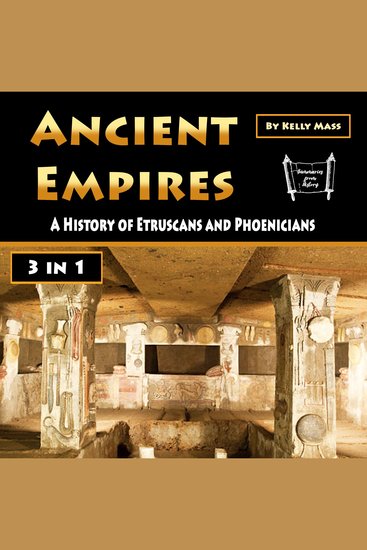
    This bundle consists of 3 short books, which are about the following subjects: 
    Subject 1: Nineveh was an age-old Assyrian city in Upper Mesopotamia, near Mosul in modern-day northern Iraq. It was the capital and biggest city of the Neo-Assyrian Empire, and the world's biggest city for some decades, and is on the eastern bank of the Tigris River. It's now a prevalent name for the portion of Mosul that's on the Tigris' eastern bank, and it is also the name of the nation's Nineveh Governorate. 
    It was the world's largest city for about fifty years till it was sacked by a union of its previous subject tribes, including but not limited to the Babylonians, Medes, Persians, Scythians, and Cimmerians, in the year 612 BC, following a severe period of civil dispute in Assyria.  
    Subject 2: The term "Phoenicians" describes the people living in Phoenicia, a sometimes-forgotten civilization that was age-old and remarkable. Let's check out the tradition, the history, and the specifics of Phoenicia. 
    Phoenicia was a thalassocratic (a state with mostly maritime worlds) society that thrived in the eastern Mediterranean's Levant area, mainly in modern-day Lebanon. It was fixated the coast of Lebanon, with some seaside parts of modern-day Syria and Galilee included for good procedure, varying as far north as Arwad and as far south as Acre and perhaps Gaza. 
    Subject 3: At its peak, the Etruscan society of age-old Italy covered circa what's now Tuscany, western Umbria, and northern Lazio, and areas of what's now the Po Valley, Emilia-Romagna, south-eastern Lombardy, southern Veneto, and small parts of Campania. 
    The first proof of an Etruscan society might be traced back to around 900 BC.
    Ver libro
  • Passion & Provocation: Selected Poems - cover

    Passion & Provocation: Selected...

    Judith Partelow

    • 0
    • 0
    • 0
    “Here are poems for the people, reflections of deep sorrow and joy that cover the spectrum of a lifetime—a distillation of passion and pain. Judith Partelow speaks from the heart, shines a light into the soul, captures the fragility of life, and conveys complex emotional experiences with clarity. This collection is truly a treasure.” 
    – Lily Poritz Miller, author, former editor at The Macmillan Company and McGraw-Hill, senior editor at McClelland and Stewart. 
    "Judith Partelow’s poetry collection, Passion & Provocation, is a must-read for any woman who has lived and loved. Her voice will sound as familiar as your own with its yearnings, triumphs, regrets and humor, a voice that speaks from the 'inside out' about a woman’s life today."  
    - Nancy Rubin Stuart, author, POOR RICHARD’S WOMEN: Deborah Read Franklin and the Other Women Behind the Founding Father 
    "Passion and Provocation is a rich compilation of poems about the many phases of womanhood. Partelow uses musical language that sings her emotion: “Tropical ma-an/pulsates to a calypso beat.” In a tender moment, the author ponders the life of a mother: “an endless tune/we dance to all our lives.” She chronicles past relationships, old loves and new, while drawing the reader in with sensual images that celebrate her children and her own younger self. These are poems to savor for their astonishing beauty and contemplative vision."  
    —Robin Smith-Johnson, Author, Dream of the Antique Dealer’s Daughter, and Gale Warnings 
    Passion & Provocation is an invitation to explore the many colors of Judith Partelow’s poetry; a tapestry of threads woven through tender longings and joyful celebrations of love, friendships, marriages, family bonds, the soul, and other themes of a life well lived. 
    Ver libro
  • Peter the Great - cover

    Peter the Great

    Kelly Mass

    • 0
    • 0
    • 0
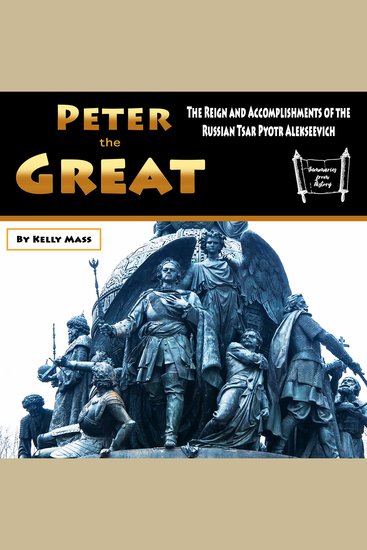
    From May the 7th, in 1682 till his death in 1725, Peter the Great or Pyotr Alekséyevich governed the Tsardom of Russia and ultimately the Russian Empire, collectively ruling before 1696 with his older half-brother, Ivan V.He got ports on the Azov and Baltic Seas through a series of triumphant disputes, creating the structure for the Imperial Russian Navy, ending undisputed Swedish control in the Baltic, and launching the Tsardom's development into a much larger empire that would end up being a major European force. He was the leader of a cultural revolution that saw some standard and middle ages social and political structures changed with modern-day, clinical, Westernized, and Enlightenment-based systems. Peter's reforms had a long-lasting effect on Russia, and tons of the Russian federal government's organizations can be traced back to his reign. In 1721, he changed the former title of Tsar with the title of Emperor, and he created and broadened the city of Saint Petersburg, which stayed Russia's capital till 1917.Peter the Great has had a significance influence on the structure of Russia, the history, and the future in the succeeding decades after him. Let’s see what else he did while he was alive.
    Ver libro
  • The French Resistance - Stories of Courage and Defiance under Nazi Occupation - cover

    The French Resistance - Stories...

    Sage Winters

    • 0
    • 0
    • 0
    The French Resistance is one of the most remarkable and inspiring stories of World War II, a testament to the courage and defiance shown by ordinary people in the face of unimaginable adversity. During the Nazi occupation of France from 1940 to 1944, countless men and women rose to challenge the brutal regime that had taken control of their country. With their lives at risk and a constant threat of betrayal or capture, these brave souls fought in the shadows, working tirelessly to undermine the Nazi war effort, sabotage military operations, and support the Allies. 
      
    At the heart of the Resistance was a spirit of defiance, a refusal to accept the status quo and a deep-seated belief in the values of freedom and liberty. The people who joined the movement were motivated by a sense of duty to their country, but also by a moral obligation to resist the horrors of the Nazi regime. From the rural villages to the bustling streets of Paris, the Resistance spread across France, forging networks of covert cells that communicated through secret codes, hidden messages, and underground newspapers. 
      
    The introduction of the Resistance was not a single event but a gradual process of collective resistance that evolved over time. In the early days, acts of defiance were small and isolated—anonymous leaflets denouncing the occupation, graffiti calling for revolt, and the quiet refusal of French citizens to cooperate with Nazi authorities. These early acts were the spark that would ignite a larger, more organized resistance movement. As the war progressed, Resistance groups grew in strength and sophistication, developing into a network of fighters, spies, and saboteurs working in unison to disrupt the Nazi regime’s operations.
    Ver libro